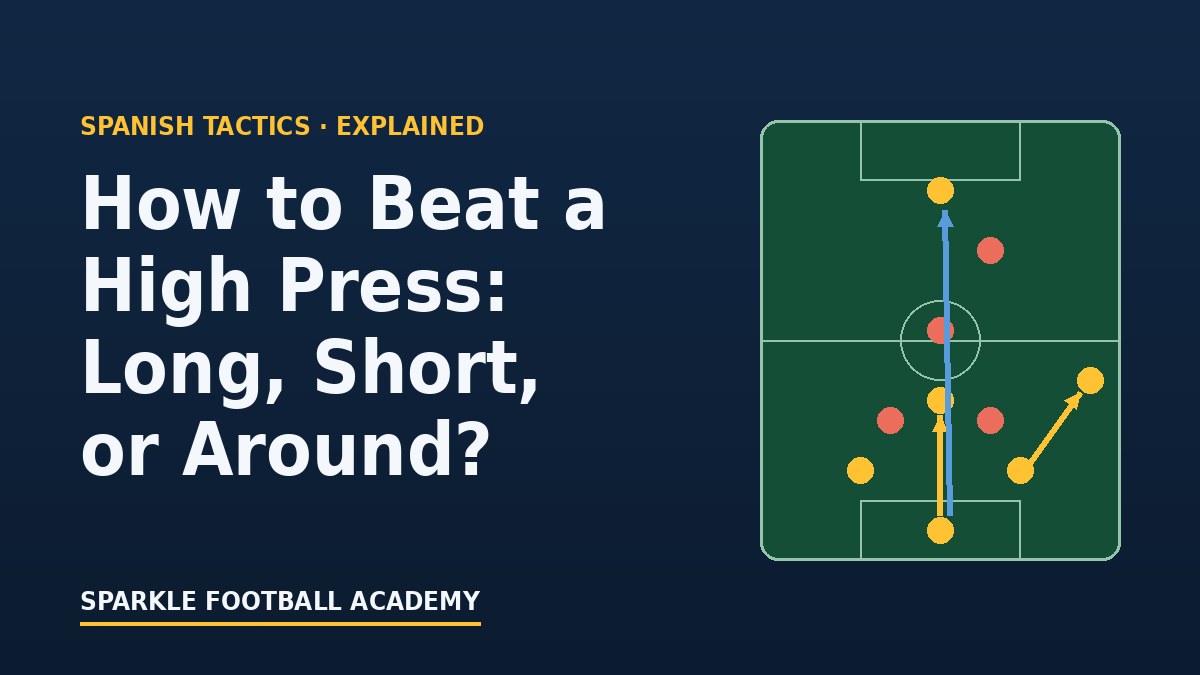
How to beat a high press, explained simply: when the other team sends five players to chase your defenders, they have to take those five players from somewhere else. Your job is to find that somewhere else before the pressure arrives. In Spanish coaching this is superar la presión alta, and it comes down to three exits: short, around, or long. The press itself tells you which one is open.
If you watched Brighton press the Premier League champions into three errors and a 3-0 defeat this weekend, you saw what happens when a team cannot answer that question. If you watched Atlético beat Real Madrid with one long pass behind a high line, you saw what happens when a team can. This article is the youth version of both games.
What a High Press Is Actually Trying to Do
A high press is a bet. The pressing team pushes its forwards and midfielders into your half and tries to win the ball within a few passes of your goalkeeper, where a turnover becomes a shot in seconds. To make the bet work, they need numbers around the ball: two or three players on your center-backs, someone on your pivot, wingers ready to jump on the fullbacks.
Every one of those players has left a space. The press is high, so the space behind their back line is big. The press is central, so the far touchline is empty. The press is fast, so one player is usually a step late. Beating a high press is not about being braver than the pressers. It is about seeing which of those three spaces they left you, and playing into it calmly.
Exit 1: Short, Through the Free Man
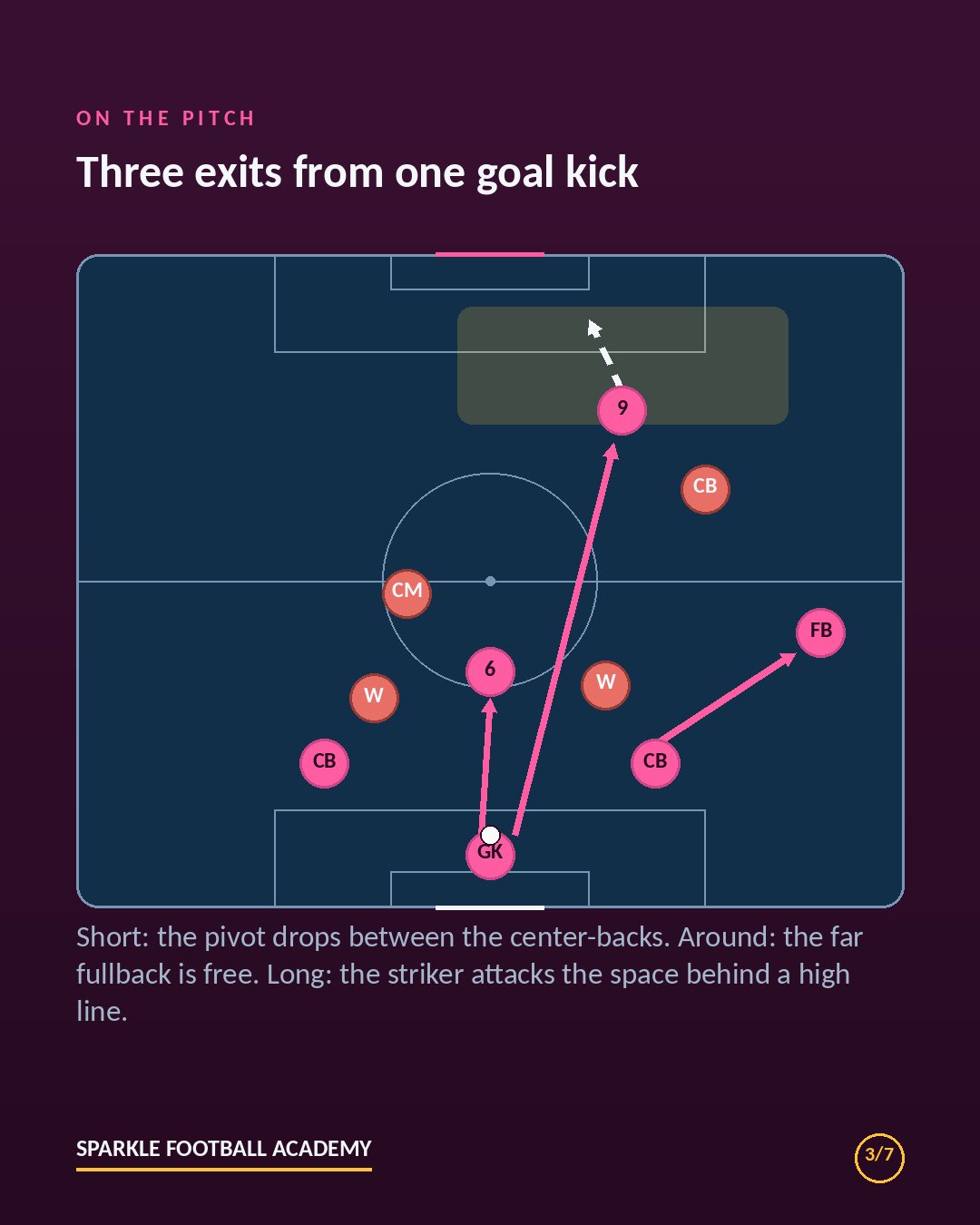
A press almost always leaves one player free near the ball. Often it is the goalkeeper, because most teams will not send a presser all the way to him. Sometimes it is the pivot, the number 6, who drops between the center-backs so the two pressing forwards suddenly have three players to cover. Sometimes it is a center-back whose presser arrived a second late.
The short exit is the cleanest way out because once the ball goes past the first wave of pressers, those players are behind the ball and out of the game. Two or three of your opponents just became spectators. The price is that it requires a calm first touch and a receiver who has already looked over his shoulder. Kids who panic on the first touch cannot use the short exit, which is why we spend so much time on receiving under pressure.
Exit 2: Around, to the Far Side
When the press is narrow and central, the far fullback is standing alone on the touchline with 30 yards of grass around him. The around exit is a pass, or two quick passes, to that player. Now the entire pressing team has to slide across the field, and a sliding press is a slow press. The fullback can carry the ball forward or hit a diagonal into midfield before they arrive.
This exit works because pressing is tiring. Every switch of play forces five players to sprint 40 yards sideways. Do it three or four times and the press stops being high, because the pressers cannot get back up the pitch in time. If your team already knows how to switch the play, you already own this exit.
Exit 3: Long, Behind the Line
If the press is high and tight, look at the pressing team’s last line of defenders. To keep the press compact, their center-backs have to push up too, sometimes to the halfway line. That leaves the biggest space on the pitch behind them. The long exit is a firm pass over or through that line to your striker, or into the space he is running into.
Here is the important part for young players: the long exit is a decision, not a panic. A long ball because you saw the space, with a striker ready to receive and two midfielders ready for the second ball, is superar la presión alta. A long ball because a defender ran at you and you closed your eyes is a giveaway. They look similar for half a second. They are not the same thing.
The Cue: Read the Press Before the Ball Arrives
So how does a 12-year-old know which exit to take? We teach one cue, and it works from U10 up to the first team.
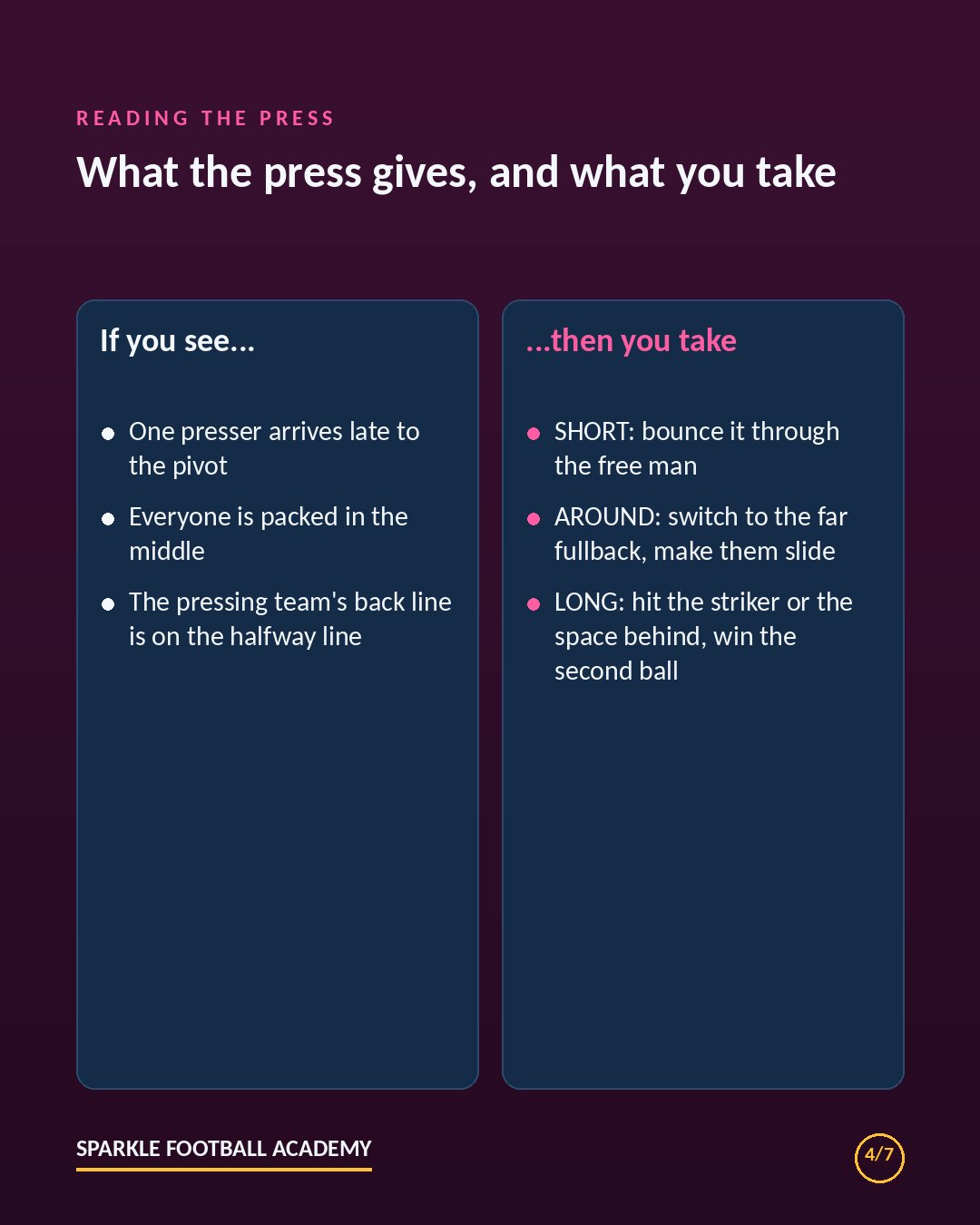
- Look at their back line first. If it is high, the long exit is open. Play it early, before they drop.
- Look at the middle second. If it is packed with pressers, the around exit is open. Go to the far side.
- Look for the late player last. If one presser is jogging while the others sprint, the free man is next to him. Play short through that gap.
The order matters. Long first, because the space behind closes fastest. Around second. Short last, because it is the exit that is almost always available and the one players default to anyway. Good build-up teams like Spain and Manchester City look like they are always playing short. Watch closely and you will see them take the long exit the moment the back line steps too high.
What Goes Wrong: Kicking First, Looking Second
The most common mistake in youth soccer is the reflex clearance. A presser sprints at the center-back, the center-back kicks it 40 yards to nobody, and the other team has the ball back in ten seconds. Parents cheer because it looked like a big kick. Coaches groan because the team just gave the ball away.
The second mistake is the opposite: a team that has been told “never kick it long” keeps playing short into a press that has already covered the short options. That is how Arsenal ended up with three errors leading to shots at Brighton. Playing out from the back is a principle, not a rule. When the press has closed the short exit, the correct pass is the long one.
The third mistake is body shape. A defender who receives the ball facing his own goal has one option, backward. A defender who receives side-on can see all three exits. We drill possession habits for exactly this reason: the read starts before the ball arrives.
How We Train It at Sparkle
We do not teach the three exits with a whiteboard. We teach them with a game that makes the exits appear over and over.
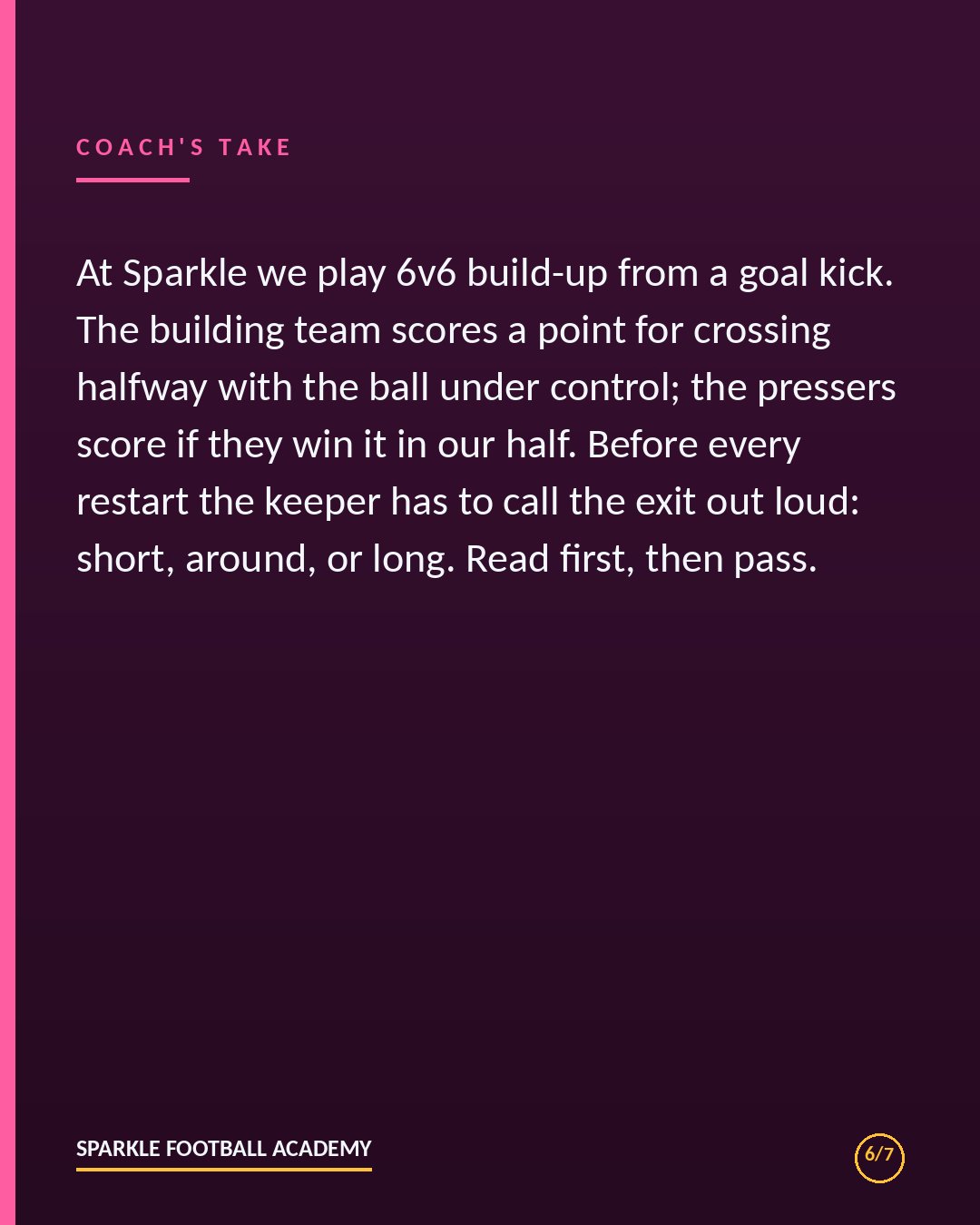
6v6 build-up from a goal kick. Half a field. The building team starts every rep with their goalkeeper, exactly as the Laws of the Game allow from a goal kick, and scores one point for crossing the halfway line with the ball under control. The pressing team scores if they win the ball in the building team’s half and get a shot away within eight seconds. Before each restart, the goalkeeper has to call the exit out loud: short, around, or long. If the team takes a different exit than the one he called, no point, even if they cross halfway.
Progressions we add over a few weeks:
- The pressing team must press with everyone, no sitting off. This makes the long exit appear.
- The building team may only play one long ball per three reps. This forces them to find the short and around exits.
- Add a neutral player who plays for the building team. Players learn that the press always leaves a free man somewhere, and their job is to find him.
Within a month, the change is visible on Saturdays. Players stop kicking on reflex and start pointing at spaces before the goal kick is taken. That is the habit we want: read first, then pass.
For Parents: What to Watch and What to Say
If your child plays in defense or in goal, high pressing is the most stressful thing they face in a game. Here is how to help from the sideline.
- Do not shout “clear it!” Your child’s coach has probably spent weeks teaching them to look before they kick. One shout from the sideline undoes that in a second.
- Praise the read, not the outcome. If your child looked up, saw the space, and played a good pass that a teammate then lost, that was a good decision. Say so in the car.
- Ask one question after the game: “Which exit did you use most today?” If they can answer, the lesson is landing.
Mistakes will happen. A center-back who tries to play out and gets caught once will concede a goal that looks terrible. That is part of learning to beat a high press, and a coach who takes the risk away from the player is also taking the learning away.
The Bigger Picture: Why This Skill Matters
Pressing is not going away. Every level of the modern game, from academy football to the Premier League, is built around winning the ball high. The teams that survive are the teams whose defenders and goalkeepers can read the press and pick an exit under pressure. If you want to understand the other side of this coin, read our piece on counterpressing and how the pressing team tries to win the ball back in five seconds.
For a young player, learning how to beat a high press teaches three things that transfer everywhere: scan before you receive, make a decision before the ball arrives, and be brave enough to play the pass you saw. Those are the habits of a footballer, not just a defender.
Come and Train It With Us
At Sparkle Football Academy, every session ends in a game, and most of those games start with a goal kick and a press. Your child will learn to see the three exits, call them, and play them, in a setting where a mistake is a rep and not a disaster. If you are in the Vancouver area and want to see how we do it, book a free trial session. Bring your center-back. We will bring the press.