
Our Japan soccer training camp took Sparkle Football Academy players from Vancouver to Kobe and Nagasaki this summer, to train inside three very different Japanese youth football environments: the grassroots powerhouse Cemano Kobe, Kansai high school side Ashiya Gakuen, and the academy of J1 club V-Varen Nagasaki.
Most overseas camps for young players are built around soccer schools and tourist stops. We wanted something different: real sessions with real Japanese teams, so our players could feel the standard for themselves. Here is what each stop looked like, and what we brought home to Canada.
Cemano Kobe: proof that player development can be taught
Our U12 player joined Cemano Kobe (センアーノ神戸), one of the strongest youth clubs in Japan. In 2016 its U12 team won both of Japan’s national U-12 titles, the JFA U-12 Football Championship and the JFA U-12 Futsal Championship (Vermont Cup), and the club has produced many professional players. The best known is Shinji Kagawa, formerly of Borussia Dortmund and Manchester United. Kagawa came through Kobe NK, the club Cemano Kobe grew out of. Kobe NK had so many players that it split into two teams, and the stronger group became FC Rayos, today’s Cemano Kobe. His Kobe NK coach then took him to FC Miyagi Barcelona, a club the coach set up with other coaches to take Kagawa to the next level, so his whole youth career ran through the same club family. Our own Coach Tomoya also spent his junior high school years there.
What makes Cemano Kobe special is the quality of its player development. It is not the academy of a professional club, so it does not get first pick of the most talented kids, and players arrive through open tryouts. In their first year of junior high, heavy defeats are normal. By their third year, the same group regularly beats the academies of professional clubs.
That is the strength of Japanese football education in one club: players are not selected into quality, they are coached into it.
Ashiya Gakuen High School: outrun, outthink, outwork
In Kobe we also partnered with Ashiya Gakuen High School (芦屋学園高校), a rising force in Kansai high school football.
Many people outside Japan do not know this, but in Japan the main pathway is not independent clubs. J.League academy teams (often called J-Youth) and high school teams are the mainstream, and plenty of high schools beat J.League academies. Becoming a top team in Kansai, one of the most competitive regions in the country, is not easy.
Under head coach Heo Tae-man, Ashiya Gakuen builds its players with real care, and the first thing we noticed was how much they run. Against national-tournament regulars who often have more individual quality, Ashiya Gakuen keeps creating numerical superiority, superioridad numérica, in every phase of play. They run more than the opponent, think more than the opponent and sweat more than the opponent. That mentality is what makes the team strong.
V-Varen Nagasaki academy: training inside a J1 club
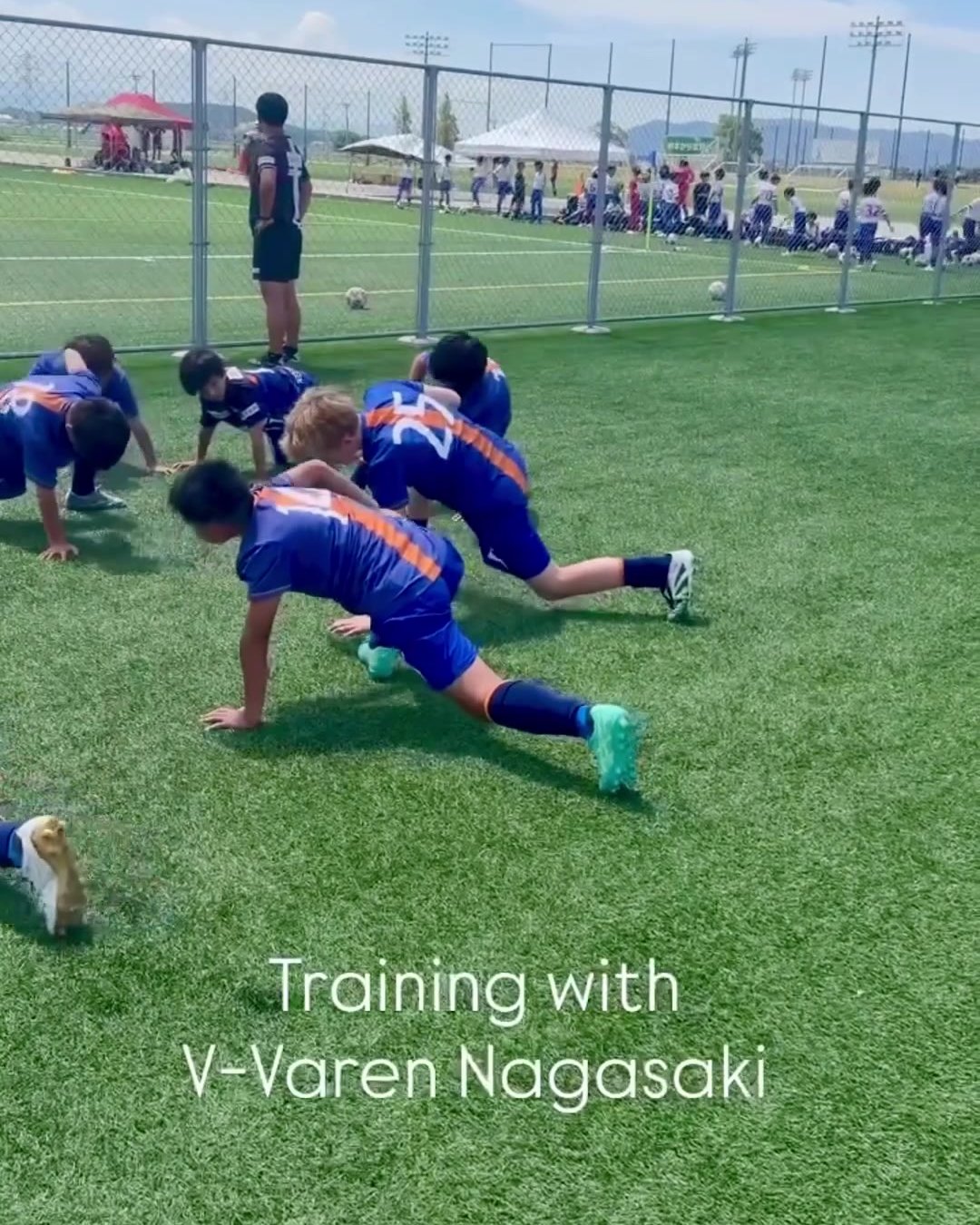
We were given the opportunity to join the academy of V-Varen Nagasaki, a J1 club. Many overseas programs can only partner with soccer schools. We partnered with V-Varen Nagasaki so our players could experience the real standard of a professional academy.
Clear purpose in every session
As you would expect at a J1 club, the players are very good. The coaches had a clear idea of the football they want to play. This was not “just let them play”: every session had a purpose and a direction. Whenever there was a spare moment, the players talked to each other about what to fix and how. That habit of constant discussion and improvement, from both players and coaching staff, is something we have never seen in a North American team.
A different speed of football
For our older player, the gap was overwhelming. Tactical understanding, intensity, technique, stamina and physicality were all at a level you rarely see in North America. Honestly, most North American players dropped into this session would panic and finish without doing much. The speed of play was on another level.
Even so, when we spoke with the coaches, they told us their players are still behind the top youth teams in every area. That is how high the ceiling is in J-Youth and in Japan’s top high schools. For a player from Canada, testing yourself at this level is something you keep for the rest of your life.
Life off the pitch at Nagasaki Stadium City
Our players are still young, and football is not their whole life. We want them to take football seriously and enjoy it seriously, and also to relax away from the pitch and look after their life outside it.
In Nagasaki the players stayed at the Stadium City Hotel, part of Nagasaki Stadium City, V-Varen Nagasaki’s futuristic stadium complex. You can watch a match from your room, and the supermarket, food hall, shops and the club’s own facilities are all in one place. The whole site is designed so local people can drop into the stadium any day of the week.
Our players trained hard and finished the camp without injury, and that is thanks to great facilities, a great environment, and everyone who looked after us in Kobe and Nagasaki. Thank you all.
What our players brought home to Canada
- Purpose in every drill. Japanese academies train with a clear idea of the football they want to play. Every session answers “why are we doing this?”
- Talking to improve. Players fix problems themselves, between reps, without waiting for the coach.
- Work rate as a tactic. At Ashiya Gakuen, running more is how a team creates numerical superiority against stronger opponents.
- A higher ceiling. After seeing the speed of a J1 academy, “good enough” in Canada looks very different.
These are the same ideas behind our coaching philosophy in Vancouver: decisions, positioning and purpose, built on Spanish positional play. If you want to see how they look on the pitch, start with the positional rondo and counterpressing.
For Parents
A Japan soccer camp is not about one week of training. It is about your child seeing, with their own eyes, what the standard looks like, and coming home with a clearer picture of the player they want to become. Our players returned with new habits and new questions, and that is where real development starts.
Train with Sparkle Football Academy
Sparkle Football Academy runs sessions in Burnaby and Vancouver built on Spanish positional play and the lessons we bring back from Japan. Book a free trial session or contact us to ask about future Japan training camps.