
How to break a low block in soccer is one of the questions we hear most from young players and their parents. Your team has the ball for long spells, the other team sits deep with ten players behind it, and nothing seems to get through. The good news: a low block can be beaten, and the answer is not to run harder. It is to stretch the block wide, stay patient, and finish with the cut-back.
In Spanish coaching this defensive shape is called the bloque bajo. Below we explain what it is, why it is so hard to play through, and the three-step plan we teach at Sparkle Football Academy.
What Is a Low Block in Soccer?
A low block is a defensive shape where a team drops its lines close to its own goal. Usually it is two compact lines (a back four or five and a midfield four) with very little space between them and very little space between the players in each line. The defending team gives up possession on purpose. It is happy to let you pass the ball around in front of it, as long as you never get behind it or into the middle of it.
Teams use a low block when they are protecting a lead, when they face a stronger opponent, or simply because it suits their players. It is very effective at youth level because young attackers tend to try the same thing again and again: dribble into the crowd or force a pass through the middle.
Why a Low Block Is So Hard to Break
- No space behind. The defensive line is already near its own box, so there is no room for a through ball over the top.
- No space between the lines. The midfield sits right in front of the defense, so a player who receives between the lines is closed down in a second.
- Numbers in the middle. Most of the defenders are packed around the width of the penalty box, exactly where young attackers want to go.
- Crosses are expected. Tall center-backs and the keeper are facing the ball, so a high cross from deep is the easiest ball for them to deal with.
Step 1: How to Break a Low Block With Width
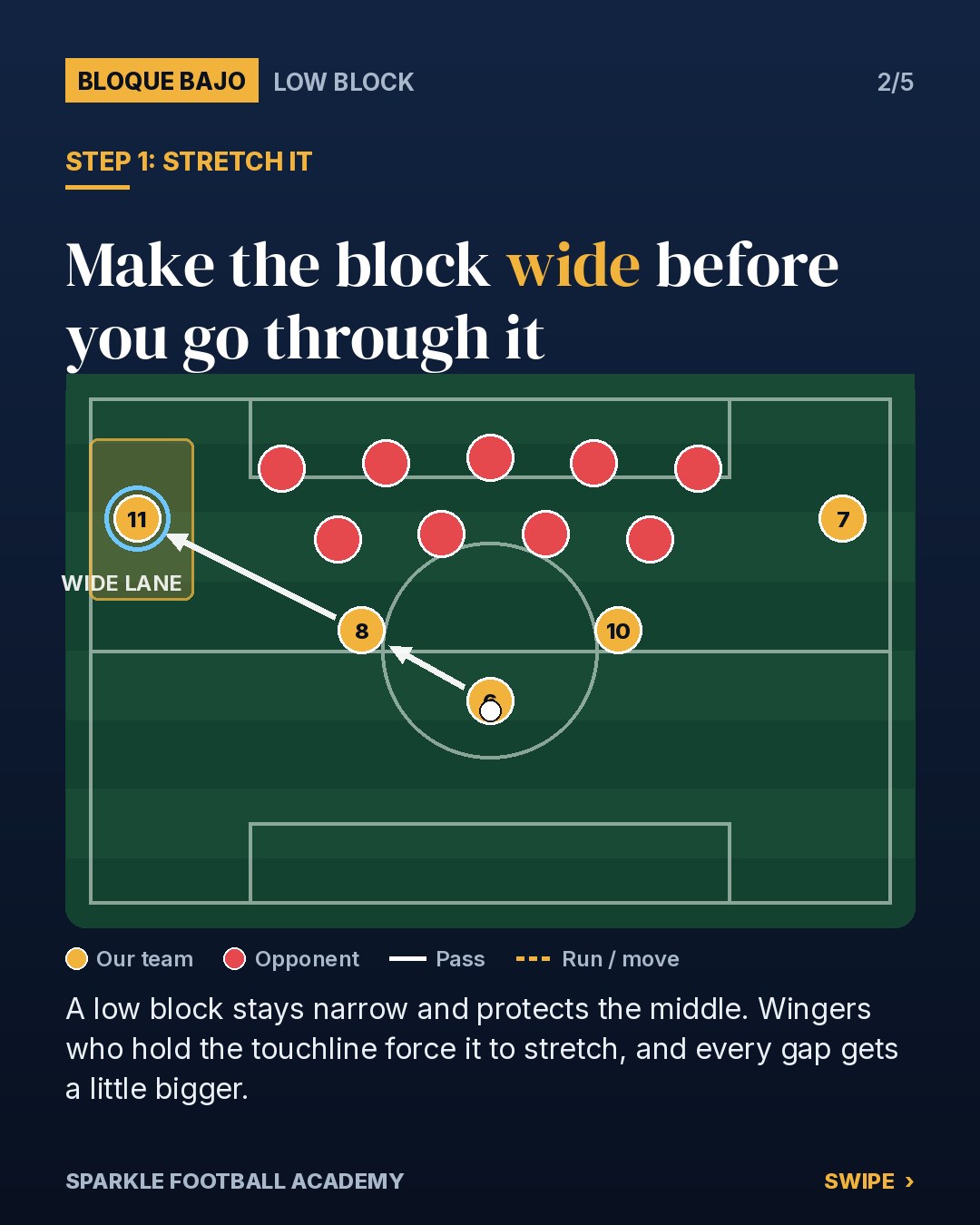
The space against a low block is not in front of you. It is out wide. When your wingers stay high and hold the touchline, the block has a problem: if it stays narrow, your winger is free; if it slides out to close him, gaps open in the middle. Either way you have created something.
This is why we tell our wingers that their first job against a packed defense is to stand still in the right place. Being wide is not lazy. It is what stretches the defense so your midfielders have room to play.
Step 2: Patience and Switching the Play
Once the block is stretched, move the ball quickly from side to side. Every time the ball travels across the pitch the defenders have to shuffle across with it, and tired, shuffling defenders leave gaps. We explain the technique behind this in our guides to switching the play and the diagonal switch.
Patience does not mean slow. It means the ball moves fast while the team waits for the right moment. A good rule for young players: if the pass forward is not on, the ball goes sideways or back, not into a crowd. Combinations like the third-man run help a team finally find a player facing forward inside the block.
Step 3: The Cut-Back Beats the Cross
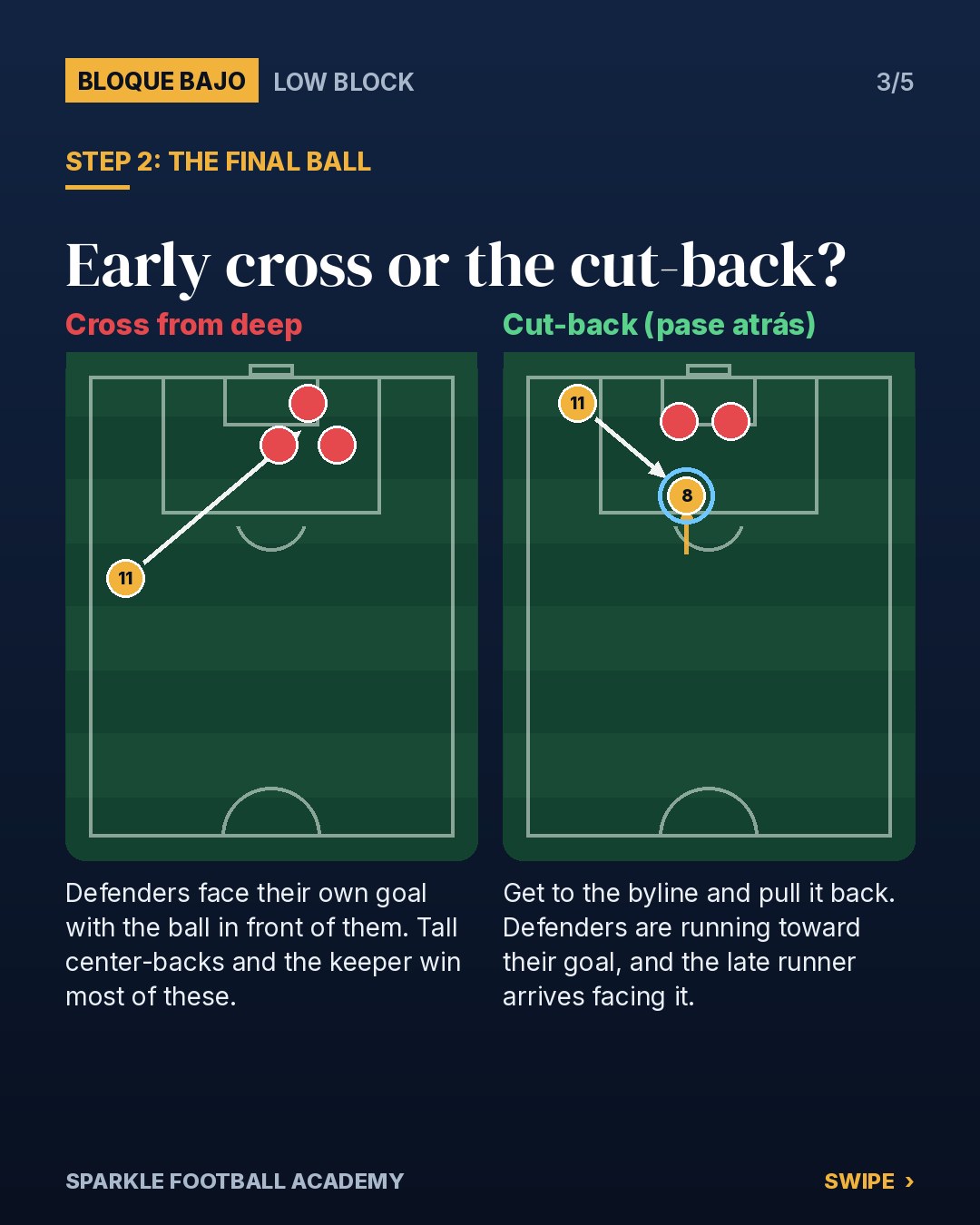
When the winger finally gets into space, the choice of final ball decides the attack. A cross from deep is aimed at a crowded box where defenders are facing the ball. A cut-back, or pase atrás, is different. The winger drives to the byline and pulls the ball back toward the penalty spot. Now the defenders are running toward their own goal, and a midfielder arriving late meets the ball facing the goal with time to shoot.
That is why so many goals against deep defenses come from the cut-back. It turns the defense around, which is the one thing a low block hates.
A Drill to Break a Low Block: The Byline Game
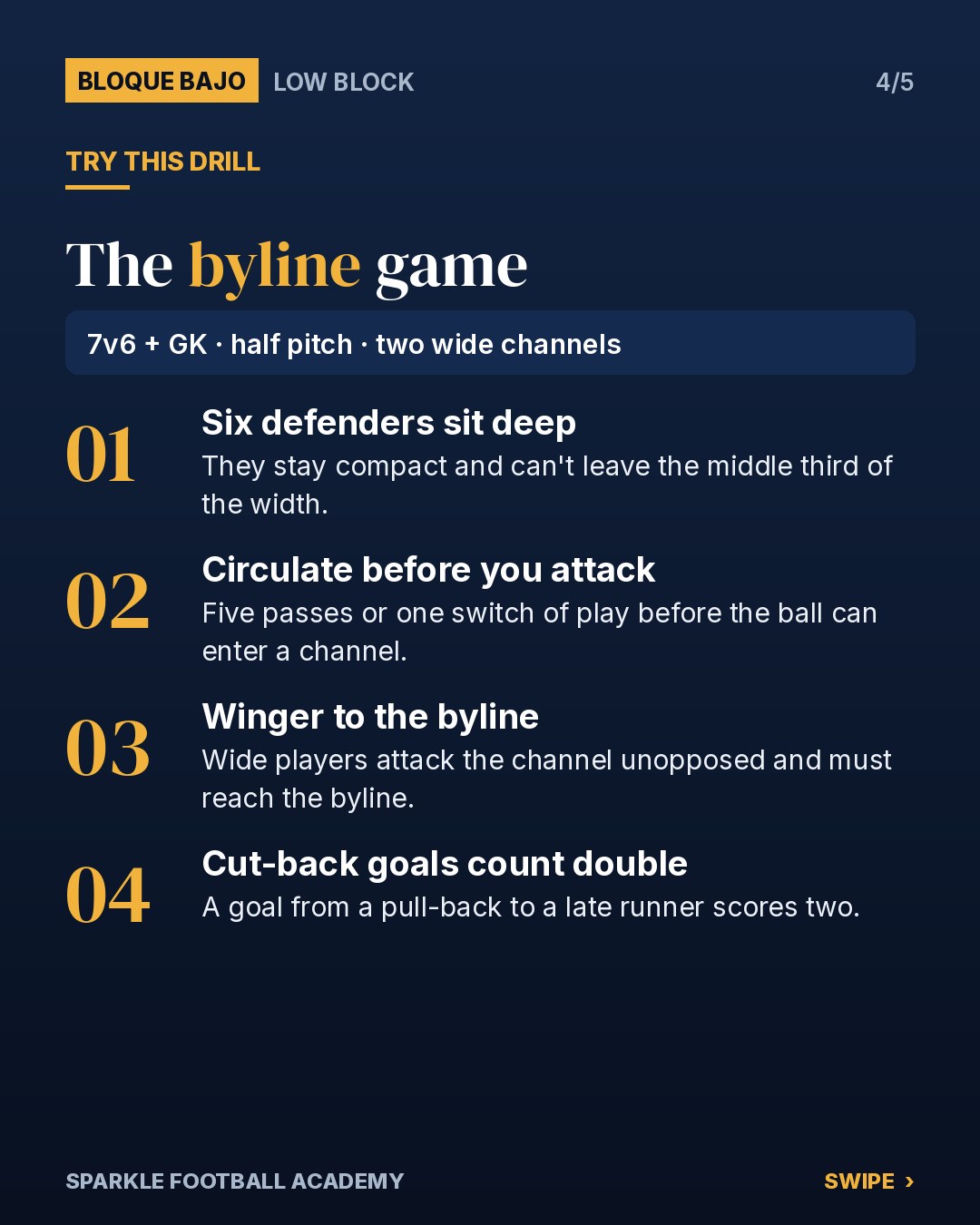
- Set up half a pitch with a goal and keeper, plus two wide channels about 10 yards wide.
- Six defenders sit deep and must stay inside the central area. Seven attackers try to score.
- The attackers need five passes or one switch of play before the ball can go into a channel.
- Wide players attack the channel unopposed and must reach the byline before crossing.
- Any goal from a cut-back to a late runner counts double.
The scoring rule does the coaching for you. Players quickly learn that patience, width, and the pull-back produce goals. For more crossing and finishing work, try our crossing and finishing drill in waves.
For Parents: How to Help Your Player
If your child plays on the wing, praise them for staying wide even when they do not touch the ball for a while. That position is doing a job. If your child is a midfielder, encourage late runs into the box rather than standing on the penalty spot early. When you watch a professional game together, look for the cut-back goals and point them out. Young players learn fast when they can see the pattern.
Train It With Sparkle Football Academy
Breaking a low block is a decision-making skill, and decision-making is trained, not lectured. At Sparkle Football Academy our sessions use small-sided games that reward the right choices, so players learn to read the defense in front of them. Book a free trial session and see how we coach the game.