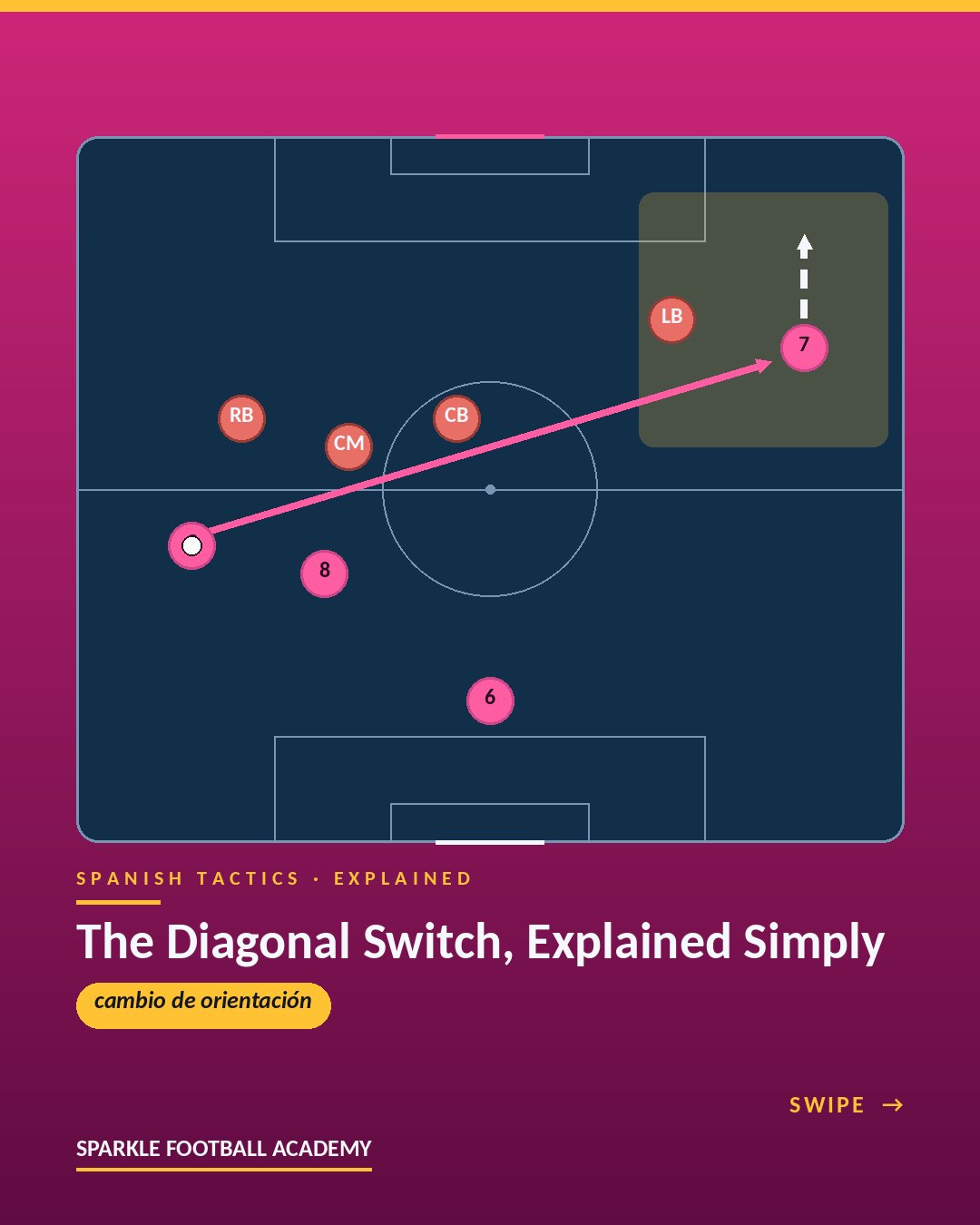
Diagonal switch in soccer explained simply: it is one long, flat pass from the crowded side of the field to a free teammate on the other side. When it works, the whole defense has to run 40 yards while your winger is already facing goal.
At Sparkle Football Academy we teach the cambio de orientación to players as young as ten. It looks fancy on TV, but the idea is simple, and any player with a decent driven pass can learn when to use it.
What Is a Diagonal Switch in Soccer?
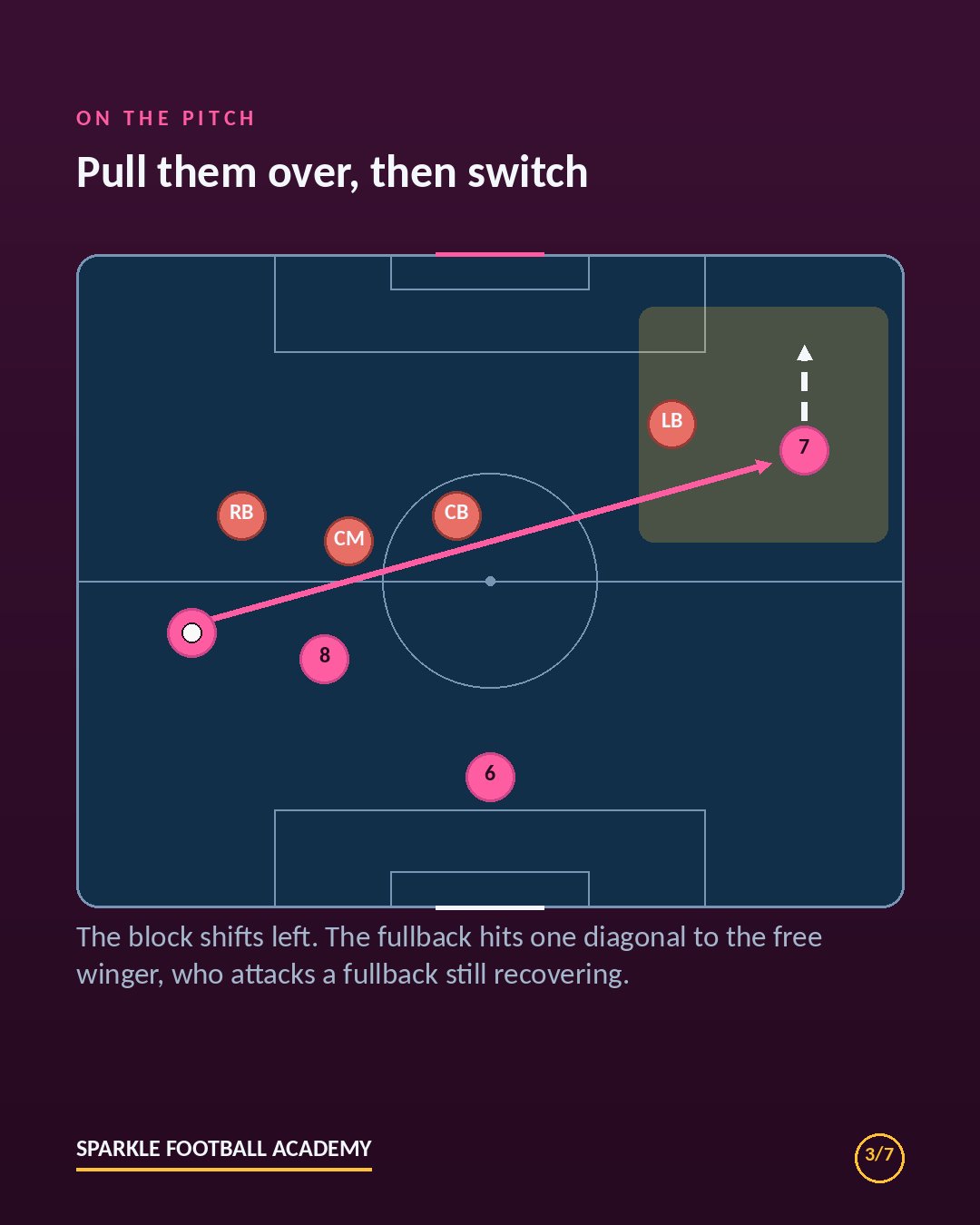
A diagonal switch is a cross-field pass that changes the point of attack. Your team builds play on one side, the defenders slide over to meet it, and then you hit a long ball to the winger or fullback who has been waiting on the far touchline.
The key word is diagonal. A flat sideways pass is easy to read and to cut out. A diagonal ball travels forward as well as across, so it gains ground and shifts the defense at the same time.
Why the Diagonal Switch Works
Defenses move as a block. When the ball goes left, the whole line leans left. That leaves the right side thin, and the defenders there are usually only a few steps from the touchline with their eyes on the ball.
A good switch does three things at once:
- It skips six or seven defenders with a single pass.
- It gives your far winger time and space to receive, instead of a fullback breathing down their neck.
- It forces the defending team to slide, scramble, and re-set, which is when gaps appear.
Three Cues Before You Hit the Switch
The biggest mistake young players make is hitting long diagonals all the time. A switch is a tool, not a habit. We teach three cues:
- The defense is shifted toward the ball. If the defenders are still spread across the field, there is no free side to attack.
- Your far winger is wide and high. They need to hold the touchline and not drift inside, or the pass has nowhere to go.
- The passer has a second to look up. A switch under heavy pressure is a gift to the other team. If you are crowded, keep it simple.
Miss one of the three cues and the best answer is usually a short pass. Good teams are patient about this. They move the ball quickly on one side to draw the block, then change the point of attack.
Diagonal Switch vs Playing Through the Block
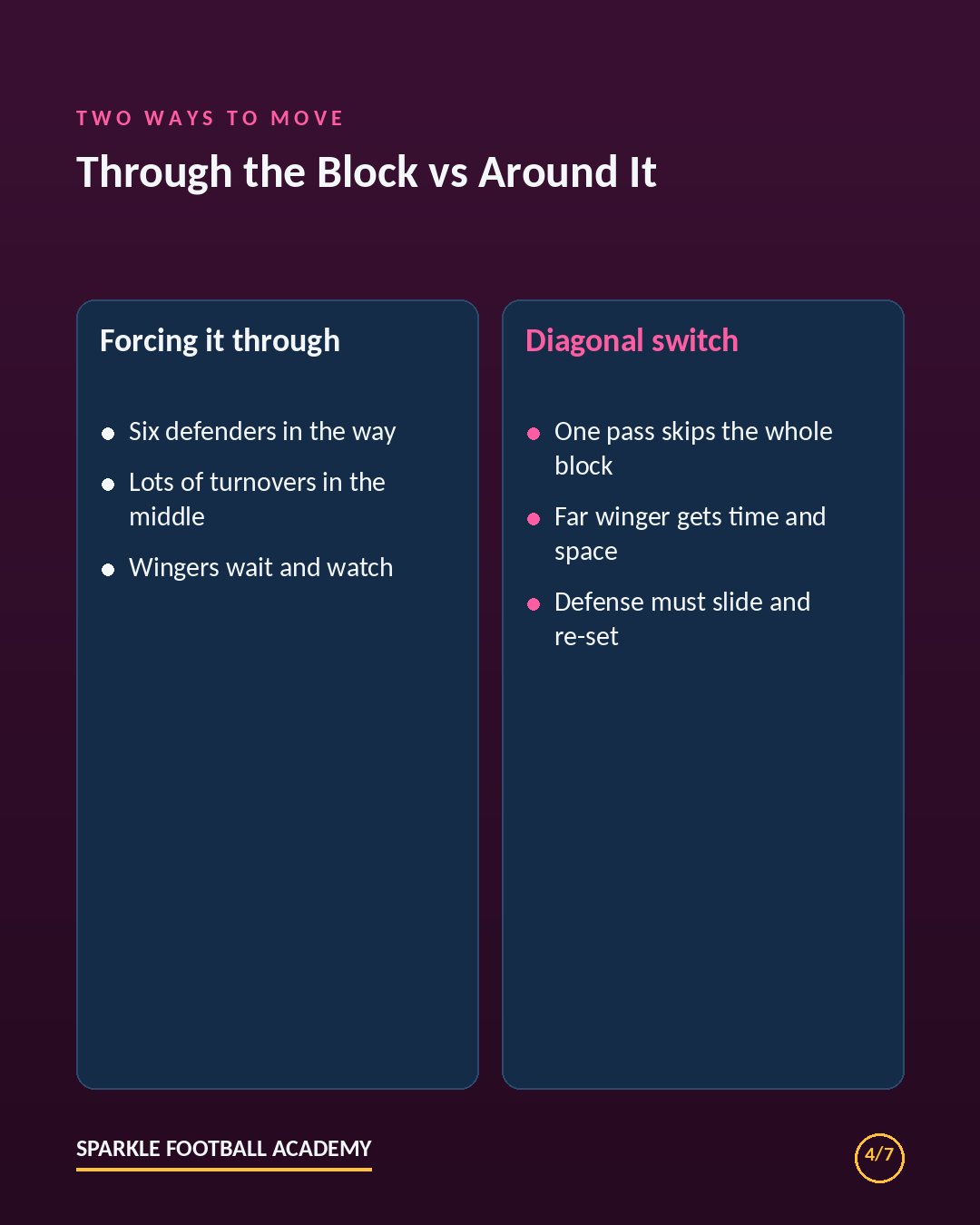
Playing through the middle is great when the gaps are there. But against a compact block, every pass is a risk and every turnover starts a counterattack. Switching around the block is lower risk because the ball travels over the traffic, not through it.
It also pairs well with other ideas we teach. If you already understand the mid-block and the pressing line, you will see why the weak side opens up. And if you have read our guide on how to beat a high press, the switch is one of the cleanest ways out when the first line of the press is crowded to one side.
Who Makes the Switch? Roles on the Pitch
Almost anyone can start one, but some positions are natural. A center-back or a number 6 can play it from deep, a fullback can play it from wide, and a central midfielder with a good passing range can play it from the middle.
The receiver matters as much as the passer. The far winger holds the touchline, checks their shoulder, and prepares a first touch that goes forward. A switch is only useful if the player on the other end can attack with it.
How to Train the Diagonal Switch
You do not need a long drill to teach this. Try these three steps in practice:
- Four-goal game. Play 6v6 with two small goals on each end line. Teams score by passing through any goal, so switching sides is the natural way to find space.
- Overload one side. Put five attackers against four on the left. The extra player draws the defense over. The coach calls “switch” the moment the defense slides, and the team hits the far side.
- Passing technique. Practice the driven diagonal in pairs from 30 yards. The goal is a flat, firm pass that arrives at the receiver’s feet, not a high floating ball the defense can read.
If you want a warm-up that builds the passing habit, our rondo progressions are a great place to start.
For Parents: What to Look For
If your child plays center-back, fullback, or central midfield, watch for the moment they look across the field before they look forward. That head turn is the first sign of a player who is learning to read the game, not only react to it.
You can also ask a simple question after a match: “Where was the open side?” Players who can answer that are already thinking like a switch passer. At Sparkle, we train this scanning habit in small games first, so it feels natural before the match starts.
Coach’s Take
We do not start with chalkboards. We start with games that reward changing the point of attack, then add one coaching point at a time: pull the defense over, look across, then hit the diagonal. The picture teaches the position.
Ready to Train With Us?
Sparkle Football Academy teaches Spanish-influenced soccer tactics in small groups, with clear explanations and a lot of touches on the ball. If you want your player to learn the game like this, book a free trial session and come see how we train.