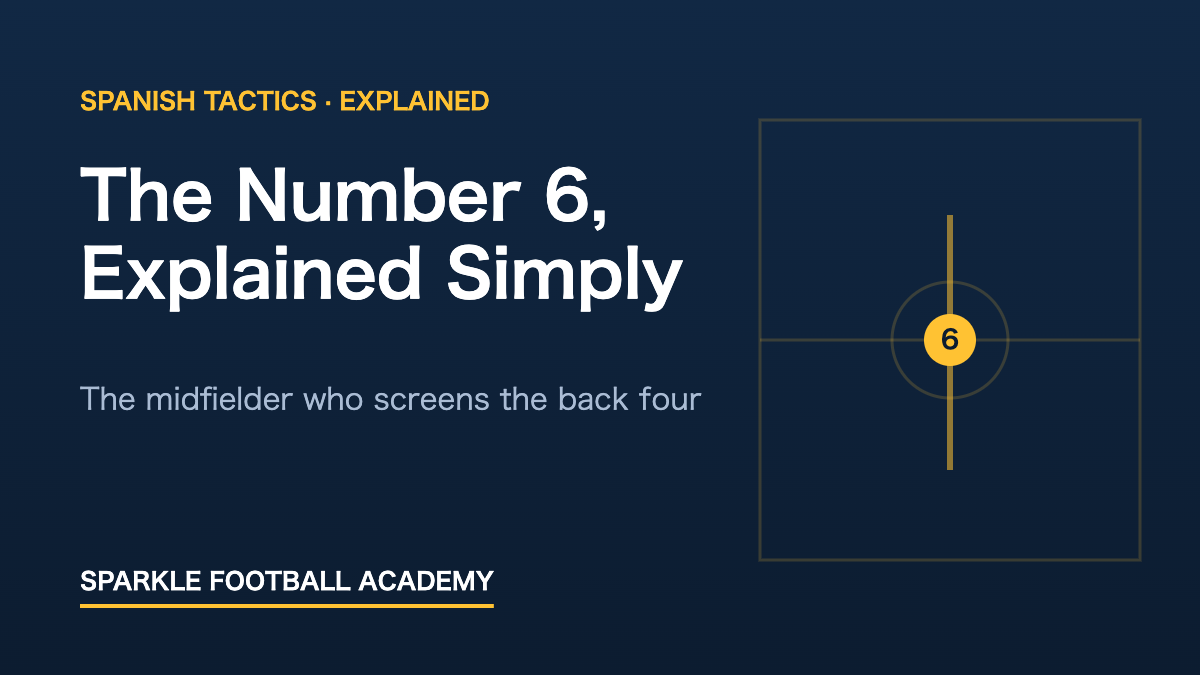
If you have ever wondered what the number 6 in soccer actually does, the honest answer is that most of the job is invisible. There is no highlight reel for a pass that never happened. But ask any coach which position they struggle hardest to fill, and a lot of them will say the same thing: a proper number 6.
This is the holding midfielder who sits in front of the back four. In Spanish football he is the mediocentro defensivo, and the word coaches use for his main skill is screening. Here is what that means, why it matters more than tackling, and how a young player can start learning it this season.
What the number 6 in soccer actually is
The number 6 is the deepest midfielder on the team. He plays between his own center-backs and the rest of the midfield, and his default position is central. If you drew a line from your own goal to the opponent’s goal, the 6 spends most of the game within about ten yards of it.
The shirt number is a convention rather than a rule. Plenty of number 6s wear 4, 5, or 14. What defines the role is the space he is responsible for, not the number on his back. You can read more about how positional numbering developed in the general history of midfield roles.
Screening: the skill that defines the role
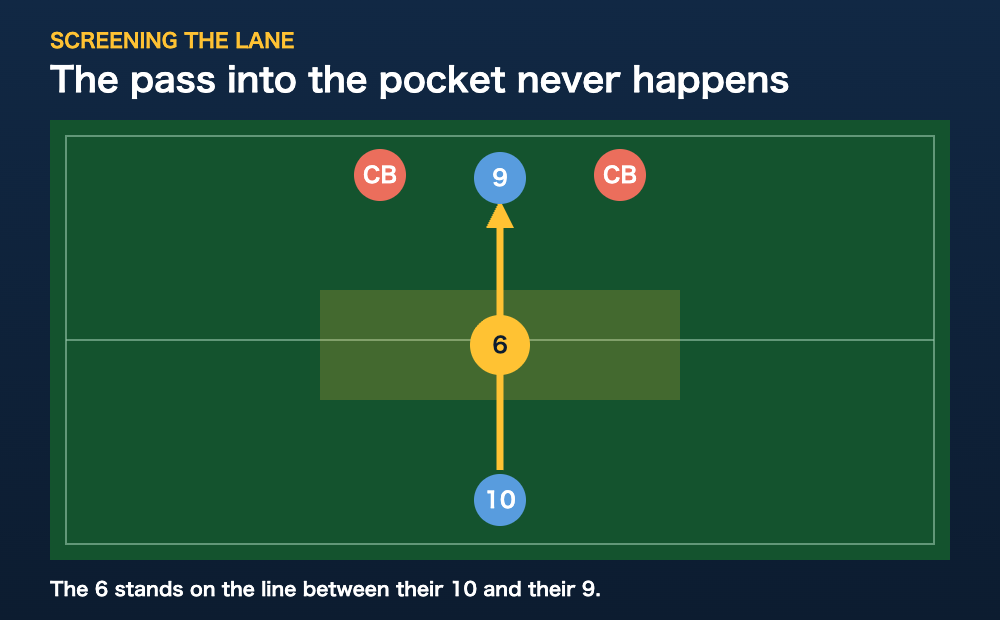
Screening means standing in the passing lane between the ball and a dangerous receiver, so the pass is simply never played. The 6 is not sprinting at anyone. He is positioning himself somewhere so useful that the opponent’s best option disappears from the picture.
Picture the opponent’s playmaker on the ball, thirty yards from goal. Ahead of him, their striker is drifting into the pocket between your midfield and your center-backs. That pass is the one that hurts you. A good number 6 does not wait for it to be played and then react. He stands on the line between those two players before the ball even arrives, and the playmaker looks up, sees nothing, and plays sideways.
That sideways pass is the number 6 doing his job. It looks like nothing happened. Nothing happening is the point.
The three jobs of a number 6, in order
When we coach this role at Sparkle, we give players a strict priority list. The order matters as much as the list.
- Block the lane into the pocket. Protect the space in front of the center-backs first. Everything else is secondary.
- Cover the center-back who steps out. When a defender jumps forward to press, the 6 drops into the space he left. The back line never gets a hole.
- Start the attack with the simplest pass available. Once the ball is won, the 6 is usually the first free player. His job is a clean forward pass, not a spectacular one.
Young players almost always want to do these in reverse order. They want the ball, then the tackle, then the position. Reversing that is most of the coaching.
Why the best number 6s rarely make tackles
This surprises people, so it is worth stating plainly. If a number 6 is making six or seven tackles a game, that is usually a warning sign, not a compliment. It means the ball kept arriving in dangerous places and he kept having to rescue the situation.
A tackle is a recovery from a positioning problem. The elite holding midfielders make very few of them because the ball rarely gets to where a tackle would be needed. Their statistics look quiet. Their teams concede very little.
So when you are evaluating a young 6, do not count tackles. Watch where he stands when his team does not have the ball, and watch whether the opponent’s best pass keeps going missing.
Number 6 versus number 8: what is different
Both play in midfield, and at youth level they often get treated as the same job. They are not.
The number 8 is a box-to-box midfielder. He is allowed and expected to leave the middle, join attacks, arrive late in the box, and be measured on goals and assists. The number 6 is measured on the passes he prevented, and he stays in the middle precisely so the 8 is free to go.
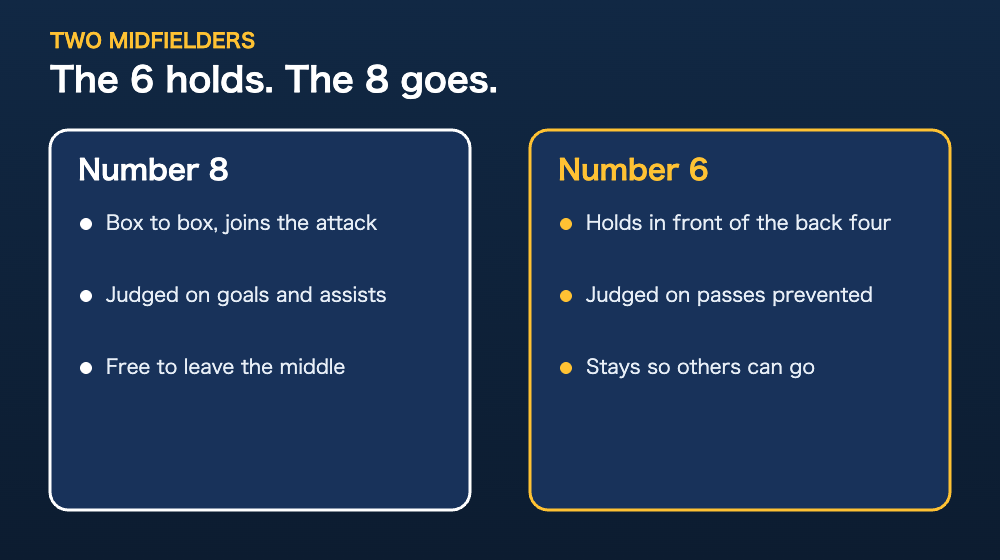
That relationship is the whole point. A team can only afford an adventurous 8 if it has a disciplined 6 behind him. The same logic applies further out wide, which is why the role pairs so closely with the modern fullback and the balance he provides.
How the number 6 connects to the rest of your play model
The role does not exist in isolation. A number 6 who screens well makes three other things possible.
In possession, he gives the center-backs a permanent forward option, which is the foundation of building up from the back instead of hitting it long. Against a deep opponent, his position determines whether your attackers can find space between the lines without leaving your defense exposed. And the moment your team loses the ball, he is the reference point that makes counterpressing safe rather than reckless.
If your players already understand the three zones and five lanes, the simplest way to explain the 6 is this: he owns the middle lane of the middle zone, and he almost never leaves it.
How to train the number 6 role at youth level
Three exercises, in this order, and none of them start with a tackle.
- Shadow movement, no ball. Two attackers pass an imaginary ball between fixed cones. The 6 simply moves to stay on the line between the ball and the dangerous receiver. Sixty seconds at a time. It feels too easy, and it is the most valuable minute of the session.
- Five versus five with a locked middle zone. The 6 is the only player who cannot leave the central zone. He learns that his value comes from being somewhere, not from chasing.
- Win it and go. As soon as the 6 intercepts, his team has five seconds to play forward. This trains the third job so it does not get forgotten once the ball is won.
For Parents
If your child has been asked to play number 6, it is worth knowing that coaches usually give this role to a player they trust. It requires reading the game, staying disciplined when teammates are running forward, and accepting that the reward is rarely a goal.
It can be a hard sell to a ten year old. Two things help. First, watch a professional game together and follow only the holding midfielder for ten minutes, not the ball. Second, praise the boring moments. When your child steps across a passing lane and the other team plays backwards, say so on the drive home. That is the game being won.
Parents also ask whether playing 6 limits development. It does the opposite. Almost every skill the position demands, scanning, body position, first touch away from pressure, and simple forward passing, transfers to every other role on the pitch.
Start with position, then add the ball
The number 6 in soccer is not a destroyer and not a passenger. He is the player who makes the dangerous pass disappear, covers for the defender who steps out, and turns a won ball into an attack with the simplest option available.
At Sparkle Football Academy we teach the role the Spanish way: position first, then pressure, then the ball. Our coaches work in small groups so players get real repetitions and real feedback, not a queue.
Want to see it in practice? Book a free trial session and come and watch a training block with us.