The Two Ways a Winger Can Hurt You
Picture a young right winger who gets the ball out wide. The old-school move is simple: race to the byline and whip in a cross. But watch Spain’s best wide players and you’ll see something different — they take a touch inside, toward goal, and suddenly the whole defense is in trouble. That player is an inverted winger, and learning to play the position well is one of the fastest ways a young attacker can level up.
If your child plays out wide — or dreams of it — this is one of the most important ideas in the modern game. Here’s the inverted winger explained simply: what it is, why cutting inside is so dangerous, the trade-offs, and exactly how we teach it at Sparkle Football Academy.
What “Inverted Winger” Actually Means
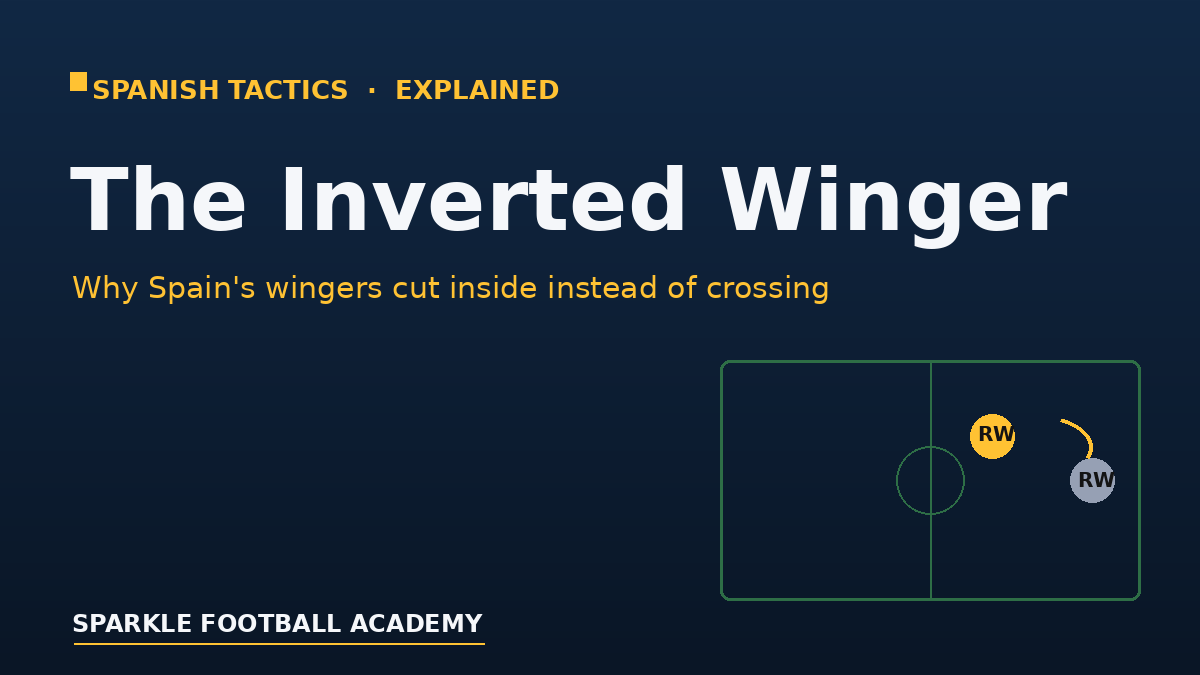
An inverted winger is a wide player on their “wrong” side: a left-footed player on the right wing, or a right-footed player on the left. Because their strong foot points toward the middle of the field, cutting inside opens up everything — a shot, a through ball, or a driving run at the defense. Traditional wingers stay glued to the touchline with their strong foot on the outside, built to cross. Inverted wingers drift into the half-space and attack the goal. (For a broader overview of the role, this guide to the winger position is a useful primer.)
Why Cutting Inside Is So Dangerous
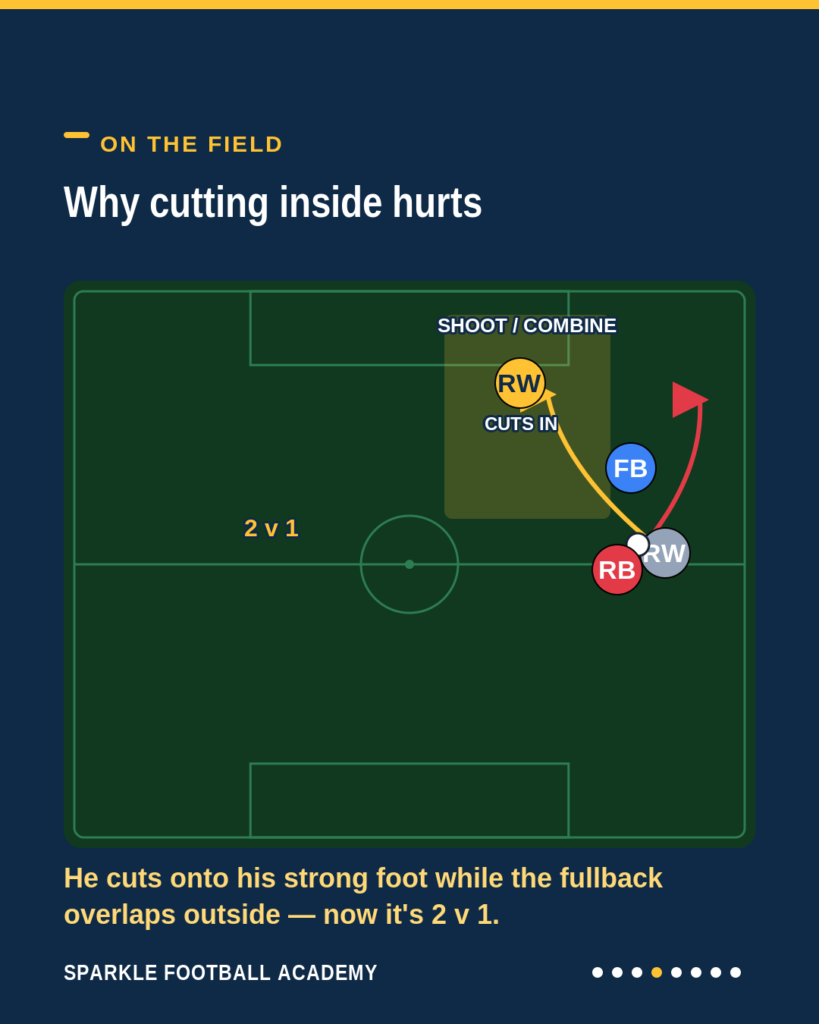
When the winger cuts onto their strong foot, the defender faces an impossible guessing game. Go too tight and the winger spins outside; back off and the winger shoots or slides a pass through. The single biggest weapon, though, is what happens behind the winger: as they drift in, the fullback comes flying down the outside lane. Now there are two attackers and one defender — a clean 2 v 1 that a lone fullback simply cannot solve.
This partnership is everything. The winger and the overlapping fullback have to read each other perfectly, which is exactly why we spend so much time on the modern fullback’s role — the “unsung hero” who makes the inverted winger work. One player creates the space; the other attacks it.
The Half-Space: Where the Magic Happens
Coaches talk about the “half-space” — the lane between the wing and the center of the pitch. It’s the most dangerous real estate on the field because a player there can shoot, pass, or dribble in any direction, and defenders hate stepping out to cover it. Inverted wingers live in this zone. If you’ve read our breakdown of the 3 zones and 5 lanes that organize the modern game, the inverted winger is the player who hunts the half-space lane and turns it into goals.
Old Winger vs. Inverted Winger
It helps young players to see the contrast clearly:
- Traditional winger: stays wide on the touchline, strong foot on the outside, beats the defender and crosses toward the back post.
- Inverted winger: drifts into the half-space, strong foot pointing at goal, cuts in to shoot or combine, and drags defenders inside to free up teammates.
Neither is “better” in every situation — but the inverted winger gives a team more ways to score, which is why it has become the default in Spanish football and across the world’s best clubs. It’s the same positional thinking behind possession-based soccer: control the middle, and you control the game.
The Trade-Offs (Because Nothing Is Free)
Honest coaching means naming the downsides. When the winger tucks inside, the team can become narrow, and crossing chances drop. The flank gets exposed if the fullback can’t get forward — or can’t get back. And a young inverted winger has to be brave enough to receive the ball facing pressure, then make a fast decision. That decision-making is the real skill, and it’s coachable. Spanish football calls the close-control dribble regate and the carrying run conducción; if those words are new, our glossary of Spanish soccer terminology is a great place to start.
How We Coach the Inverted Winger at Sparkle Football Academy
We don’t hand young players a pattern to run on repeat. We teach them to read the defender. Our progression is simple and it works:
- Start with the angle. First we get the strong-foot body shape right, so cutting inside is natural, not forced.
- Add the overlap. Then we bring in the fullback so players learn the 2 v 1 and when to use it.
- Coach the choice. Finally, players learn to pick the right option in the moment — shoot, slide the fullback in, or drive at goal — based on what the defender gives them.
As our coaches like to say: “Cut in with a purpose, not a habit.” That mindset — understanding the why behind every movement — is exactly what separates players who simply follow drills from players who genuinely understand the game. It’s the same philosophy behind learning a play model instead of memorizing tactics.
For Parents: Why This Develops More Than Just a Winger
Here’s what makes this exciting beyond one position: learning the inverted winger role teaches a child to make decisions under pressure, read the field, and solve problems on their own — skills that matter long after the final whistle. We’re not just building faster dribblers. We’re building smarter, more confident players who see options where others see chaos.
That blend of Spanish-style tactical education and player-first coaching is the heart of what we do. If you want your child to understand the game at this level — not just run faster, but think sharper — come see a session at Sparkle Football Academy. Book a free trial and watch how quickly young players light up when the game finally makes sense.
Cut in with a purpose, not a habit. — Sparkle Football Academy