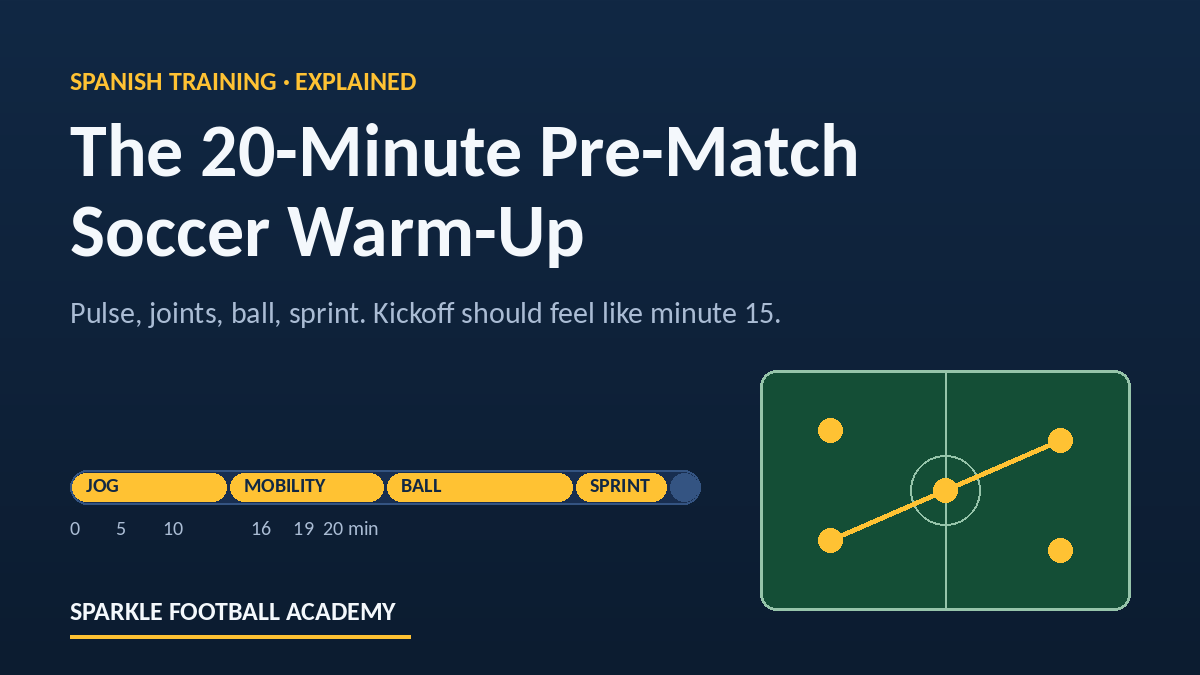
A pre-match soccer warm-up is the 20 minutes that decide how the first 15 minutes of the game feel. Get it right and your player is sharp, loose and already thinking about the ball when the whistle goes. Skip it or rush it, and the first ten minutes of the match become the warm-up, played against opponents who already did theirs. This guide lays out the exact 20-minute pre-match warm-up we run at Sparkle Football Academy, block by block, with the reasons behind the order, so your player (or your whole team) can run it without a coach standing over them.
What a pre-match soccer warm-up is really for
Spanish coaches call it the calentamiento previo, literally the “warming beforehand.” The name matters because it tells you the job: to prepare the body and the brain for what is about to happen, not to tire them out and not to tick a box. A good pre-match soccer warm-up does four things in order. It raises the heart rate so the muscles are warm. It moves the joints through the shapes the game will demand: hips opening, hamstrings lengthening, ankles turning. It brings in the ball so the feet and eyes are already working together. And it finishes with short, sharp sprints so the first explosive play of the match is not the first explosive movement of the day.
Miss any one of those four and something in the first 15 minutes will feel off. Miss the ball work, and the first touch is a guess. Miss the sprints, and the first duel is lost by half a yard. Miss the mobility, and that is usually when a hamstring goes.
The 20-minute pre-match soccer warm-up, minute by minute
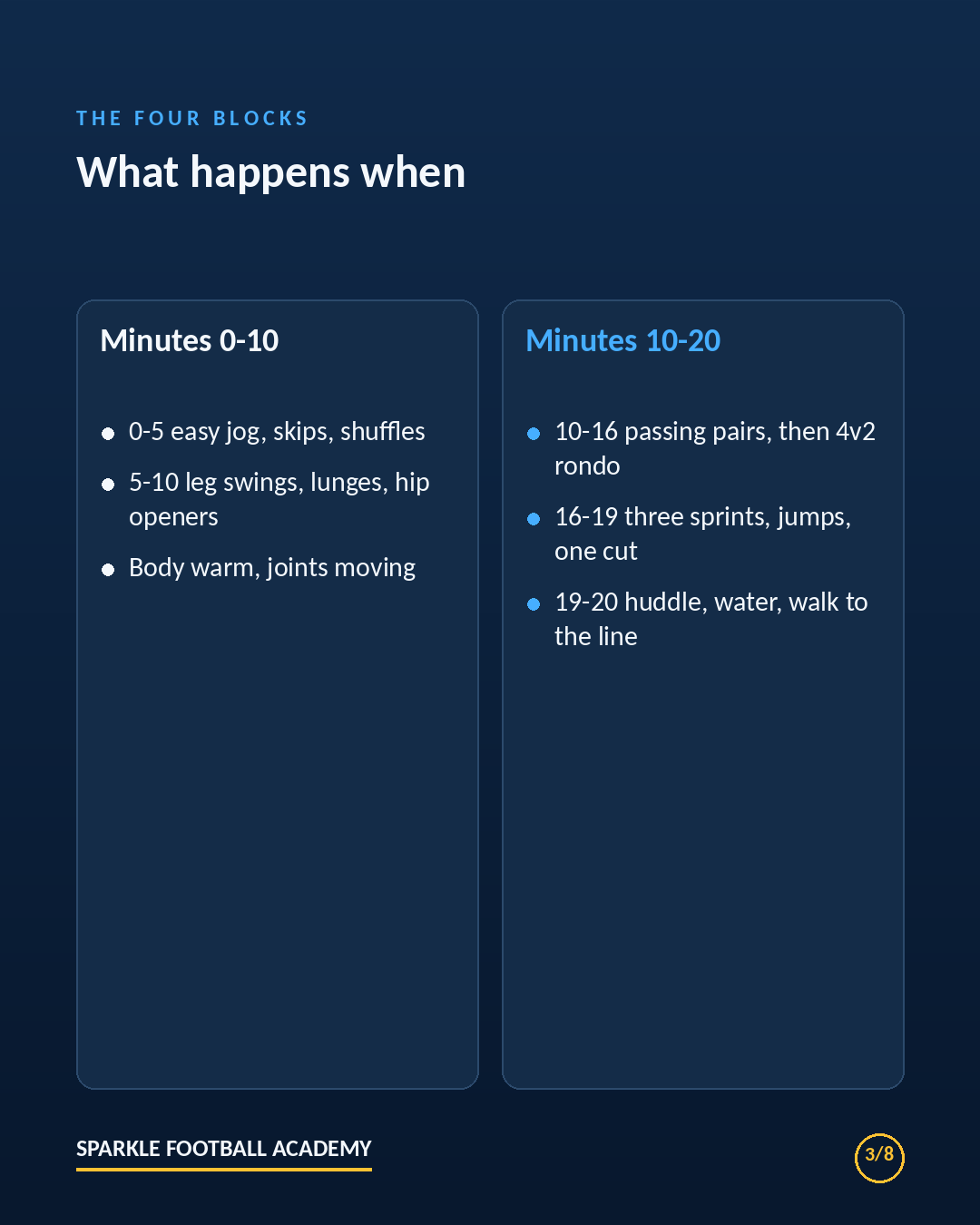
Here is the full sequence. It starts 22 minutes before kickoff and ends two minutes before the whistle, which leaves just enough time for water and a huddle without letting the body cool down.
- 0–5 minutes: raise the pulse. Easy jog across the width of the pitch, skips, side shuffles, backwards jog, arm circles. Talking is allowed. The goal is a light sweat, not heavy breathing.
- 5–10 minutes: open the joints. Dynamic stretches on the move: leg swings forward and sideways, walking lunges with a twist, open-the-gate and close-the-gate hip circles, high knees, heel flicks. No static stretching here; long holds relax muscles that are about to need tension.
- 10–16 minutes: the ball. Passing in pairs at 10 yards, then 20, two touches then one touch. Then a quick 4v2 rondo in a tight square. This block is where scanning, calling for the ball and first touch wake up.
- 16–19 minutes: sprint. Three short sprints from a standing start over 10 meters, a couple of jumps, and one hard change of direction to each side. Full recovery between reps. This is the block most youth teams skip, and it is the one that prevents the slow start.
- 19–20 minutes: huddle. Water, one message from the coach, walk to the line. Nobody sits down.
The whole thing fits on one page and, by mid-season, our captains run it themselves.
Why the order of the warm-up matters
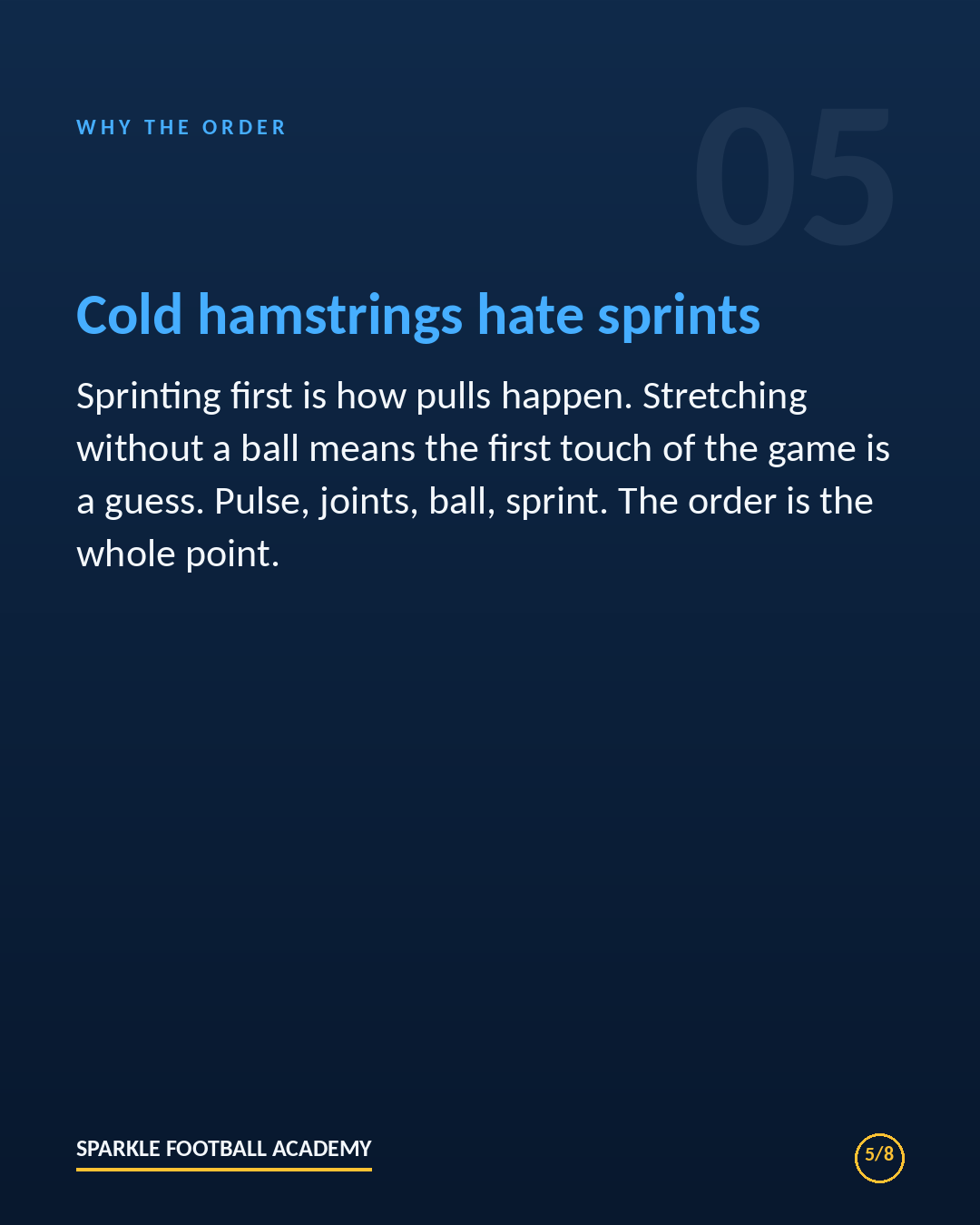
Parents sometimes ask why we are so strict about the sequence. The answer is that each block prepares the next one, and swapping them breaks the chain. Sprinting on cold hamstrings is how pulls happen, so sprints go last. Stretching a cold muscle does very little, so the jog goes first. And a body that is warm but has not touched a ball will still play a bad first pass, so the ball block sits between mobility and sprints, where the legs are ready and the mind is switching on.
There is a second reason. A fixed order removes decisions. On match day, young players are nervous, parents are talking, the other team is watching. A routine they know by heart is calming. They are not thinking about what comes next; they are already inside the game.
Where the pre-match warm-up lives on the pitch
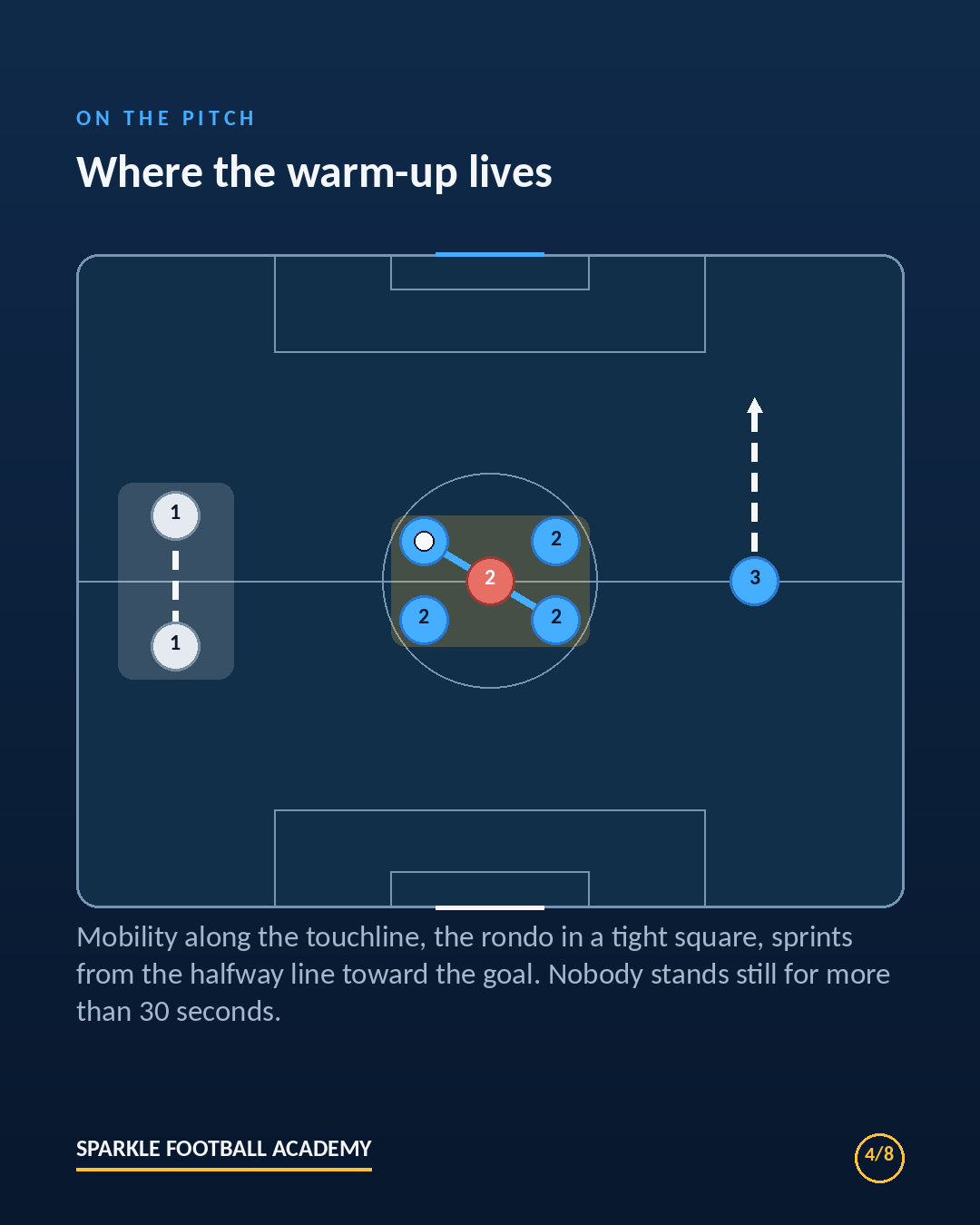
Space is usually tight before a game, so we use the pitch in three zones. The jog and mobility work runs along one touchline, where players can move up and down without getting in anyone’s way. The passing and the rondo happen in a tight square near the center circle, because a small square forces sharp passes and quick decisions. The sprints run from the halfway line toward our own goal, so nobody is sprinting into the other team’s warm-up. If the pitch is not available, all three zones fit on a strip of grass beside it.
Dynamic stretching vs static stretching before a game
This is the most common question we get, so here is the short version. Before a match, stretch on the move. Leg swings, lunges, hip openers and high knees take the joints through a full range while the muscles stay warm and ready to contract. Static stretching, where you hold a position for 20 or 30 seconds, is excellent after the game and on recovery days, but right before kickoff it tends to leave the muscles relaxed and slightly slower to fire. The general principle, that a warm-up should gradually raise intensity and rehearse the movements to come, is why the whole sequence builds toward the sprints rather than starting with them.
Common pre-match warm-up mistakes
A few things we see every weekend, and the simple fix for each.
- Arriving late and warming up for six minutes. The fix is a family rule: at the field 30 minutes before kickoff, every time.
- Standing in a shooting line. Ten players waiting for one shot each is cooling down, not warming up. A 4v2 rondo keeps everyone moving and touching the ball.
- Finishing the warm-up with a chat. If the last five minutes are spent sitting and listening, the body cools. Keep the huddle to one message and one minute.
- Skipping the sprints because the legs feel fine. The legs always feel fine until the first 50-50 ball. Three sprints take 90 seconds.
How we coach the warm-up at Sparkle Football Academy
The warm-up is the same before every match, and that is on purpose. In the first weeks of a season, the coach leads all four blocks and explains why each one exists. By the middle of the season, the captain leads the jog and the mobility, and the coach only steps in for the rondo and the sprints. By the end of the season, most of our teams can run the whole 20 minutes without a word from the sideline. That independence is the real goal. A player who owns his own preparation shows up ready, and that habit follows him into every team he ever joins.
We also connect the warm-up to the way we play. The rondo in the middle block is the same 4v2 rondo we use in training, so the passing shapes and the scanning habits from the week show up in the first minute of the match. If your player is new to those ideas, our guide to first touch and our breakdown of small-sided games explain why so much of our work happens in tight spaces with lots of touches.
For parents: what you can do on match day
You do not need to know a single drill to help. The most useful thing a parent can do is protect the 30 minutes before kickoff. Arrive early, hand over the water bottle, and let the team run its routine without conversation from the touchline. If your child’s team does not have a set warm-up, share this sequence with the coach; it is designed to be run by the players themselves, so it asks very little of a volunteer coach. And after the match, praise the preparation, not only the goals. A player who hears “you looked ready from the first whistle” learns that readiness is something they control.
One more thing worth knowing: the warm-up is where a large share of soft-tissue injuries are prevented. Twenty minutes of jogging, mobility, ball work and sprints is not extra; it is the cheapest injury insurance in youth soccer.
Start your player’s journey at Sparkle
The 20-minute pre-match soccer warm-up is one small piece of how we teach players to prepare, think and play. At Sparkle Football Academy in Burnaby and Vancouver, every session is built around the ball, decisions and habits that last. If you would like to see it in person, book a free trial session and watch your player arrive at kickoff already playing.
![Read more about the article [5 Things to Know About] How to Choose the Right Spanish soccer](https://www.sparklesocceracademy.com/wp-content/uploads/2024/12/c3d22633-0366-471b-9e11-9e984696a251-300x226.webp)