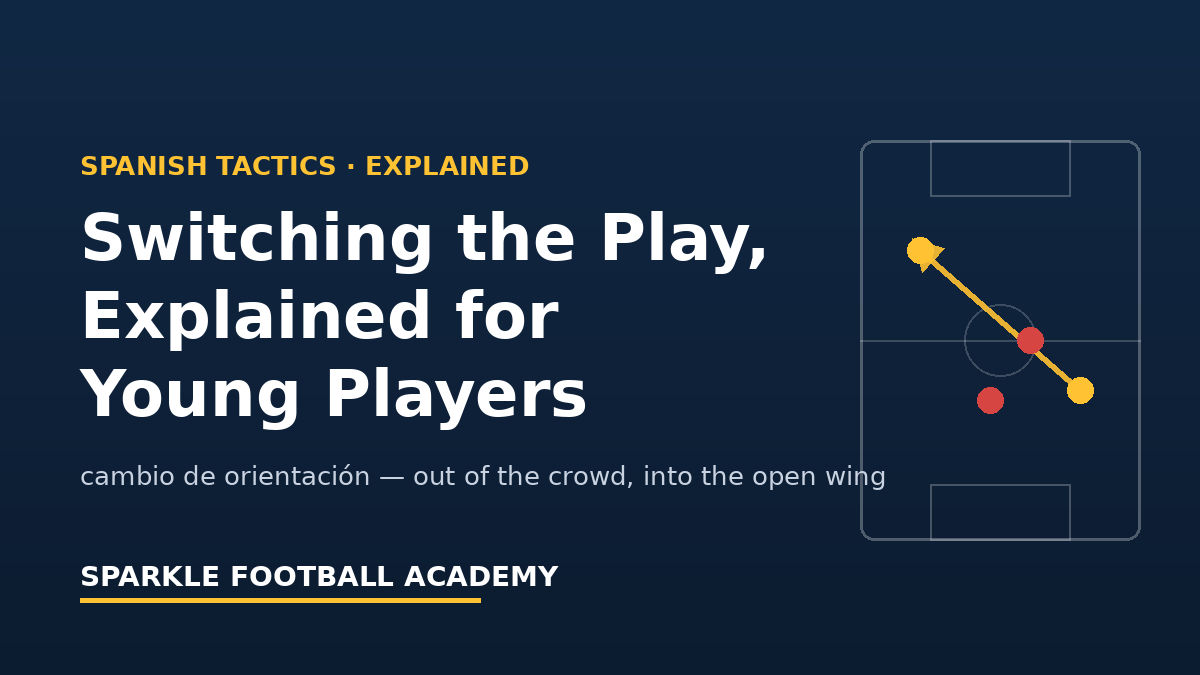
Switching the play is one of the first big tactical ideas young soccer players can actually feel working in a real game. One moment your team is trapped on the touchline with three defenders closing in. Two passes later, your winger on the other side of the field is running at one lonely fullback with forty yards of grass to attack. Nothing magical happened — the ball just moved faster than the defense could.
Spanish coaches call it cambio de orientación, a “change of orientation,” and it sits at the heart of how possession teams escape pressure. Here’s what it means, why it works, and how we teach it to young players at Sparkle Football Academy.
What Switching the Play Means (and Why Spain Calls It Cambio de Orientación)
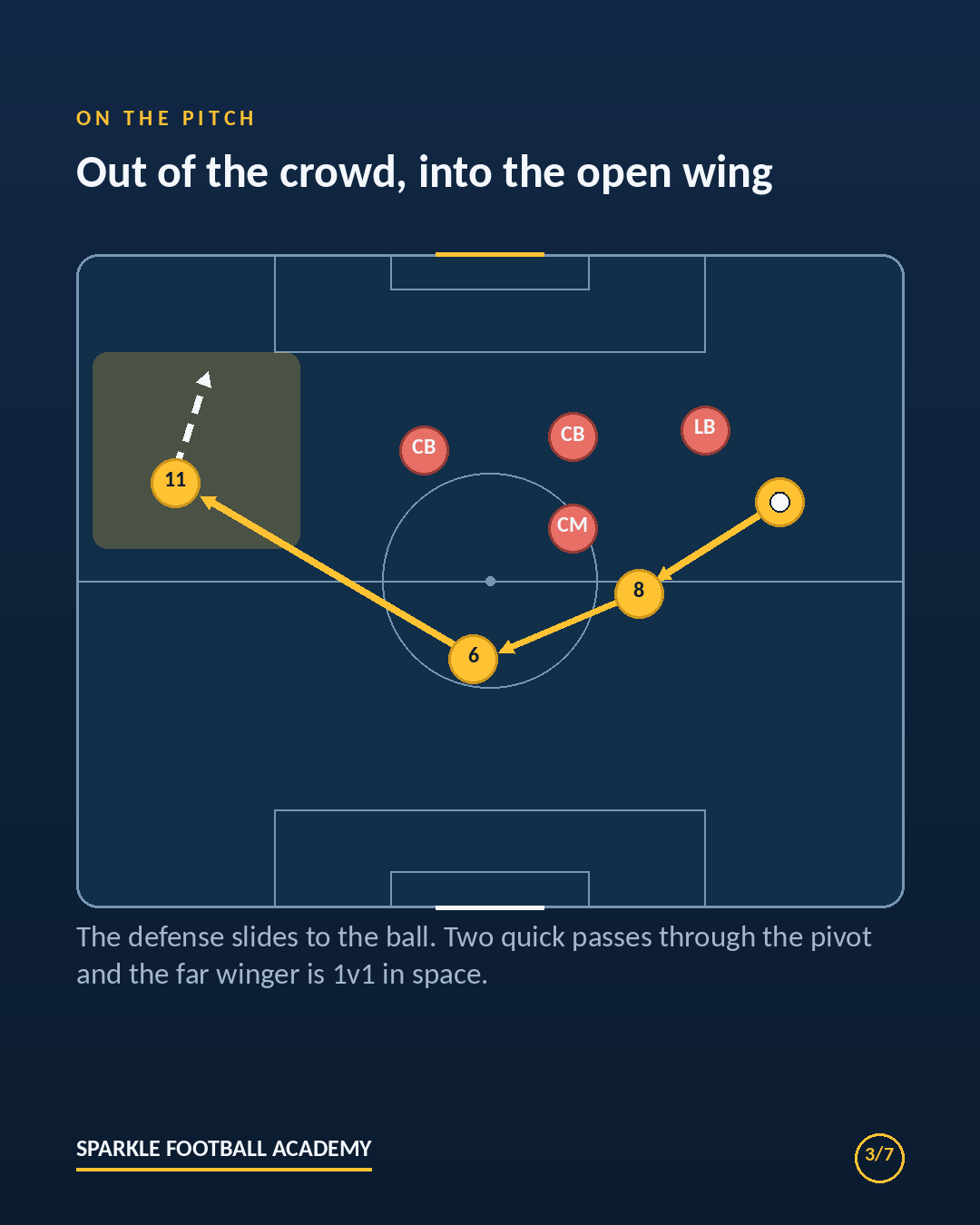
Switching the play means moving the ball quickly from one side of the field to the other — usually from a crowded wing to an open one. In Spain it’s cambio de orientación because the whole team changes the direction it’s facing: one second everyone is oriented toward the right touchline, the next the attack flows down the left.
The switch can travel through two or three short passes, or fly over everything in one long diagonal. What matters isn’t the route. It’s the idea underneath: the side of the field where the ball is gets crowded, so the other side gets free.
Why It Works: Every Defense Chases the Ball
Watch any well-coached team defend and you’ll see the whole block slide toward the ball. That’s good defending — it packs numbers around the danger and cuts passing lanes. Teams that defend in a 4-3-3 or any other shape all obey the same rule: squeeze the ball side.
But every action in soccer buys something and pays for something. The price of crowding one wing is acres of space on the opposite one. A defense can’t be in two places at once, and it takes a back line several seconds to slide thirty yards across the field. A firm pass crosses that same distance in about one second. That gap — defenders shuffling at jogging speed while the ball travels at passing speed — is the entire trick behind switching the play.
Two Ways to Switch the Play
At youth level there are two honest routes to the far side, and smart teams use both.
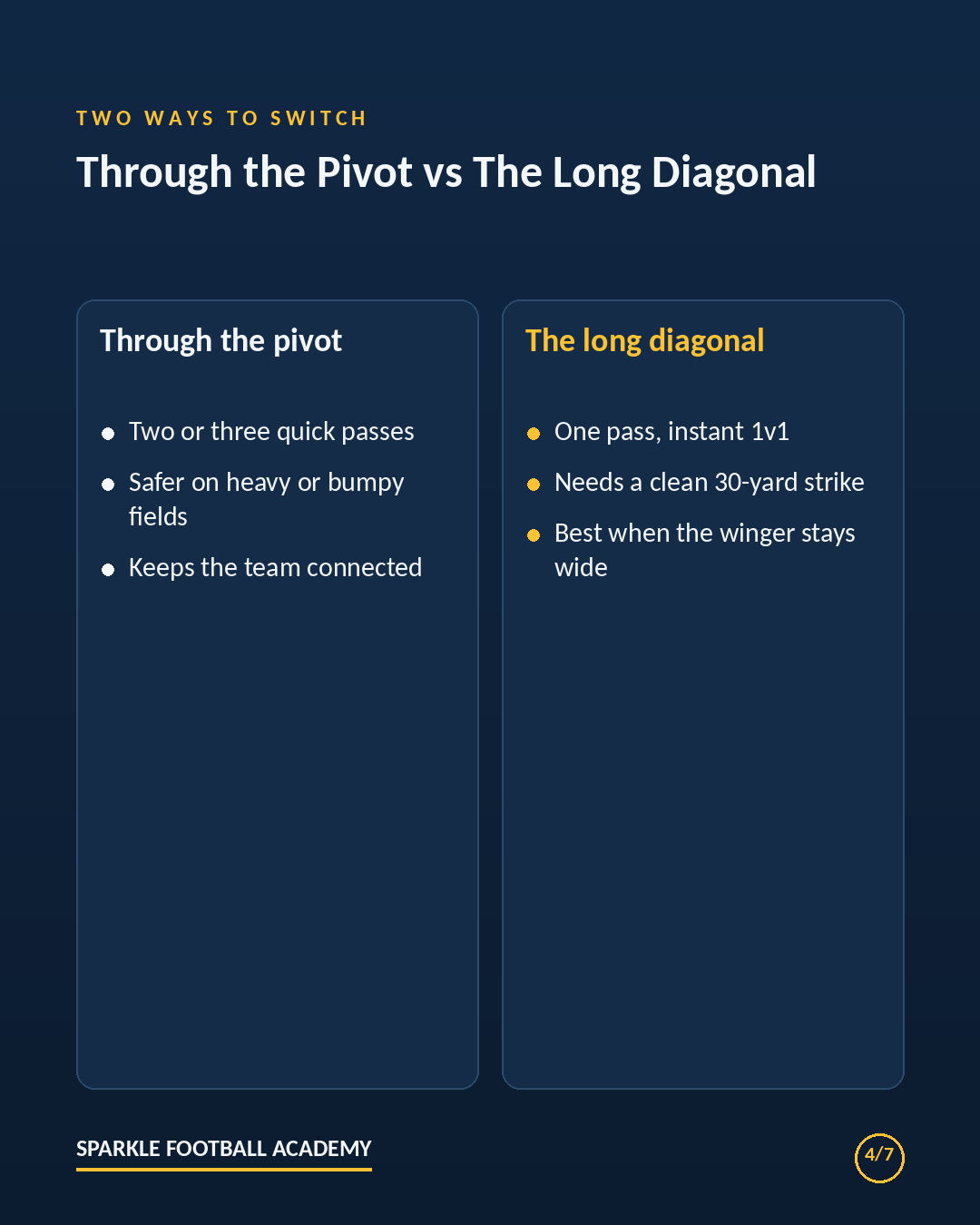
1. Through the pivot. The ball comes off the crowded wing into the holding midfielder — the player Spanish coaches call the pivote — who opens their body and plays the very next pass to the far winger. Two or three touches, low risk, and it works even on bumpy fields where a 40-yard ball might bounce away. This is the version we teach first.
2. The long diagonal. One player strikes a single cross-field ball, usually lofted, straight to the opposite winger. It’s faster and more spectacular, but it asks for a clean 30-plus-yard strike and a winger disciplined enough to stay wide instead of drifting toward the ball. Older youth players love learning this one — it’s a real weapon once the technique arrives.
A useful rule of thumb for young teams: master the pivot route first, earn the diagonal later.
When to Switch: Watch for the Three-Defender Trigger
Knowing how to switch matters less than knowing when. We give players one simple visual cue:
- Three or more defenders inside the width of the ball? Switch now — the far side is outnumbered and open.
- Only one or two defenders nearby? Keep playing forward — you don’t need the switch yet.
- Just won the ball back? Look long and diagonal first — the defense is still leaning toward where they lost it.
And one warning that saves a lot of turnovers: a slow switch is worse than no switch. If the ball crawls across the field through lazy square passes, the defense slides along with it and arrives before the winger can do anything. Speed of the pass — not the distance — is what makes the defense pay.
How We Train Switching the Play at Sparkle
We don’t teach this on a whiteboard. Players learn the switch the same way they learn everything in our possession style — inside small games that force the picture to appear over and over.
Our favorite is a two-goal possession game: each team can score in either of two small goals placed on opposite wings, but only after completing a switch. Suddenly nobody needs reminding to look across the field — the game itself rewards the scan. It builds on the habits players pick up in the rondo, where keeping the ball under pressure becomes second nature, and in our 3v3+3 possession game, where players learn to use the free man on the far side.
Younger groups play it 4v4, older groups 7v7 with a neutral pivot. Within a session or two, you’ll hear kids shouting “switch it!” at each other — which is exactly the moment a tactic stops being the coach’s idea and becomes theirs.
Common Mistakes (and Easy Fixes)
- The winger drifts inside. If the far winger wanders toward the ball, the switch has nowhere to land. Fix: paint a line with your eyes — heels to the touchline until the ball starts traveling.
- The switch is an escape, not an attack. Some teams switch just to switch, then stand still. Fix: the first touch after a switch should attack the open space, not stop the ball.
- Floaty, hopeful passes. A soft cross-field ball gets cut out or arrives too late. Fix: drive the pass — a firm ball beats a long float, every time.
- Switching too early. If only one defender is near the ball, the switch hands away an advantage. Fix: use the three-defender trigger before looking across.
For Parents: What to Watch From the Sideline
You don’t need a coaching license to see this tactic developing in your child’s game. Watch for three little habits: does your player glance across the field before receiving the ball? When the team is stuck on one wing, do they offer on the opposite side instead of crowding in? And when a long switch lands near them, is their first touch forward into space?
Those small moments are what tactical learning at a good academy actually looks like (the broader framework is covered in association football tactics and skills) — not memorized formations, but a child starting to read the game. If you spot a switch that leads to a chance this weekend, mention it on the car ride home. That’s the kind of soccer conversation kids remember.
Come Switch the Field With Us
Switching the play is simple to explain and endlessly fun to master — and it’s exactly the kind of soccer we play every week at Sparkle Football Academy. Our coaches build sessions where young players learn possession, scanning, and brave passing through games they don’t want to leave.
Curious whether it’s the right fit for your player? Book a free trial session — bring cleats, a water bottle, and we’ll handle the rest. We’d love to see your young player switch the field for the first time.