The 3v3+3 possession game is a small-sided drill where two teams of three play inside a tight grid while three neutral players always join the team that has the ball. The team in possession plays 6v3. The team that loses it becomes the three chasing. That single rule makes it one of the most efficient training games in soccer — and it’s how Spanish academies introduce juego de posición (positional play) to players as young as eight. Here’s how the 3v3+3 possession game works, why coaches love it, and what your child actually learns from it.
What Is the 3v3+3 Possession Game?
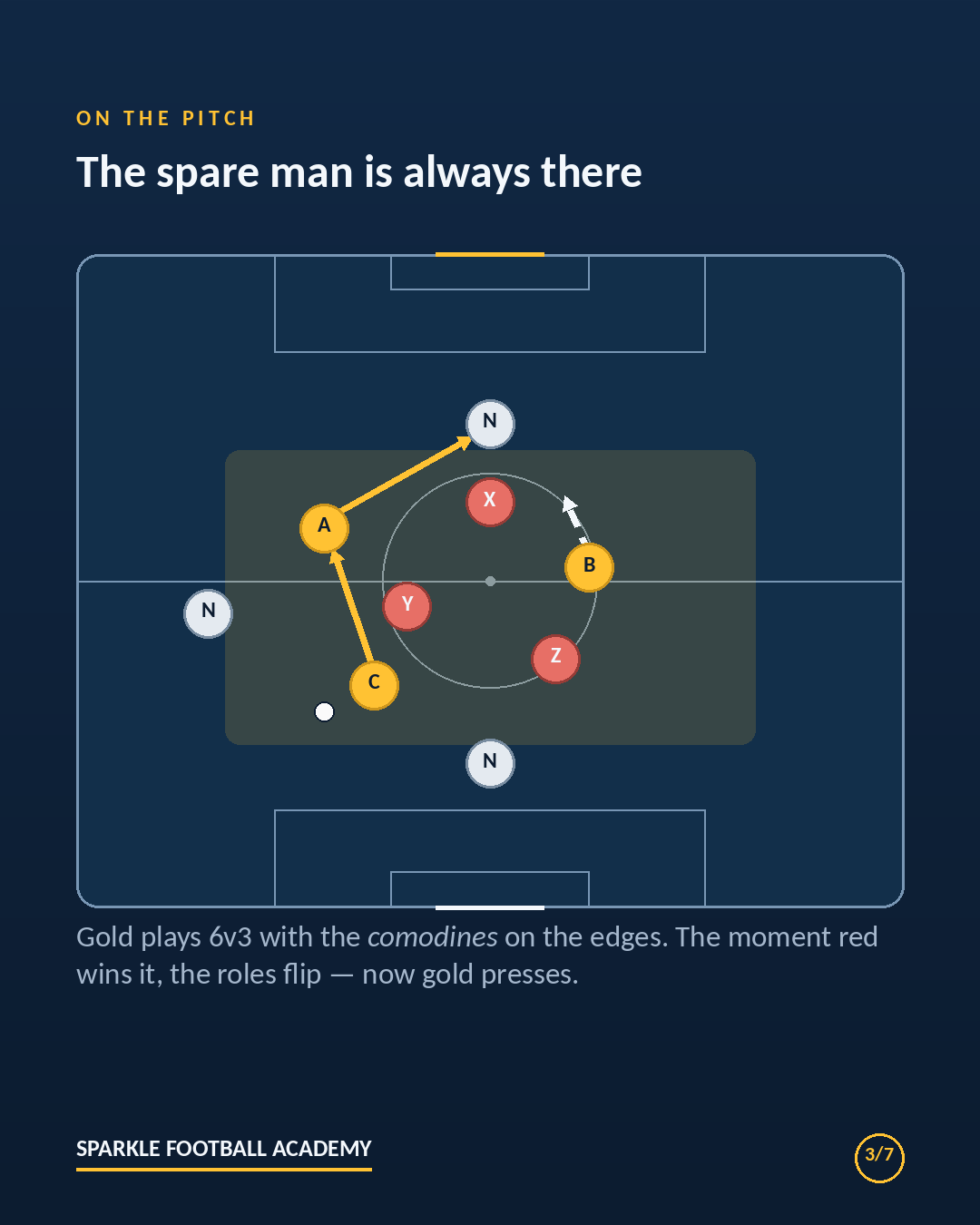
Picture a rectangle about 12 by 18 yards. Inside it: three players in gold, three in red. Around the edges (and sometimes one in the middle): three players in white — the neutrals, or comodines as Spanish coaches call them. The Spanish word means “jokers” or “wildcards,” and that’s exactly what they are: they play for whichever team has the ball.
So whoever has possession enjoys a 6v3 advantage. There’s always a spare man somewhere — the question the game asks on every touch is: can you find him before the pressure arrives?
If you’ve read our breakdown of the rondo drill, this is the natural next step. The rondo teaches the pass and the first touch in a circle. The 3v3+3 possession game adds real positions, real direction, and — most importantly — real consequences when the ball is lost.
How to Set Up the 3v3+3 Possession Game
You need nine players, a handful of cones, and one ball. Here’s the standard setup we use:
- Grid: 12×18 yards for ages 10–13; stretch to 15×20 for older or more advanced groups. Tighter grid = faster decisions.
- Teams: two teams of three inside the grid, plus three neutrals — one on each end line and one floating inside (or all three on the outside lines for beginners).
- Rules: the team in possession keeps the ball with help from all three neutrals. Neutrals are limited to two touches. If the defending three win it, the roles flip instantly — no whistle, no reset.
- Scoring: ten connected passes equals a point. Or count “splits” — any pass through the middle of the defending three earns double.
- Rounds: 3–4 minute blocks with short rests. Quality drops when legs go, and this game is about quality.
That’s it. No bibs ceremony, no elaborate choreography. The constraint does the coaching.
The Turnover Is the Real Lesson
Most parents watching this drill see passing practice. Coaches see something else: the five seconds after the ball changes hands.
When the gold team loses possession, they go from a comfortable 6v3 to being the three defenders — instantly. The neutrals switch sides without moving a step. There’s no time to sulk about the giveaway, because the press has to start now, while the new possession team is still organizing itself.
This is counterpressing in miniature. The habit of reacting to the loss — instead of watching it happen — is one of the clearest differences between players who’ve grown up in possession-based academies and players who haven’t. The 3v3+3 builds that reaction into muscle memory, rep after rep, without a single lecture.
What Young Players Learn From 3v3+3
A well-run 3v3+3 session trains an enormous amount in twenty minutes:
- Playing with a spare man. Possession soccer is a numbers game. Kids learn to hunt for the free player — the same skill that drives possession play at every level of soccer.
- Triangles everywhere. With nine players around a small grid, there’s always a triangle to pass through. Players feel good support angles instead of memorizing them.
- Scanning. Pressure arrives in under a second, so players must check their shoulders before receiving — a habit we drill constantly at Sparkle.
- Pressing triggers. The defending three can’t chase randomly; three players can’t cover six without hunting as a pack at the right moments.
- Composure under pressure. The grid is small on purpose. Players learn that a calm first touch beats a panicked clearance.
Notice what’s missing: laps, lines, and standing around. Every player is involved on every touch — exactly what growing players need.
3v3+3 vs the Classic Rondo
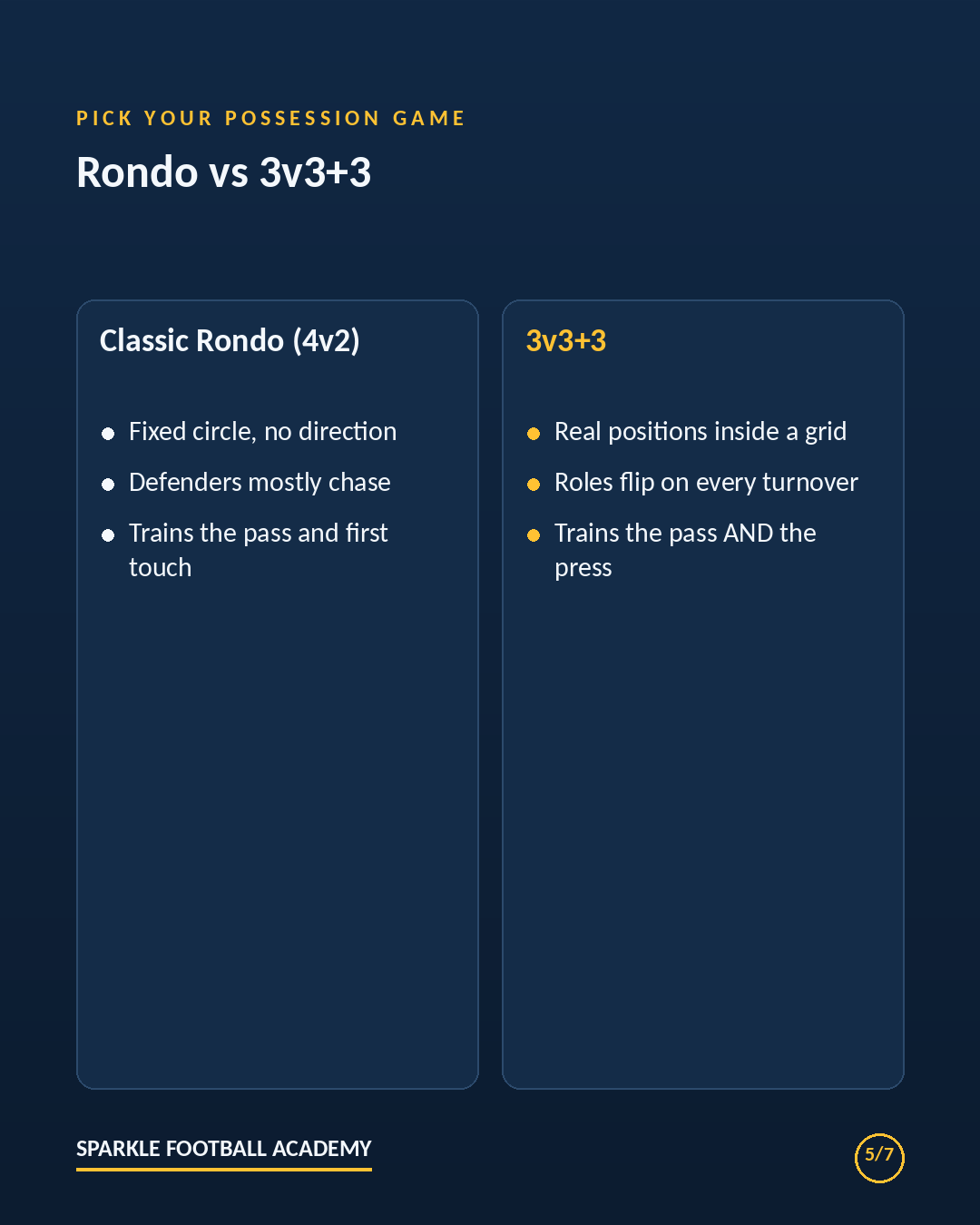
Both games come from the same possession-first school of thought, but they teach different layers:
The classic 4v2 rondo is a circle with no direction. It’s brilliant for first touches, pass weight, and quick feet, which is why Spanish academies start every session with it. But defenders mostly chase, and nobody occupies a real position.
The 3v3+3 possession game keeps everything the rondo teaches and adds the missing pieces: genuine positions inside a grid, a real opponent who presses with intent, and the constant flip between attacking and defending. If the rondo is the alphabet, 3v3+3 is the first full sentence of juego de posición.
The progression we recommend: rondo first as a warm-up, then 3v3+3, then larger positional games built on zones and lanes as players mature.
How We Coach It at Sparkle Football Academy
At Sparkle Football Academy we run the 3v3+3 possession game almost every session, and we coach three moments hardest:
Before receiving: did you scan? A pass only “counts” in some of our rounds if the receiver checked their shoulder first.
On the turnover: the first defender presses the ball within two seconds, the other two cut the easy outlets. We cheer the reaction, not just the steal.
The pause: when a player on the ball has no pressure, we want them to lift their head and wait half a beat — la pausa — instead of forcing the pass. Small grid, big lesson.
Players hear the same Spanish vocabulary our coaches grew up with — comodín, juego de posición — explained in plain English, so the ideas travel with them to any team they join.
For Parents: What to Watch From the Sideline
If you’re watching your child play 3v3+3, skip the goals (there aren’t any) and look for these instead:
Head movement before the ball arrives. That little shoulder check is the single best predictor of a composed player. Reaction to losing the ball. Does your child chase immediately or stop to complain? The first response is the habit that matters. Body shape when receiving. Players who receive side-on can play forward; players who receive flat-footed can only play backward.
Progress in this game looks quiet — fewer giveaways, faster reactions, calmer touches. It won’t fill a highlight reel, but it’s exactly the foundation scouts and high-level coaches look for. For more on the ideas behind it, see the rondo’s history in Spanish football.
Try the 3v3+3 With Us
The 3v3+3 possession game looks simple — nine players, a small grid, one ball — and that’s the point. Inside that little rectangle, young players build the habits that define modern soccer: keep the ball bravely, win it back instantly, and always know where the spare man is.
Want your child to learn the game the way Spanish academies teach it, right here in North America? Book a free trial session at Sparkle Football Academy — bring boots, a water bottle, and we’ll handle the rest.