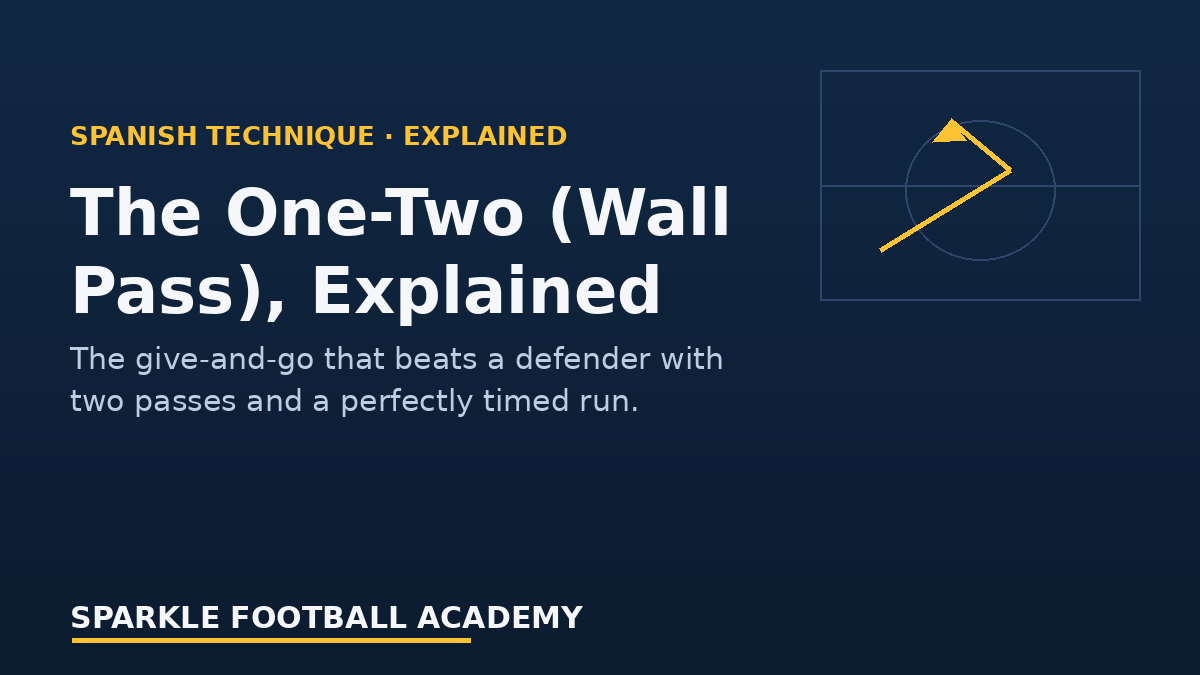
The one-two is the first piece of real teamwork most young players ever fall in love with. You pass the ball, sprint past your defender, and it comes right back to you in space — no fancy dribbling required. In Spanish it’s called the pared, literally “wall,” because you use a teammate the way a street footballer uses a wall: bounce the ball off, run around the obstacle, and collect it on the other side. This guide breaks down what the one-two is, why it works, and exactly how we coach it at Sparkle Football Academy.
What Is a One-Two in Soccer?
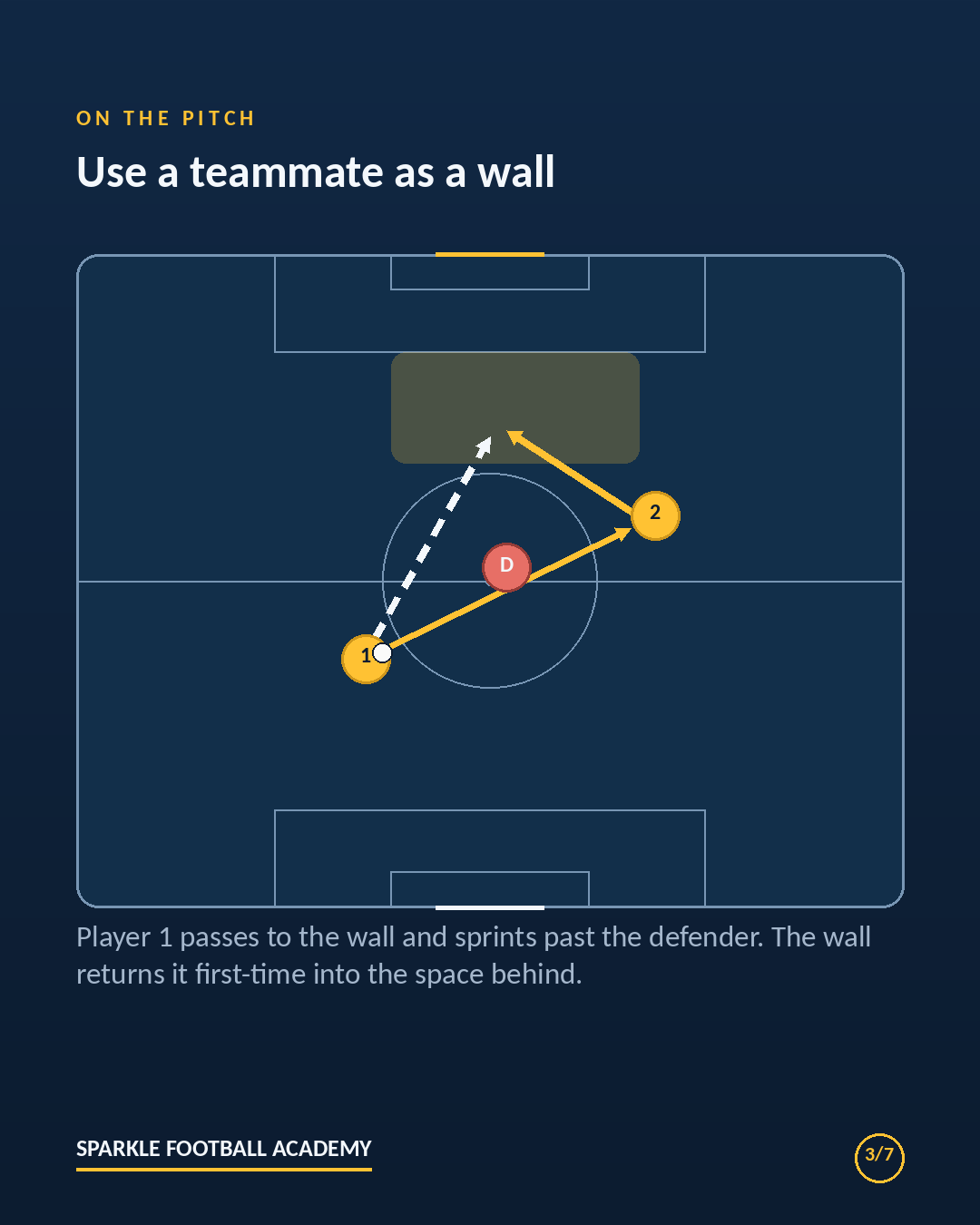
A one-two — also called a wall pass or a give-and-go — is two quick passes between two players that take a defender out of the game. Player one passes to a teammate (the “wall”), immediately bursts past the defender marking them, and the wall returns the ball first-time into the space behind. Two touches, two passes, one beaten defender.
The beauty of the one-two is its simplicity. There’s no stepover, no nutmeg, no trick. It’s the move you’ll see in every possession-based team, from the local U10s on a Saturday morning to the best sides in Europe. When two players understand it, they can pick apart a defense that’s bigger, faster, and more athletic than they are.
The Wall Pass: Where the Name Comes From
The “wall pass” name comes straight from street soccer. With no teammates around, a kid would knock the ball against a wall, run around the defender, and meet the ball as it rebounded. A one-two simply swaps the brick wall for a teammate who plays the ball back first-time. The give-and-go shows up across team sports — from basketball to hockey — but in soccer it’s one of the oldest and most reliable ways to break a line, as this overview of the give-and-go explains.
Why the One-Two Works: It’s a 2v1
Strip the one-two down and it’s pure math: two attackers against one defender. A single defender can’t be in two places at once. The moment the ball leaves the first player’s foot, the defender’s eyes follow it — and that half-second of ball-watching is all the runner needs to get goal-side.
Here’s why it keeps working at every level:
- It attacks a decision, not a body. The defender has to choose between the ball and the runner. Either choice loses.
- It’s fast. Two first-time passes happen quicker than any dribble, so there’s no time to recover.
- It uses space, not skill. You don’t beat the defender with your feet; you beat them with a run into the area they just vacated.
How to Execute a One-Two: Pass, Move, Receive
The mechanics are simple, but the details are what separate a clean one-two from a broken-down attack. Coaching the right core soccer skills early makes this almost automatic later. Walk through it in three beats:
- Pass with purpose. Play a firm, accurate ball to your teammate’s back foot — the foot farther from the defender — so they can return it in one touch.
- Explode off the mark. The instant the ball leaves your foot, accelerate. Don’t admire the pass. Run past the defender, into the space behind them, not toward your teammate.
- Demand the return. The wall plays the ball first-time into your run, ahead of you, so you meet it in stride and keep attacking.
Timing Is Everything
If a one-two falls apart, timing is almost always the reason. The return pass has to arrive exactly as you do — played first-time into space, never back to your feet. If the ball ends up behind you, you stopped running too soon. If you arrive before the ball, you were early and the defender recovers.
The fix is a shared rhythm: the wall plays quick and the runner explodes. Great combinations look almost telepathic, but they’re really just two players who have repeated the same timing hundreds of times until it became a habit.
Telegraphed vs Disguised: Make It Unstoppable
A one-two only works if the defender doesn’t see it coming. The difference between an easy-to-read attempt and an unstoppable one is small but decisive:
- Easy to read: staring at the wall the whole way, slowing down after the pass, and waiting for the ball at your feet.
- Hard to stop: passing and exploding off the mark, selling a different direction first with your eyes and hips, then running onto the return first-time, in stride.
Disguise turns a textbook pattern into a genuine weapon. The best players hide their intention until the defender has already committed.
Coaching the One-Two: How We Teach It at Sparkle
We don’t start the one-two with a whiteboard. At Sparkle we build the pared inside small games where it happens naturally and often. The progression looks like this: 4v2 rondos for the angles and quick returns, then wall-pass “gates” in small-sided games where players score a point for completing a give-and-go through a mini-goal, then full-sided play with real defenders and real pressure.
Layering it this way means players learn the why before the where. The one-two becomes a reflex — pass, move, demand it back — long before it’s ever a set play. It’s also a brilliant teacher of real teamwork, because it only works when two players trust each other and read the same picture. If you’ve ever wondered why so much of our coaching borrows from the Spanish approach to the game, the pared is a perfect example: simple idea, endless repetition, huge payoff.
Three Common One-Two Mistakes (and Easy Fixes)
When a one-two breaks down in a game, it’s usually one of three things — and all of them are fixable on the training ground:
- Passing to the wrong foot. If you hit the wall’s front foot, they have to take a touch and the move slows down. Aim for the back foot so the return can be first-time.
- Running too straight. Sprinting directly at your teammate clogs the space and lets the defender cover both of you. Angle your run past the defender’s shoulder, into the gap behind them.
- Walking after the pass. The most common one of all. A one-two is a sprint, not a stroll. The pass is the trigger to accelerate, not to relax.
Fix those three habits and the one-two goes from hit-or-miss to a pattern your team can lean on whenever a defender steps up to press.
For Parents: Why This Small Skill Matters
The one-two looks like a tactic, but it’s really teaching your child the habits that matter most in youth soccer. To play it well, a player has to scan before receiving, make a quick decision, commit to an unselfish pass, and then sprint into space to support a teammate. Those are the building blocks of a smart, generous, confident player — the kind every coach wants on the field.
It’s also a confidence-builder. A young player who can reliably combine with a teammate stops feeling like they have to beat everyone alone. They learn that soccer is a shared problem, and that two heads (and four feet) really are better than one.
Ready to Try It? Book a Free Trial
The fastest way to learn the one-two is to play it — with good coaching, the right partners, and plenty of repetition. At Sparkle Football Academy we build these combinations into every session, so players develop the timing and the teamwork together. Come see it in action: explore our programs and book a free trial. Bring a teammate you love to combine with — the pared is always better with two.
![Read more about the article [How to Play Possession Soccer] Achieve 70% Possession with These Tips](https://www.sparklesocceracademy.com/wp-content/uploads/2025/03/u2441757251_create_a_realistic_photograph_image_of_a_boy_play_4eb088fb-775e-4e82-90a9-09552d65f6e7_2-300x226.jpg)