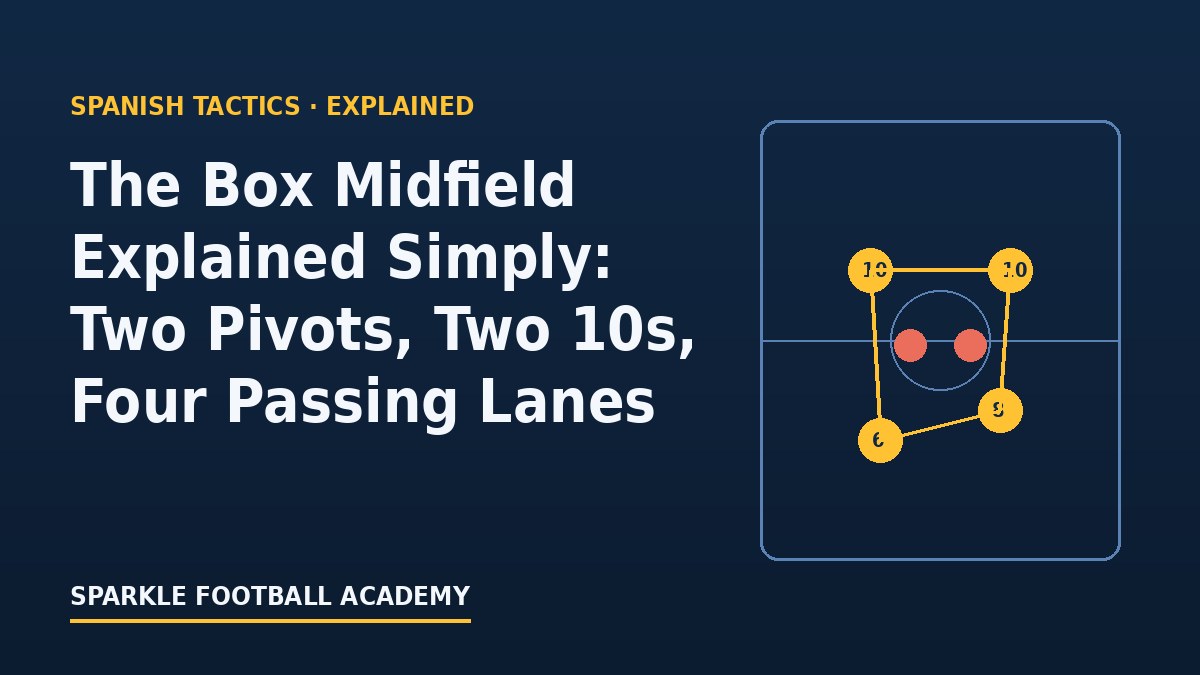
Box midfield explained simply: it is a 2-2 square in the middle of the pitch, two holding midfielders in front of the defense and two number 10s behind the opponent’s midfield line. If you have watched a top team this season and wondered why their central midfielder always seems to have a free pass, this is the reason. The box midfield gives one team four passing lanes through the center while a standard 4-4-2 only has two players to close them. In this guide we explain what the box midfield is, why coaches love it, the two rules that make it work, and how young players at Sparkle Football Academy learn it in small games before anyone says the word “formation”.
What is the box midfield?
Picture the middle of the pitch. Two players sit in front of the back four: these are the pivots, the holding midfielders. Two more players stand higher, behind the opponent’s midfield line and in front of their defenders: these are the number 10s, the attacking midfielders. Draw lines between the four and you get a square, or a box. In Spanish coaching language the shape is the doble pivote y mediapuntas, literally “double pivot and attacking midfielders”.
The box midfield is not a formation on its own. It is a shape inside a formation. Teams that line up 4-2-3-1, 4-2-2-2 or 3-2-5 in possession all end up with the same 2-2 square in the middle, and most of the top clubs in Europe use some version of it when they have the ball. You can read more about how formations are described on the Wikipedia page for formations, but the important idea is simpler than the numbers: two low, two high, always four options.
Why the box midfield works against a 4-4-2
A 4-4-2 defends with two flat lines of four. In the middle of the second line are two central midfielders, and their job is to stop passes through the center. Against a flat midfield they do this well: if your two central players stand on the same height, one defender can screen both of them.
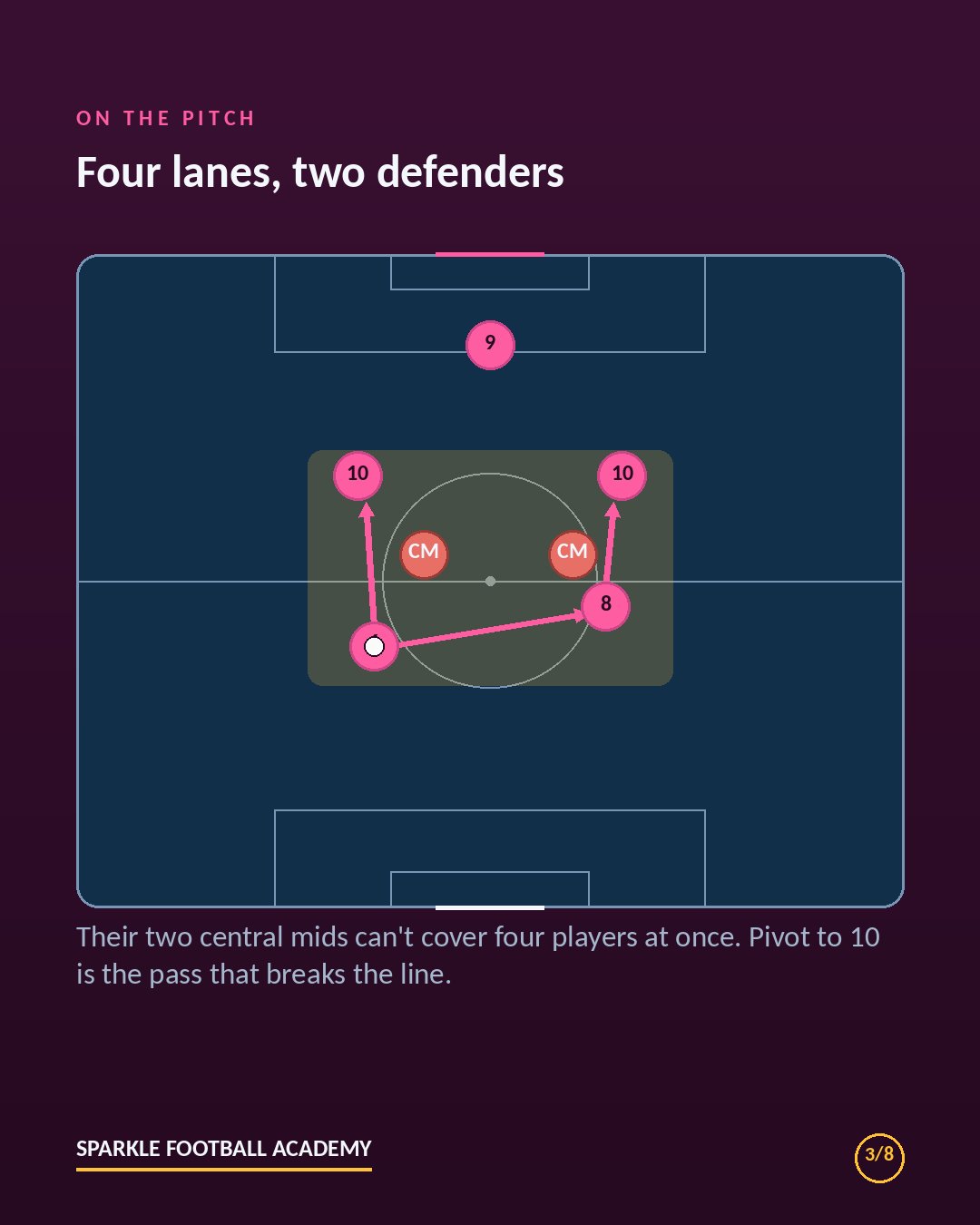
The box midfield breaks that arithmetic. Two of your players are below their midfield line and two are above it. Their two central midfielders now have to choose. Step up to press the pivots and the 10s are free behind them. Drop to cover the 10s and the pivots have all the time in the world. Whatever they choose, someone in the box is unmarked. That is what coaches mean when they talk about a free man, and it is the same idea we cover in our post on playing between the lines.
- Four lanes, two defenders. The pass from a pivot to a 10 is the one that breaks the line.
- Diagonals, not straight lines. Staggered players give the passer an angle a defender cannot block by standing still.
- Someone is always free. If the 10 is marked, the pivot has the ball facing forward. If the pivot is pressed, the 10 has space.
Rule 1: the two pivots stay on two heights
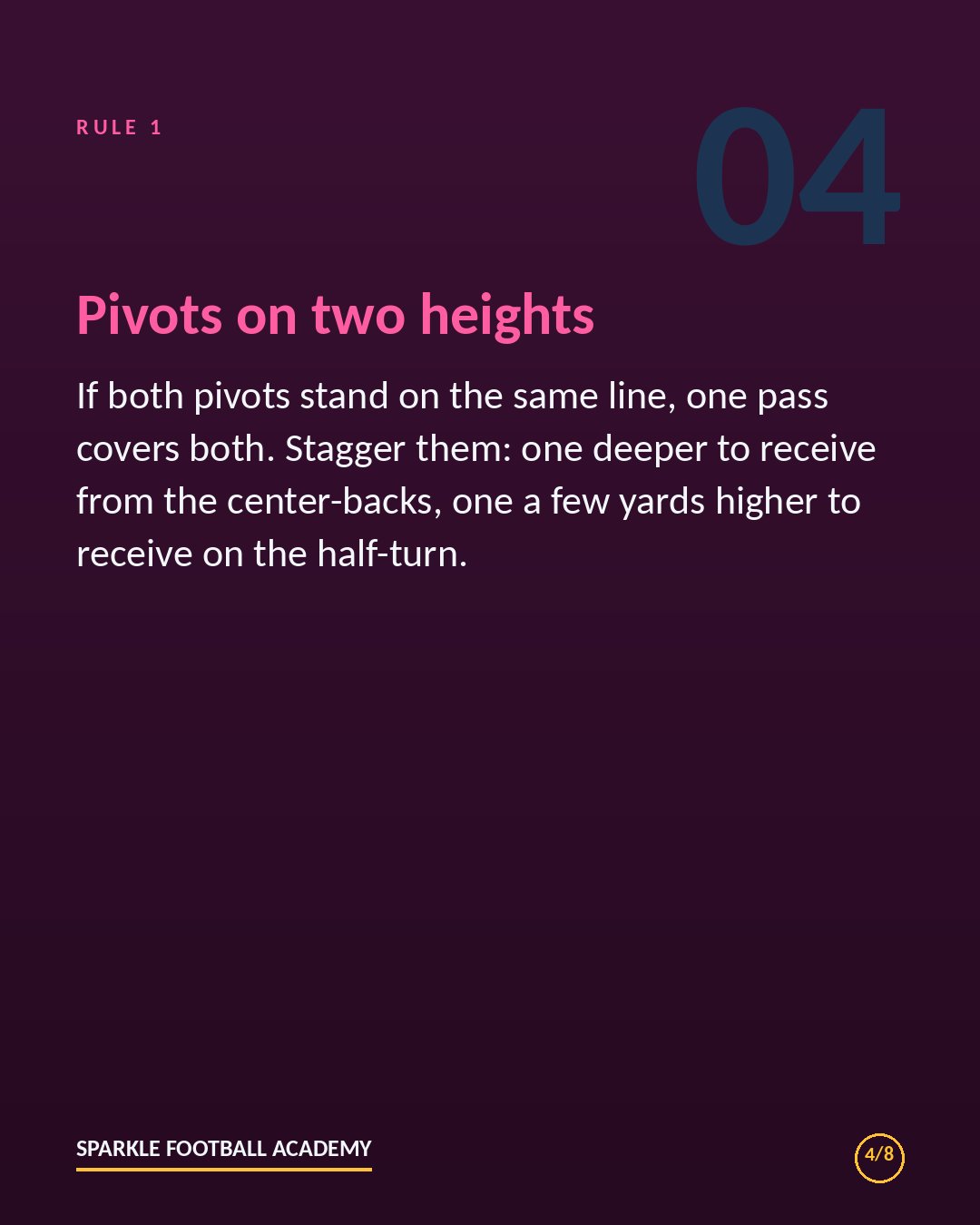
The most common mistake young teams make with a double pivot is standing side by side. Two pivots on the same line are easy to screen: one striker drops between them and both passes are gone. The fix is to stagger them. One pivot sits a little deeper, close enough to the center-backs to receive the first pass. The other stands a few yards higher and a few yards to the side, ready to receive on the half-turn.
Now the pass from the center-back into midfield is a diagonal, and a diagonal pass is much harder to intercept than a straight one. The deeper pivot also gives the team a safe outlet when the press arrives, which is the job we described in detail in our article on the number 6, the midfielder who screens the back four. In a box midfield the 6 still does that job; he just has a partner slightly ahead of him.
Rule 2: the number 10s live in the half-spaces
Where the 10s stand
The 10s do not drift to the touchline. Their home is the half-space, the channel between the opponent’s center-back and fullback, and their height is behind the opponent’s midfield line. If you are new to the idea of zones and lanes, our explainer on the 3 zones and 5 lanes shows exactly where the half-spaces are.
Why they stay inside
Width comes from the wingers or the fullbacks, not from the 10s. If a 10 wanders wide, the box loses one corner and the free-man advantage disappears. So the rule is simple: the 10s stay between the lines and wait. The moment a pivot receives, the 10 on that side drops a couple of yards to offer, and the 10 on the far side runs beyond the defense. One comes short, one goes long. That is the whole engine of the shape.
Box midfield vs a flat 4-4-2 midfield
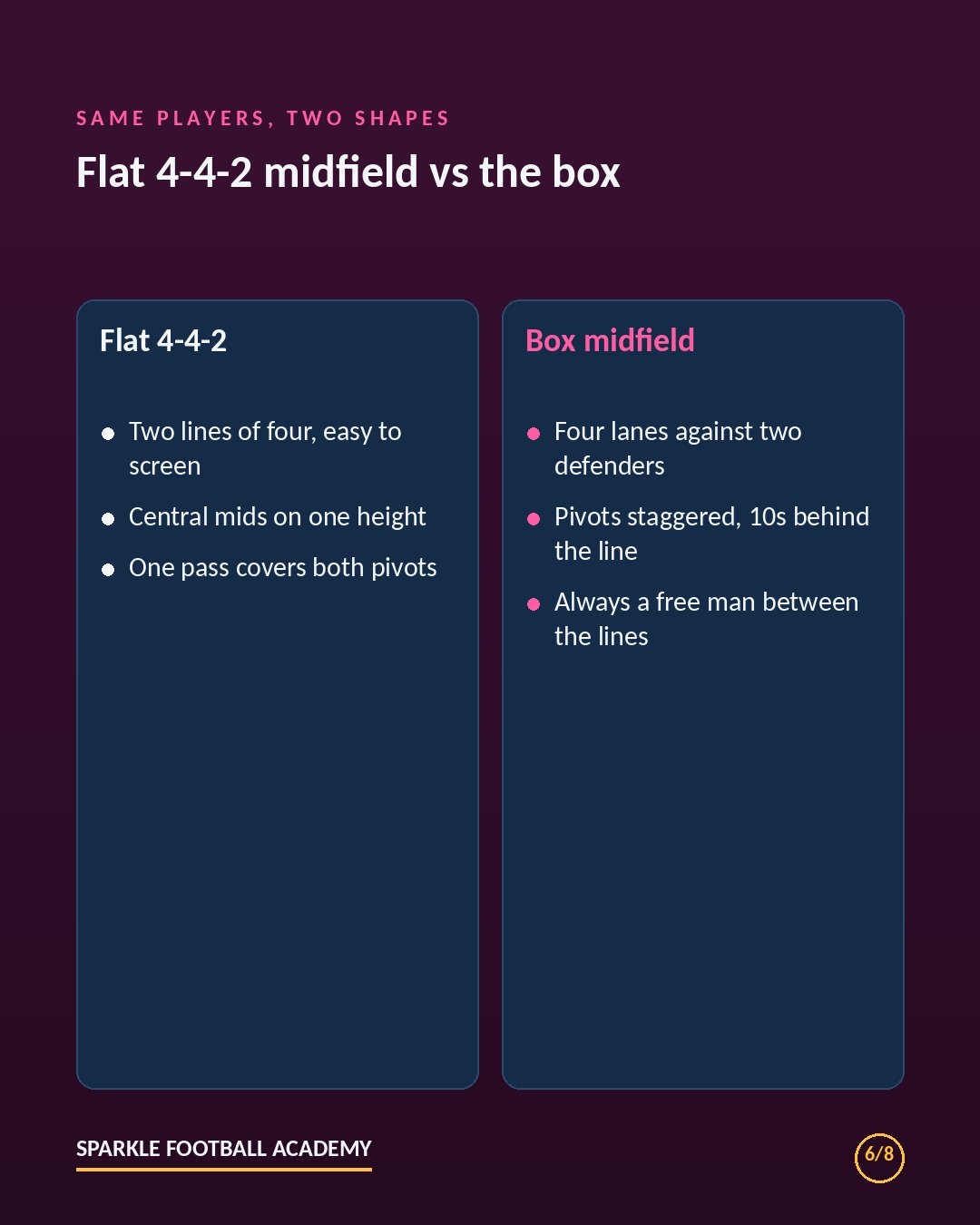
A flat midfield is easier to organize and safer when you lose the ball, which is why many youth teams start with it. The box midfield trades a little of that safety for control of the center. It is the shape teams use when they want to keep possession and progress through the middle rather than only down the wings. If your team already plays the 4-3-3, the box is a small step: one of the 8s drops next to the 6 and the other pushes up alongside the 10.
What happens when you lose the ball
The box has a defensive bonus that people forget. Because the four midfielders are close together, they can counter-press immediately after a turnover. The two 10s are already near the ball, the two pivots are already behind it, and the distances between them are short. Compare that with a flat midfield, where a turnover often leaves one line of four strung out across the pitch. Short distances between teammates are the foundation of pressing after loss, and the box gives you those distances for free.
How we teach the box midfield at Sparkle
We do not start with a whiteboard. Players learn the shape in a small possession game, the 3v3+3 or 4v4+3 game, with a 2-2 box in the middle and two simple rules:
- The two pivots can never stand on the same line. If they do, the ball goes back to the coach.
- A 10 only gets a point for receiving if the ball arrives behind a defender.
Within a few sessions the players find the diagonals, the half-spaces and the short-and-long movement on their own. Then, and only then, we name it: the doble pivote y mediapuntas. By the time they see it in a professional match on TV they already know what they are looking at.
For parents: what this means for your child
You do not need to memorize formations to support a young player. What matters is that your child is learning to scan, to position themselves where they can receive facing forward, and to understand why a teammate is free. The box midfield is a great teaching tool for exactly those habits, because every player in it has one clear question to answer: “Where is the space right now?” That question transfers to every position and every level of the game, and it is the kind of decision-making that separates players who understand soccer from players who only run.
Come and play in the box
Sparkle Football Academy teaches Spanish-style positional play to young players in the Vancouver area, in English, one idea at a time. If your child loves having the ball and wants to understand the game, not just play it, book a free trial session and come and see how we train. Bring boots, bring questions, and we will show you where the free man is.