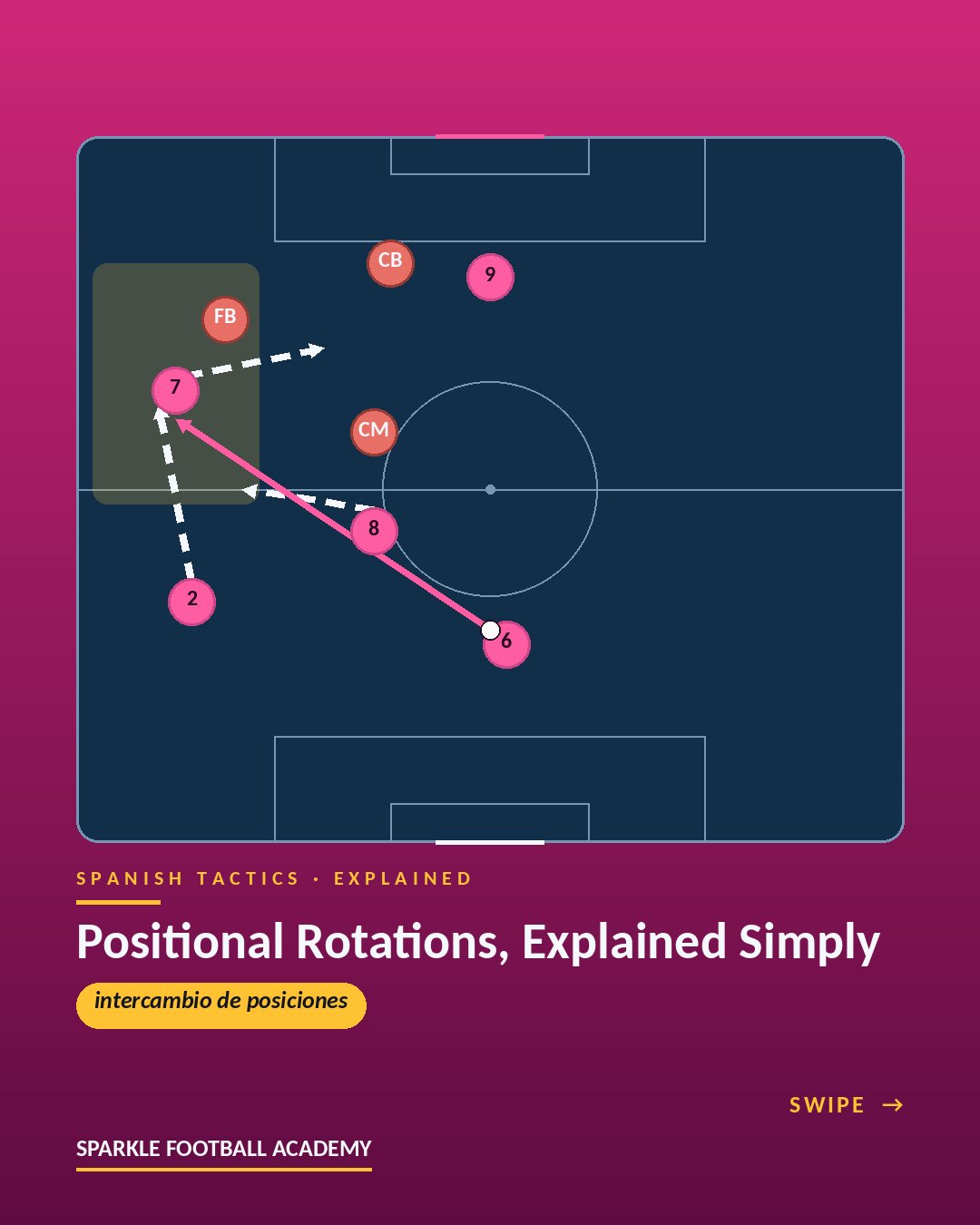
Positional rotations in soccer sound complicated, but the idea fits in one sentence: the position always stays filled, the player in it changes. When a winger comes inside, the fullback takes his lane. When the 8 drops, the 6 steps up. The shape of the team never changes, but the defenders marking them suddenly have a decision to make every few seconds. In Spanish we call it intercambio de posiciones, swapping positions, and it is one of the habits that separates a team that keeps the ball from a team that actually goes somewhere with it.
What Are Positional Rotations in Soccer?
A rotation is a planned swap between two or three teammates. One player leaves his zone, and a teammate arrives in it at the same moment. From above, the team still looks like a 4-3-3 or a 3-2-5. But the names on the shirts in each spot have moved.
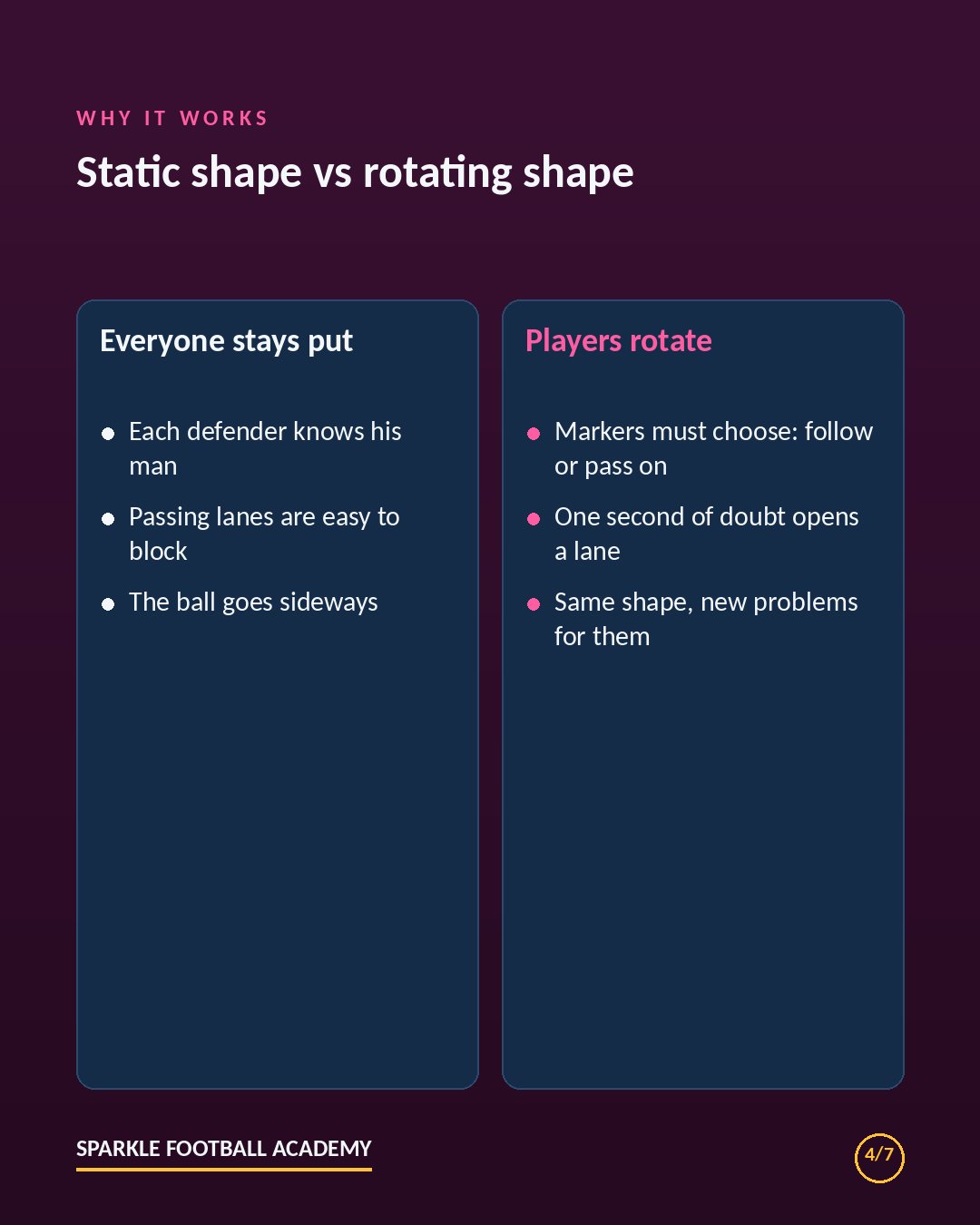
That matters because most youth defenses, and plenty of adult ones, defend people rather than spaces. If you are told “you have number 7,” and number 7 walks into midfield, you have two bad options: follow him and leave your zone empty, or let him go and hope somebody else picks him up.
Why Rotations Beat Man-Marking
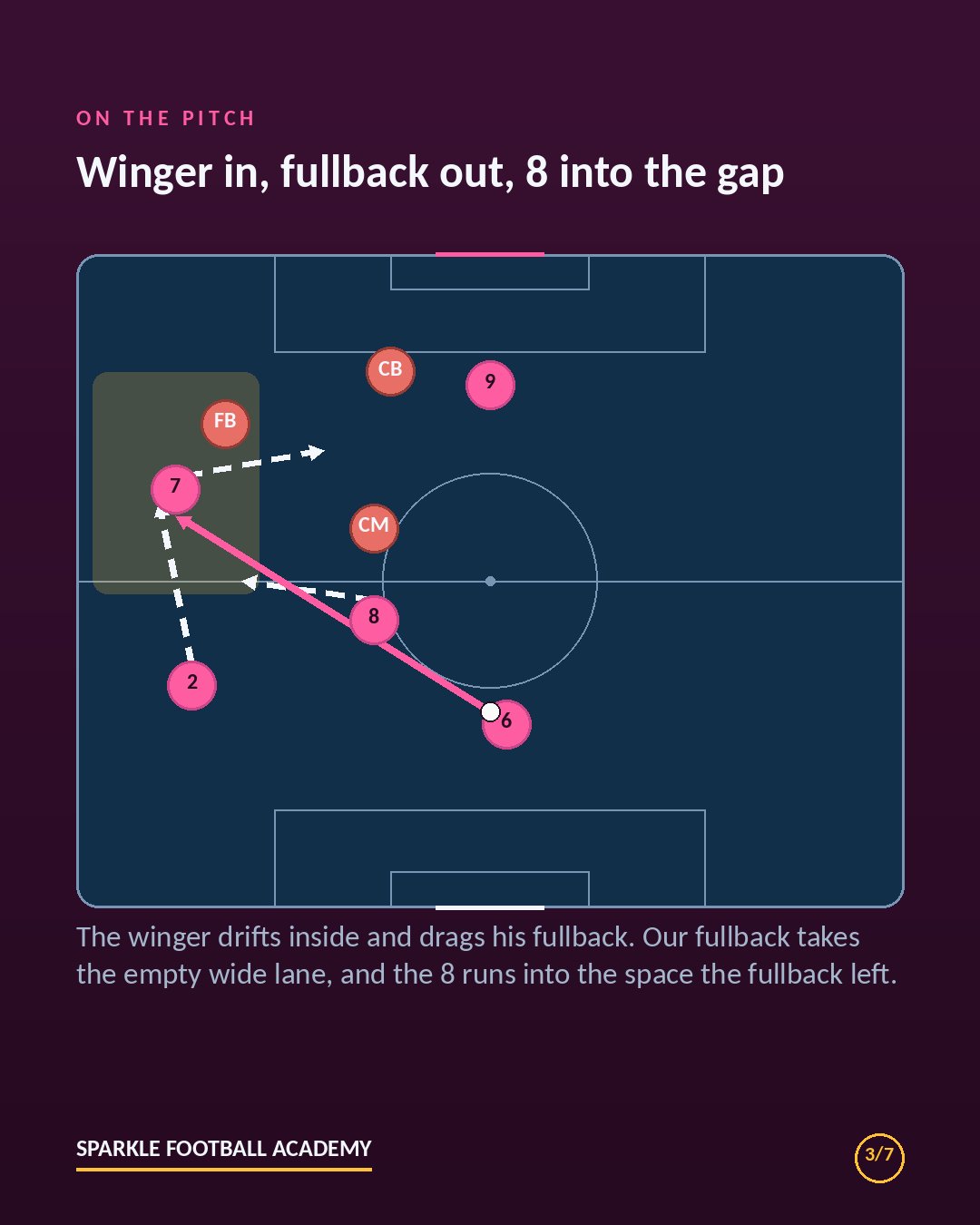
Man-marking works when everyone stays put. Rotations attack the one thing man-markers cannot control: the handoff. When the winger drifts inside, his marker has to shout “take him!” and a midfielder has to hear it, agree, and react. That takes a second. A good possession team only needs one second.
- Follow and leave a hole: the fullback follows the winger inside, and the touchline is empty for our overlapping fullback.
- Pass him on and hope: the fullback stays, the winger receives between the lines, turns, and faces goal.
- Hesitate: the worst option, and the most common. Both defenders take half a step, and the pass goes through the gap between them.
The Golden Rule: Leave a Space, Fill a Space
This is the part young players miss. A rotation is not “go wherever you want.” If you leave your lane and nobody arrives, you have not rotated. You have made a hole, and when the ball is lost, that hole is where the counter-attack goes. Every time a player moves out, the next question is: who is coming in behind me?
Three Positional Rotations to Teach First
- Winger inside, fullback outside. The winger drifts into the half-space; the fullback overlaps into the wide lane he left. The most common rotation in the modern game.
- 8 drops, 6 steps up. The 8 comes short to receive from the center-backs, and the 6 moves up into the space he vacated, so midfield never has a gap.
- 9 drops, 8 runs past him. The striker comes toward the ball and drags a center-back with him; the 8 runs beyond into the space the center-back left.
Rotations and Possession Play
Rotations are the engine of possession play. Keeping the ball is one thing; moving the opponent is another. Teams like Pep Guardiola’s Manchester City and Luis Enrique’s PSG are famous for it: their fullbacks step into midfield while the midfielders move wider, so the build-up shape stays the same with different players in each role. For young players, the lesson is simpler: the ball moves faster than any defender, but a rotation makes the defender think, and thinking is slow.
Common Mistakes (and How to Fix Them)
- Everyone rotates at once. Only two or three players swap. The rest hold their spots so the team keeps its shape.
- Rotating without looking. Check your shoulder before you leave. If nobody can arrive in your space, stay.
- Rotating away from the ball. The swap should create a passing option, not just movement for its own sake.
How We Train It: The 7v7 Lanes Game
At Sparkle we paint the field into five vertical lanes and play 7v7 with two rules: no two teammates in the same lane, and nobody can stay in one lane for more than one pass. At first it is chaotic. Within ten minutes, players start swapping on their own and calling for each other to fill the gap. We finish with a free game and ask one question: “When you left your lane, who arrived?”
For Parents
If your child’s coach talks about “rotations,” here is what to look for on the field: players moving into each other’s spaces on purpose, and nobody standing in a straight line with a teammate. It builds game intelligence, not just fitness. You can help by asking after the game, “Where did you go when your teammate moved?” rather than “Did you score?”
Try It at Sparkle Football Academy
Positional rotations are part of how every Sparkle team learns to play possession soccer the European way, explained in plain English with a little Spanish mixed in. Want to see it in a real session? Book a free trial and watch your player learn to move, swap, and find the free space.
Related reading: How to play possession soccer · Playing between the lines · The inverted winger · The third-man run · The half-turn