The outside of the foot pass looks like a trick, but at Sparkle Football Academy we teach it as one of the quickest, most disguised passes in the game. Here’s what it is, when to use it, and how young players can learn it safely and step by step.
What is the outside of the foot pass?
It’s a pass or shot struck with the outside of your laces, the area between your little toe and the top of your foot. In Spanish coaching it’s called a pass with the exterior, and when it curls a lot people often call it a trivela. Because you hit the ball off-center, it spins and bends away from your body.
Why the outside of the foot pass is about time, not style
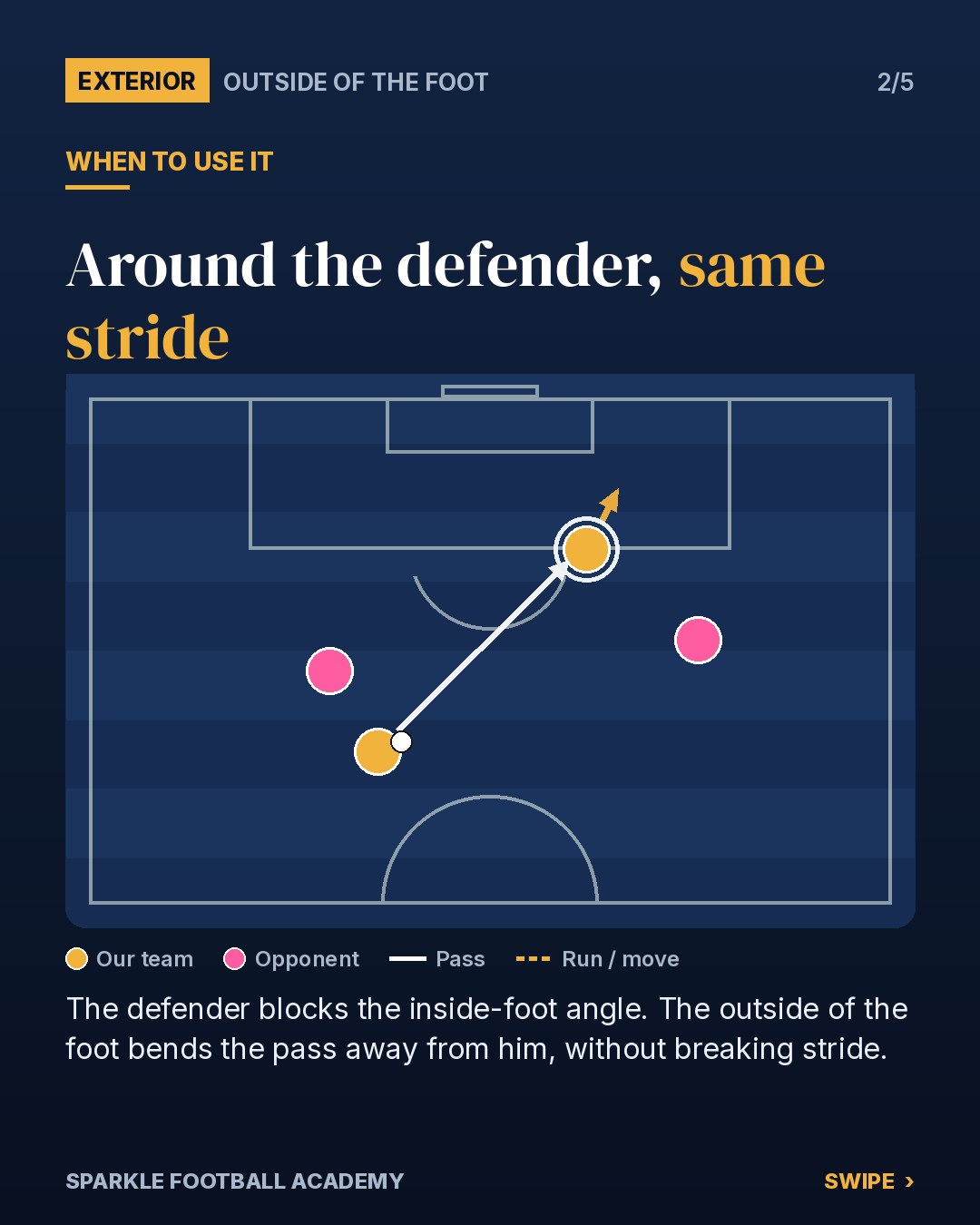
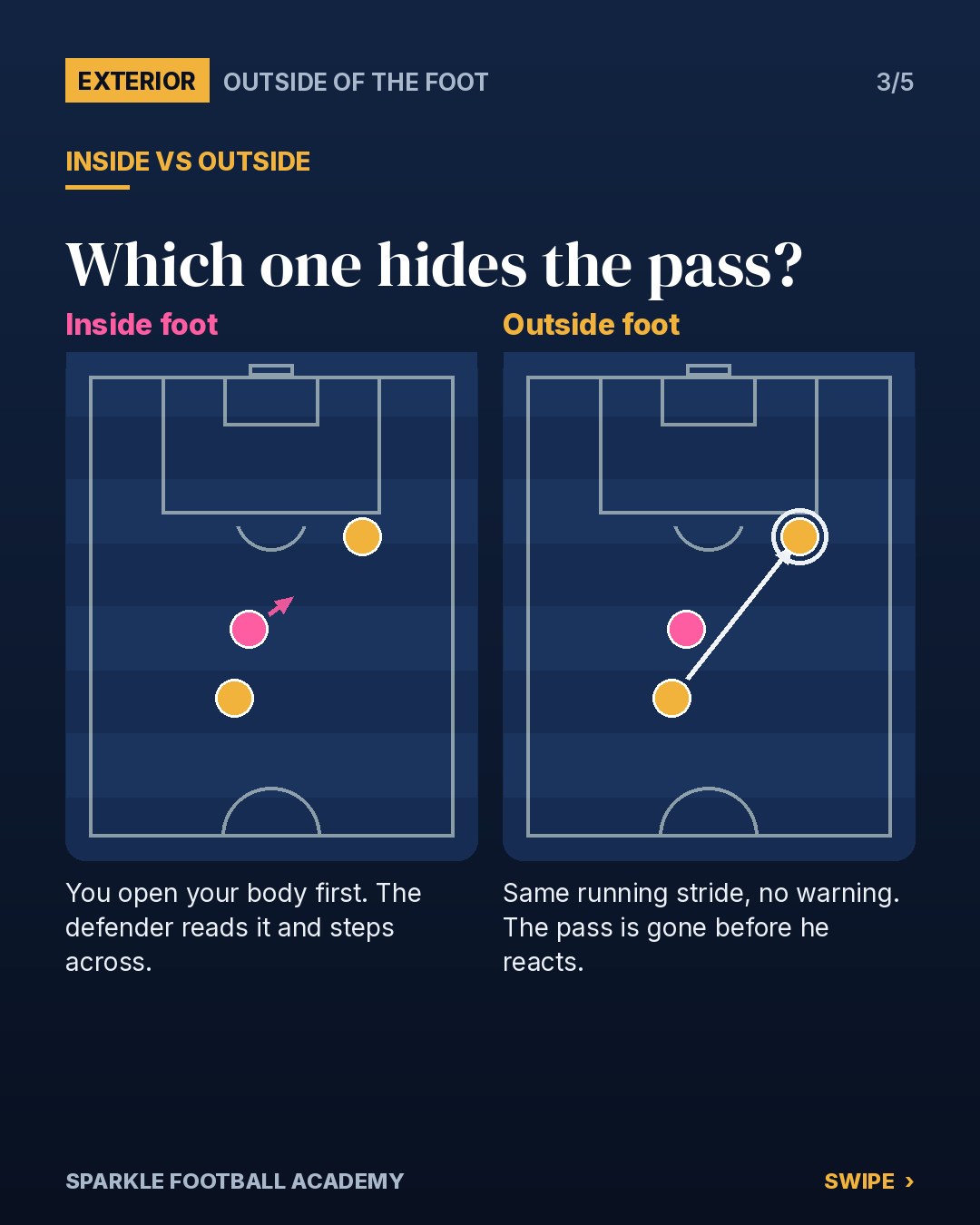
To pass with the inside of the foot you usually have to open your hips and turn your body toward the target. A good defender reads that and steps across. With the outside of the foot you can pass while running in a straight line, without changing your body shape. That means:
- No warning for the defender.
- No lost stride, so you keep your speed.
- A pass that bends around a defender instead of through him.
It works best alongside a solid inside-foot game. If your players are still building that, start with our guide to the driven pass.
When to use the outside of the foot pass
The best moment is when a defender is blocking the angle for an inside-foot pass. Instead of stopping and turning, you keep running and bend the ball away from him into a teammate’s run. It’s also useful for crosses on the run and for short passes in tight spaces when there’s no time to set your body, for example right after a half-turn in midfield.
Luka Modrić is the classic example in the modern game: he uses the outside of his foot so often that it’s simply part of how he passes. (We mention him as an illustration only; he has no affiliation with our academy.)
Outside of the foot vs inside of the foot
- Inside of the foot: the most accurate pass, best when you have time to set your body and the lane is open.
- Outside of the foot: faster and disguised, best when you’re running at speed or a defender is blocking the straight lane.
- The rule we teach: inside foot by default, outside foot when it saves you a touch or beats a defender’s angle.
How to strike the ball with the outside of the foot
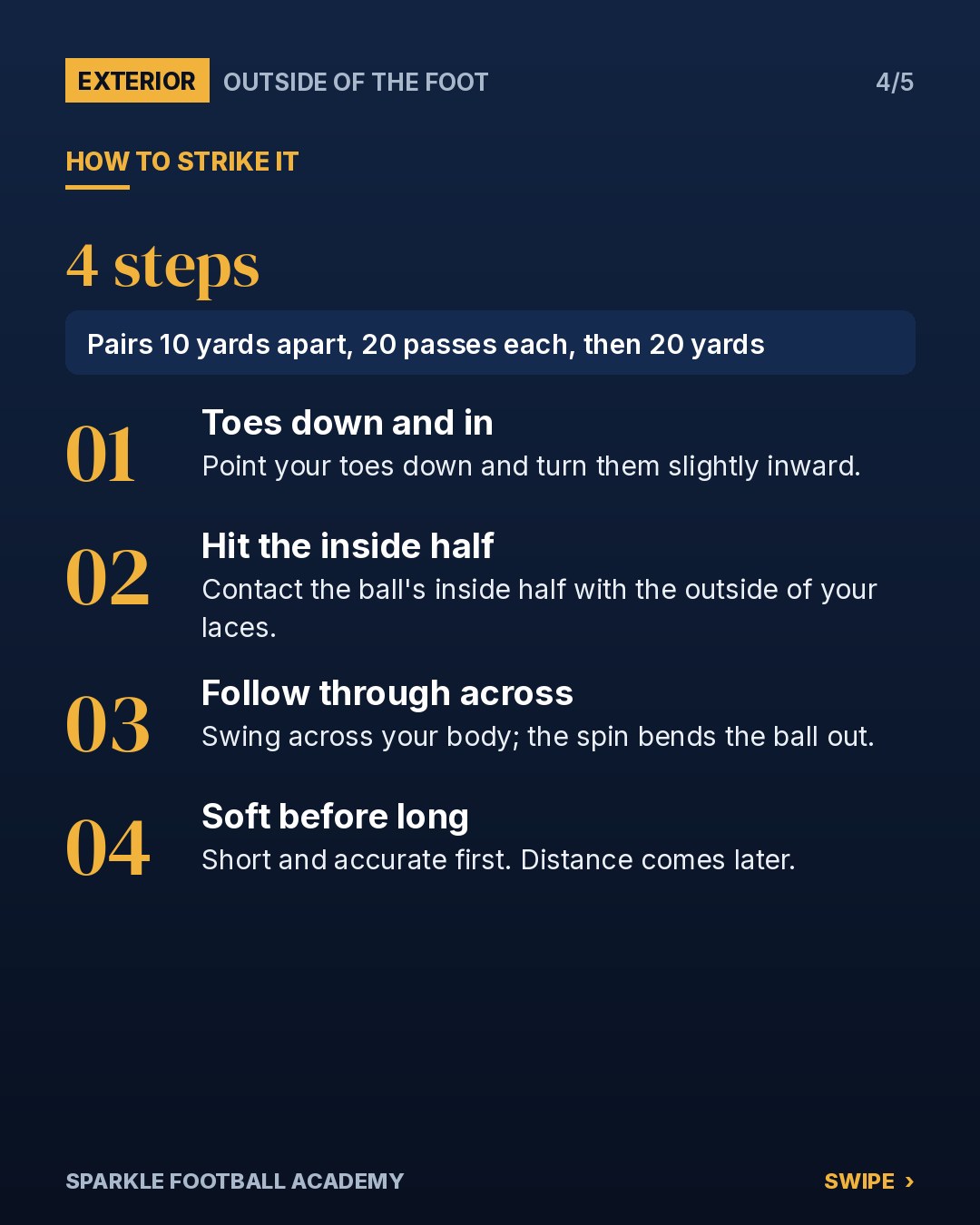
- Toes down and in. Point your toes down and turn them slightly inward so the outside of your laces faces the ball.
- Hit the inside half. Make contact on the half of the ball closest to your standing leg.
- Follow through across your body. Swing across, not straight through. The spin is what bends the ball out.
- Soft before long. Short, accurate passes first. Distance comes later.
Outside of the foot pass drills for youth players
- Wall passes: stand 5 to 10 yards from a wall and play 20 outside-foot passes with each foot.
- Partner passing: pairs 10 yards apart, then 20 yards once the passes are accurate.
- Bend around a cone: put a cone between you and your partner and bend the pass around it.
- On the move: dribble toward a cone and release the pass without breaking stride.
A 15-minute outside of the foot session
- Minutes 0 to 5: wall passes, 10 with each foot, then switch feet every pass.
- Minutes 5 to 10: partner passing around a cone, both feet, counting how many reach the partner cleanly.
- Minutes 10 to 15: dribble at a cone and pass to a partner on the run, then finish with a one-two to keep it game-like.
Common mistakes
- Hitting it with the toe instead of the laces, which makes the ball wobble.
- Trying to hit it hard too early. Accuracy first.
- Using it when a simple inside-foot pass is on. It’s a tool for the right moment, not a habit to show off. The same is true of skills in 1v1 dribbling: the move only matters if it solves a problem.
For parents: is the outside of the foot pass worth practicing?
Yes, once your child is comfortable with basic inside-foot passing. Learning to use different surfaces of the foot builds better ball feel and gives players more options under pressure. Encourage short, regular practice (ten minutes against a wall is plenty) and praise good decisions, not just fancy passes.
FAQ
What age should kids learn the outside of the foot pass?
Once a player can pass accurately with the inside of both feet. For many players that comes after a few seasons of regular practice, but readiness matters more than age.
Is the trivela only for long passes and shots?
No. Most outside-foot passes in a game are short, 5 to 15 yards, played on the run.
Should players practice with both feet?
Yes. Two-footed players have more passing angles, and the outside of the weaker foot is a great way to build confidence on that side.
Learn it with Sparkle Football Academy
We build two-footed players who can pass with every surface of the foot and know when to use each one. Book a free trial session through our contact form and see how we coach technique through real game situations in Burnaby and Vancouver.