Looking for a crossing and finishing drill that actually looks like a game? Most youth sessions still run the classic version: one winger, one cross, one striker, one shot, and then everybody stands in line for two minutes. Real crosses are nothing like that. In a match, a cross is attacked by three players arriving at three different heights at the same time, with a defender on each of them. This article explains our favorite fix: remates de centros in waves, the crossing and finishing drill we run every Thursday at Sparkle Football Academy, and how you can set it up in ten minutes on any field.
Why the classic crossing and finishing drill fails
Count the touches. In a single-file crossing drill, a player might get four crosses and four finishes in fifteen minutes. The rest of the time is spent walking back, waiting, and cooling down. Worse, the picture is wrong: the striker arrives alone, unmarked, with the whole box to himself. He never has to time a run against a teammate, never has to pick a zone, and never has to attack a ball on the move. Then Saturday arrives and the same player stands still at the penalty spot while the cross sails over his head.
Good drills reward the behaviors the game rewards. For crosses, those are timing, zone selection, and attacking the ball while moving. Waves train all three at once.
The setup: two crossers, three runners, one keeper
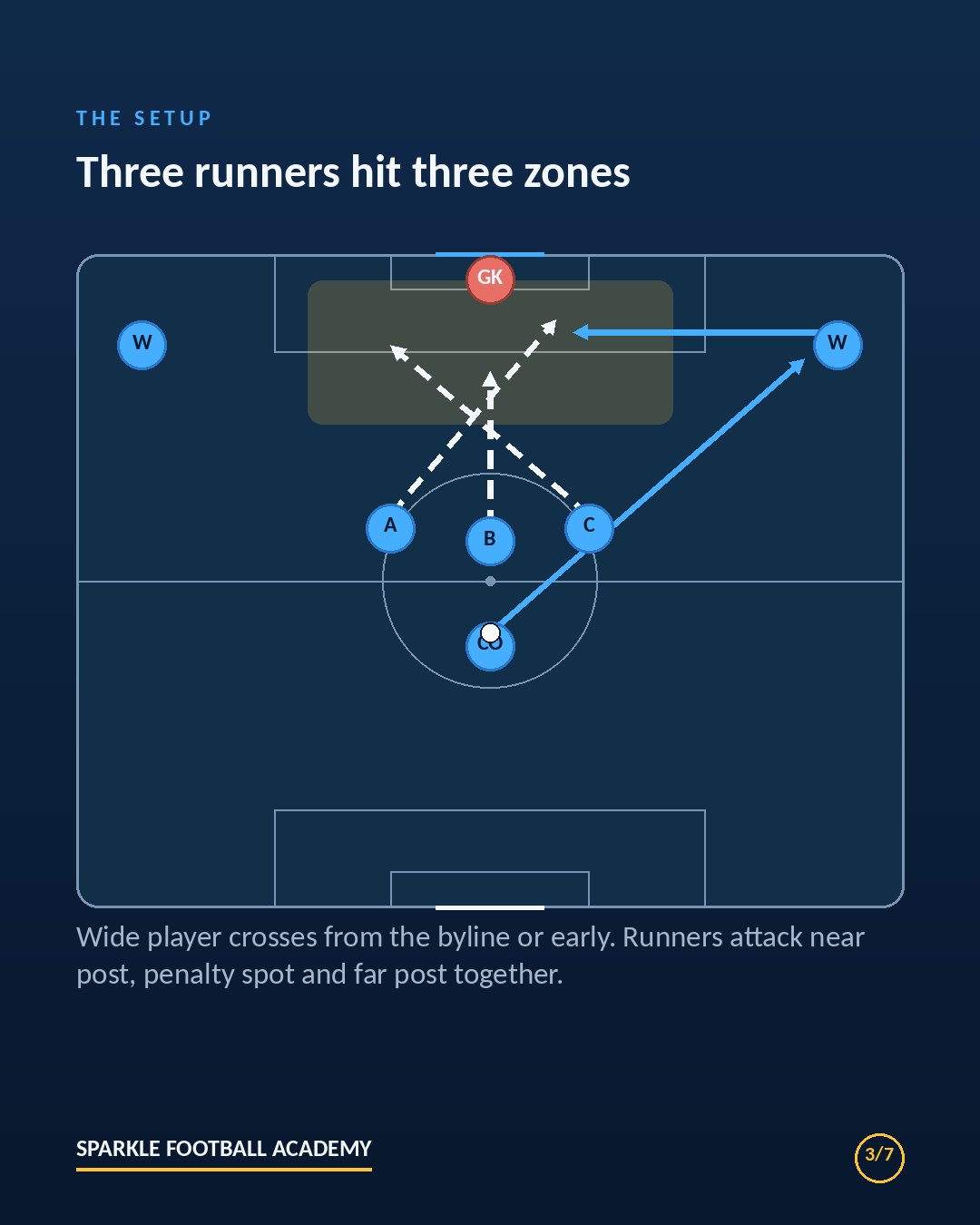
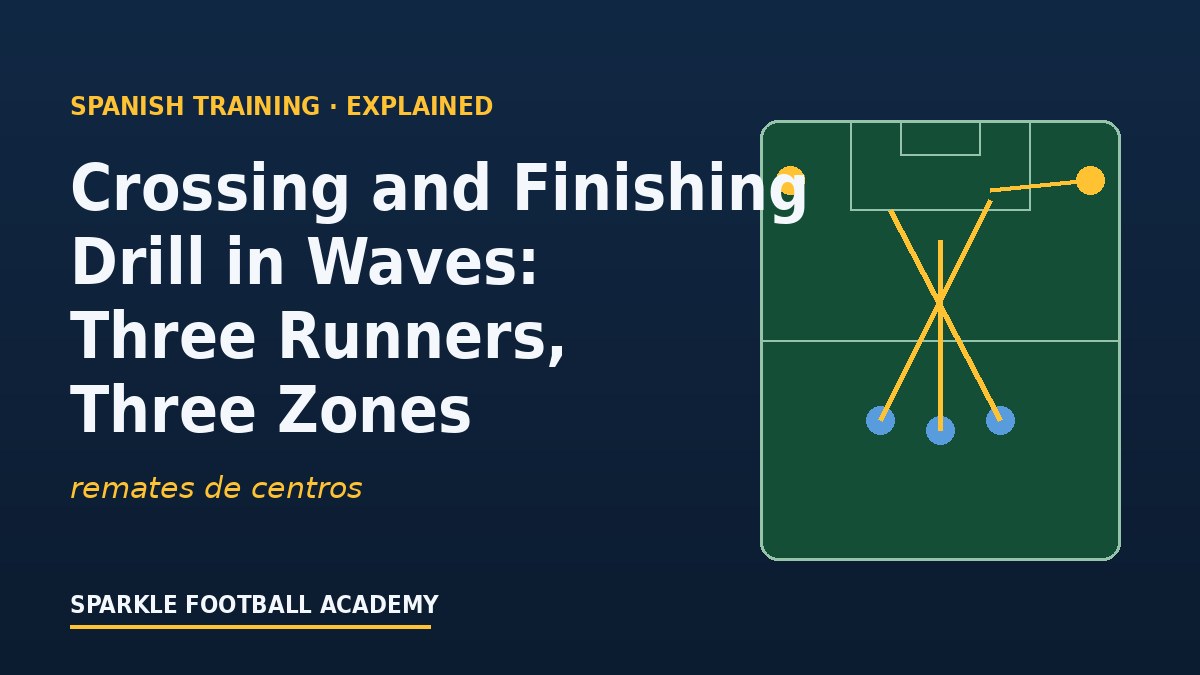
You need a goal, a goalkeeper, a supply of balls, and eight to twelve players. Place one crosser on each wing, level with the edge of the box. Put three attackers on the edge of the center circle, about 25 yards from goal. The coach stands with the balls just outside the D.
- The coach plays a firm pass to one wide player.
- The wide player either drives to the byline and pulls the ball back, or clips an early cross from deeper. Both are allowed; the crosser decides.
- The three runners go the moment the pass leaves the coach. Runner A attacks the near post, runner B the penalty spot, runner C the far post.
- One touch to finish, or a control and a shot if the ball is behind them. Then the next three are already moving on the coach’s next pass.
That is one wave. Run the left side, then the right side, 90 seconds on and 30 seconds off. Rotate the crossers every two blocks so wingers also learn to finish and strikers also learn to deliver.
The rules that do the coaching
A drill is only as good as its constraints. These four rules turn a shooting exercise into a crossing and finishing drill that transfers to matches.
- Never the same zone twice. Runners rotate A, B, C every wave. Every player learns every arrival point.
- Arrive as the ball arrives, not before. If a runner is standing in the box when the cross is struck, the wave does not count. This is the single most important habit in finishing from crosses.
- Crossers pick a zone before they strike. A cross without a target is a clearance for the other team. We ask the crosser to call “near,” “spot,” or “far” in the first week, then to do it silently.
- Keep moving between waves. Players jog back to the start, not walk. The keeper works every ten seconds, which is exactly why goalkeepers love and hate this drill.
What players learn from waves
The numbers are the first thing coaches notice: 20 crosses in 10 minutes per player instead of four. But the real gain is in the picture. Three players arriving together teaches spacing without a whiteboard. If runner B drifts to the near post, he crashes into runner A and the wave breaks down. Within one session, players start checking where their teammates are going. That is the same scanning habit we build in our first touch work and in every rondo.
The crossers learn something too. A byline cut-back to the penalty spot is a different pass from an early clipped ball to the far post, and each one needs a runner who is expecting it. When the same three attackers see both deliveries every wave, they start reading the crosser’s body shape: hips open early means the early ball is coming, head down and driving means wait for the byline.
Progressions: making it look like Saturday
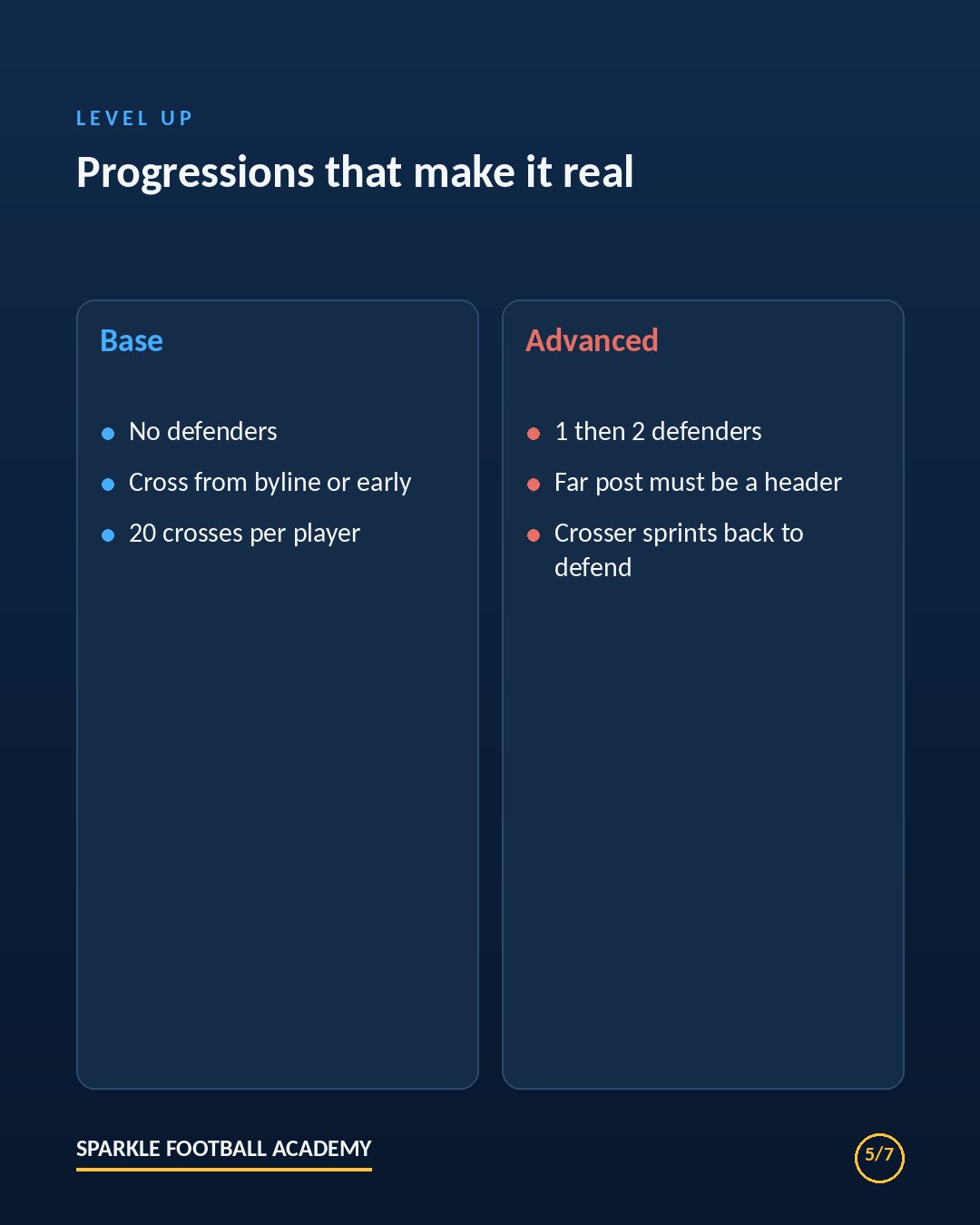
Run the base drill for two sessions before you change anything. Then add one constraint at a time.
- Add one defender, then two. Now the runners have to lose a marker with a change of pace or a short double movement. This is where the timing rule pays off: a runner who arrives early is easy to mark.
- The far-post runner must score with a header. Simple, and it forces the crosser to lift the ball when the far runner is the target.
- Whoever crosses must sprint back and defend the next wave. This is the one that makes it a game. The winger delivers, turns, and recovers as the next wave attacks. Transition, fitness, and finishing in one exercise, the same idea behind our 4v4+4 pressing game.
- Finish with a combination. Let the wide player use a one-two with the coach or a third-man run from a runner before crossing. The box now has to re-time its arrival.
Coaching points for each zone
Near post (runner A): attack the space in front of the first defender, get across him, and glance the ball with the inside of the foot or forehead. Near-post finishes are about beating the defender to the ball, not power.
Penalty spot (runner B): this is the cut-back zone. Stay on the edge of the six-yard box until the crosser reaches the byline, then arrive facing the goal with the ball rolled back low. Side-foot, low, across the keeper.
Far post (runner C): the far post is the most under-defended area on any cross. Start wide, stay wide, and attack the ball on the move. If the cross is high, head it down and back across goal. If it is low, one touch.
Age groups and how to adapt the drill
For under-9 and under-10 players, shrink everything: a smaller goal, crossers 15 yards from goal, and just two runners. Take out the header rule. Focus on arriving on time. For under-12 and up, run the full version and add defenders by the third session. For teenagers, this becomes a fitness block: four sets of 90 seconds per side with a recovering crosser is a serious workout, and technique under fatigue is exactly what the last fifteen minutes of a match demands.
The drill also fits neatly after any small-sided game: play 4v4 for fifteen minutes, then spend ten minutes on waves so the crosses the players just attempted get twenty more repetitions.
For parents: what to watch for on the sideline
If your child is a striker or winger, watch when they start their run on a cross. Early is the most common mistake in youth soccer. A player who arrives at the same time as the ball, even if the cross is poor, is doing the hard part right. Encourage the run, not the goal. And if your child is a wide player, ask them after the game which zone they were aiming for on each cross. If the answer is “I just crossed it,” this drill is the fix.
Crossing is also one of the safest ways to learn heading. The far-post header in this drill is a soft, glanced contact from a short distance with no opponent, which is how we introduce heading at Sparkle before any duels.
Key takeaways
- Train crosses the way they happen: three runners, three zones, at the same time.
- Never the same zone twice, and arrive as the ball arrives.
- Progress with defenders, a far-post header rule, and a recovering crosser.
- Twenty crosses per player in ten minutes beats four in fifteen.
Train with Sparkle Football Academy
Waves are one small block of a Sparkle session, and every block is built the same way: a game-real picture, a rule that does the coaching, and enough repetitions that the habit shows up on Saturday. If you are in the Vancouver area and want your child to train like this, book a free trial session and come watch a Thursday finishing block. Bring ear plugs for the keeper.