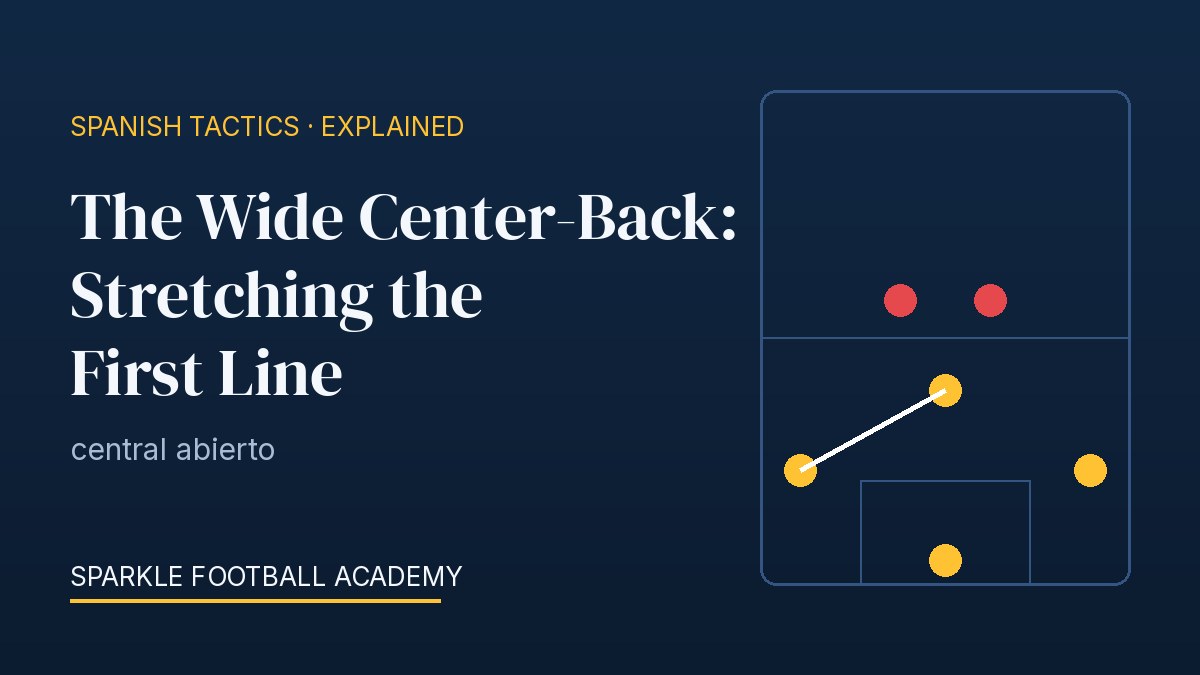
Wide center-back explained simply: when your two center-backs split to the edges of the penalty box, the opponent’s first line of pressure has to stretch, and somebody on your team ends up free. That one idea, the central abierto, is how Spanish academies teach kids to play out from the back without panic.
If your team keeps losing the ball in its own half, or your keeper keeps booting it long because there’s no safe pass, this is usually the first thing to fix. It costs nothing, it works at every age from U10 up, and players feel the difference in the very first session.
What Is a Wide Center-Back?
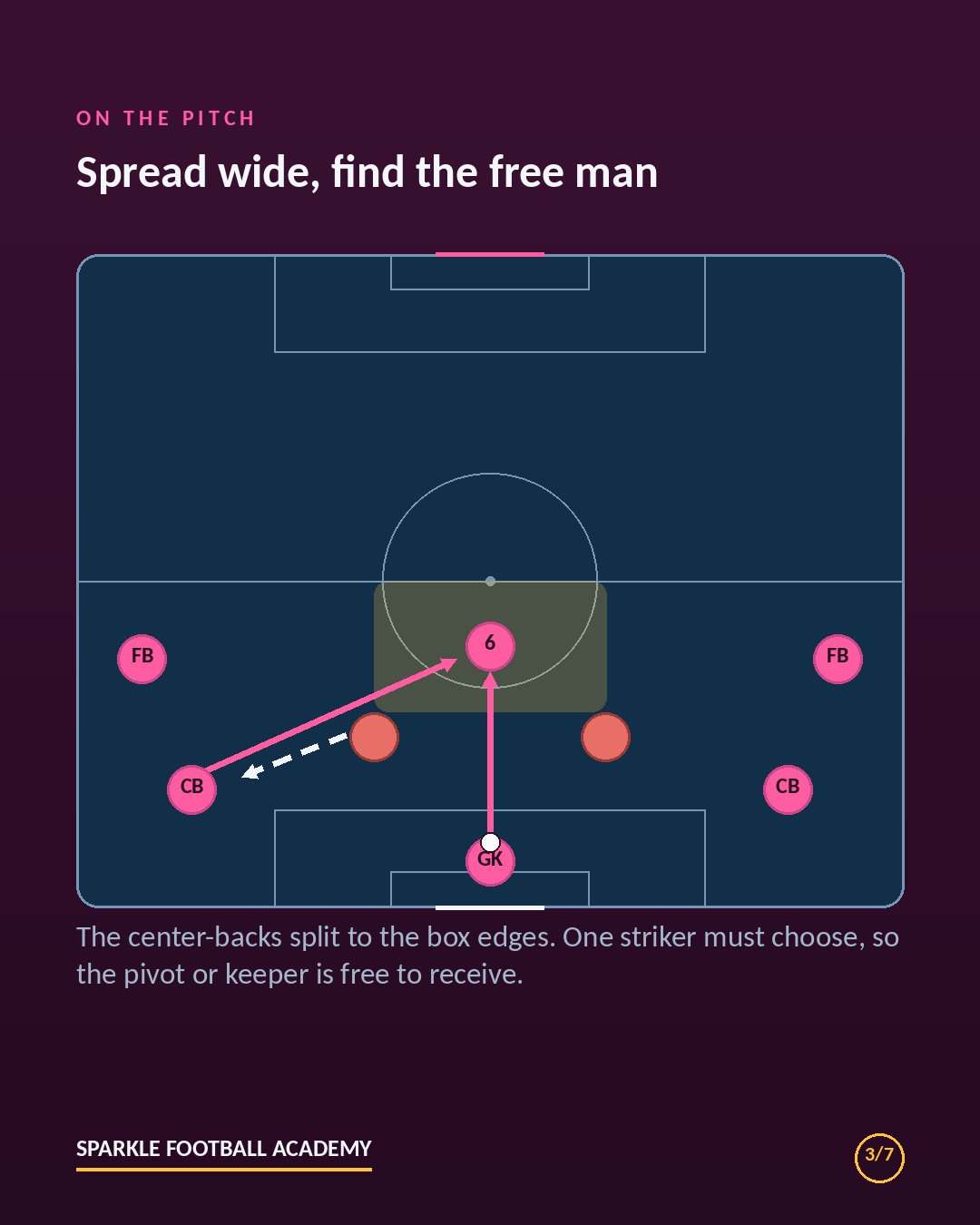
A wide center-back is simply a center-back who steps out toward the sideline instead of standing next to his partner. When your goalkeeper has the ball, the two center-backs move to the corners of the penalty area, roughly 25 to 30 yards apart. The keeper becomes the middle player of a back three, and the defensive midfielder (the pivote) drops into the space in front of them.
In Spain coaches call this player a central abierto, an “open” center-back. The word matters: he is open to the field, side-on, ready to receive and play forward, not standing square next to his partner waiting for a long ball.
Why the Wide Center-Back Stretches the First Line
Think about the opponent’s two strikers. If your center-backs stand shoulder to shoulder, two strikers can cover both of them and still block the pass into your pivot. The press feels easy for them and impossible for you.
Now spread your center-backs to the edges of the box. The gap between them is too big for two strikers to cover and still guard the middle. Each striker has to choose:
- Press the center-back with the ball. Then the pass into the pivot or back to the keeper opens.
- Stay central to block the pivot. Then the wide center-back has time to carry the ball forward or pass into midfield.
- Try to do both. That’s the moment a wide center-back loves, because the striker arrives late and off balance.
Whatever he chooses, somebody is free. The whole job of the first pass is to find that free player, then play forward. This is the same logic behind building up from the back: create a numerical edge in your own half so the ball can move forward safely.
Tight Center-Backs vs Wide Center-Backs
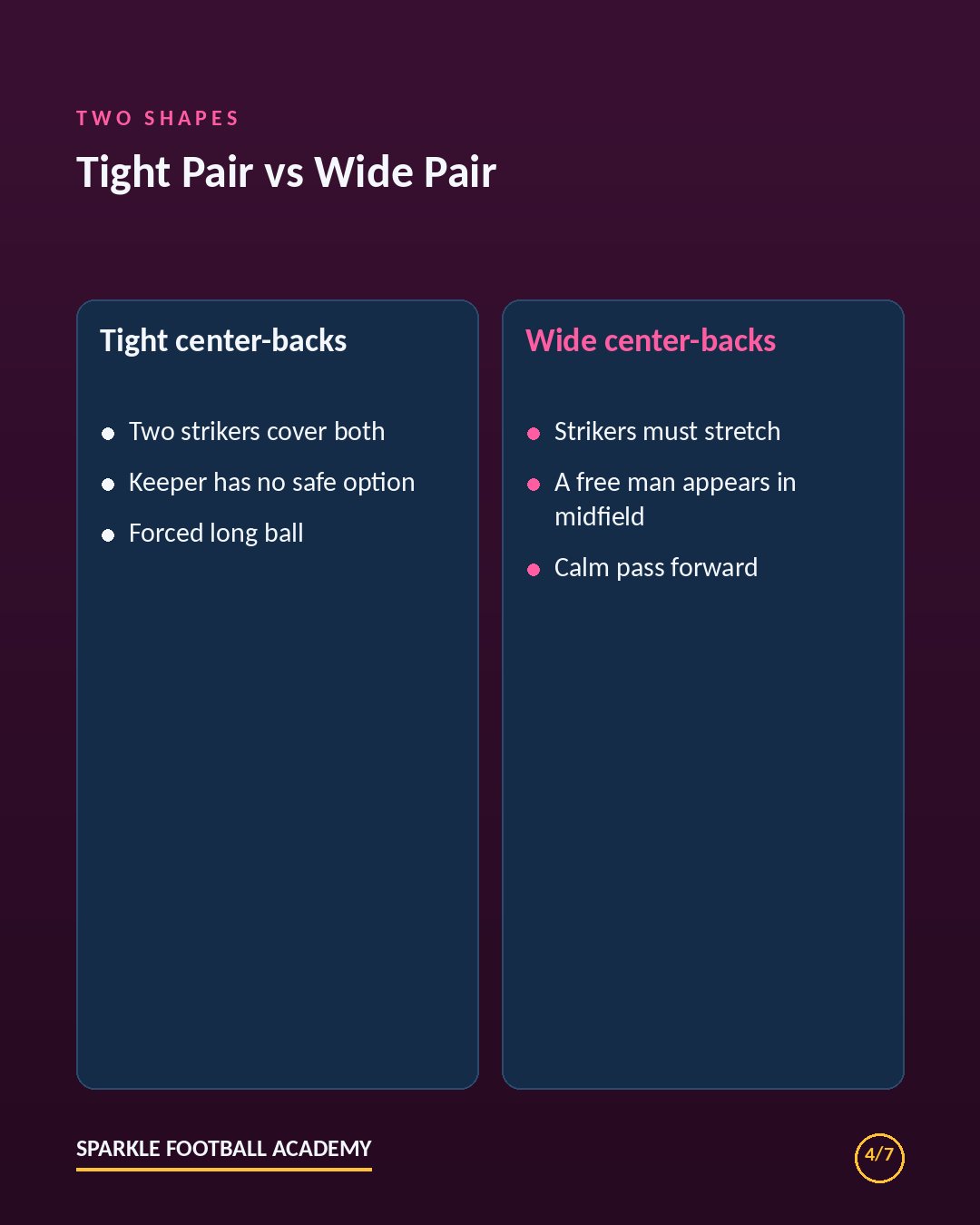
Here’s the difference in one line. Tight center-backs make the striker’s job easy; a wide center-back makes him choose. With a tight pair, two strikers cover both defenders, the keeper has no safe option, and the team is forced into a long ball. With a wide pair, the strikers must stretch, a free man appears in midfield, and the ball comes out on the ground with a calm pass forward.
The Wide Center-Back’s Three Habits
Positioning is half of it. The other half is what the wide center-back does once he gets there. We teach three habits.
- Step wide early. As soon as your keeper has the ball, move toward the corner of the box. Waiting until the striker is already on you is too late.
- Open your body. Stand side-on so you can see the keeper and the field at the same time. Receiving square-on means your first touch goes backward. We cover the same idea in our guide to receiving on the half-turn.
- Read the striker. If he follows you wide, the middle is open: play into your pivot. If he stays central, drive the ball up the side with your first touch.
How the Pivot and Keeper Help
A wide center-back never works alone. The goalkeeper has to be comfortable receiving and passing, because he is now the middle player of the first line. And the number 6 has to show for the ball in the gap between the two strikers, constantly adjusting so there is always a passing lane to him.
When those three players move together, the opponent is outnumbered three against two in your own half. That small edge is what lets young teams keep the ball under pressure instead of guessing.
A Simple Drill to Teach the Wide Center-Back
At Sparkle we start with a 4v2 build-up game. It’s simple to set up and players feel the extra time right away.
- Setup: goalkeeper, two center-backs and a pivot against two strikers, in the defending third. Two small target gates on the halfway line.
- Rule: the center-backs must start outside the lines of the penalty area every time the keeper has the ball.
- Goal: the build-up team scores by dribbling or passing through a gate. The strikers score by winning the ball and shooting.
- Progression: add a third striker so the build-up team has to solve 4v3, then add a fullback on each side.
After every rep ask one question: who was free, and did we find him? That question does more teaching than any whiteboard. If your players struggle against aggressive pressing, our article on beating a high press builds on the same ideas.
Common Mistakes With the Wide Center-Back
- Going wide but staying flat. If the center-back stands on the same line as the keeper, the angle for the pass is poor. Drop slightly deeper or step slightly higher so the passing lane is open.
- Receiving and passing straight back. The point of going wide is to play forward. If the striker stays in the middle, drive up the side.
- Panicking under pressure. When it is genuinely closed, a calm pass back to the keeper to restart is fine. A rushed long ball isn’t.
For Parents: What to Watch For
If your child plays center-back, watch the moment your keeper picks up the ball. Does your child move toward the corner of the box, or stay next to the other center-back? Does he or she look over a shoulder before the pass arrives? Those two small habits are better signs of progress than any long clearance. Playing out from the back takes courage, and mistakes in training are part of learning it.
Learn the Wide Center-Back at Sparkle Football Academy
The central abierto is one of the first ideas we teach in our Spanish positional-play program, because it gives young defenders confidence on the ball. Want your player to learn it on the field, not just on a screen? Book a free trial session at Sparkle Football Academy in Burnaby and Vancouver.