How do you receive the ball on the half-turn in soccer? You open your body before the pass arrives, so your first touch takes you forward instead of back toward your own goal. That one habit is the difference between a midfielder who keeps the game moving and one who keeps passing it backward. In Spain coaches call it recibir orientado: receiving already oriented toward where you want to go next.
If you have ever watched a youth game where every pass into midfield comes straight back to the center-backs, you have seen the problem the half-turn solves. This guide breaks down what the half-turn in soccer is, why it matters for possession play, and how we teach it to young players at Sparkle Football Academy.
What Is the Half-Turn in Soccer?
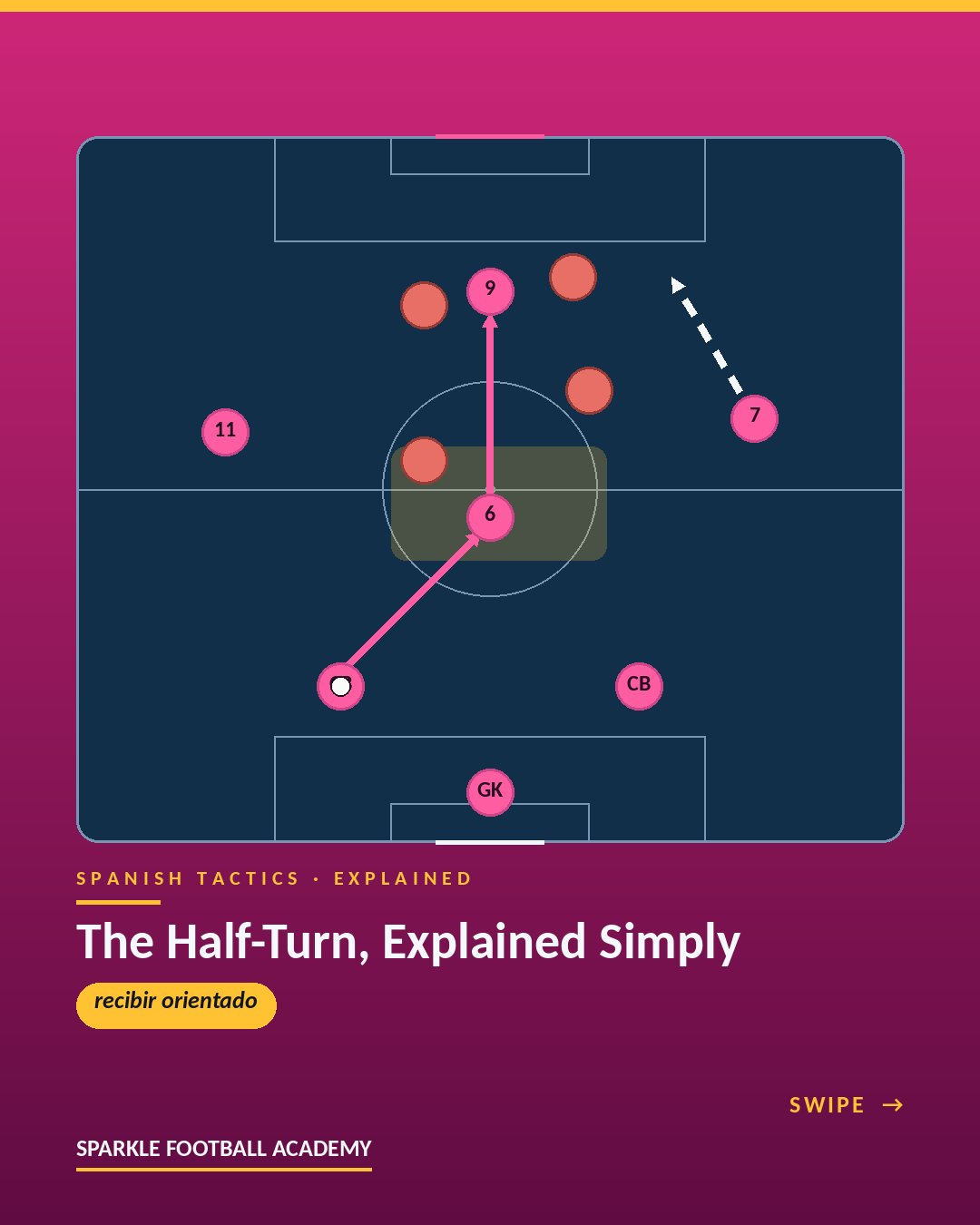
The half-turn is a way of standing and receiving. Instead of facing the passer square-on, with your back to the field, you stand side-on, at an angle, so you can see the ball and the space ahead at the same time. When the pass arrives you let it run across your body and take it with your back foot, the foot farthest from the passer.
The result: after one touch you are already facing forward. You can play through the lines, switch the play, or carry the ball into space without wasting a second turning around.
Why the Half-Turn Matters for Possession Play
Good possession play is not about how many passes you make. It is about how many passes go somewhere useful. A player who receives square-on almost always has to play backward or sideways, because the defender is closing from behind and they cannot see what is in front of them.
The half-turn changes the math. When the receiver faces forward, the opponent has to respect a forward pass. Defenders drop, gaps appear between the lines, and the team can actually progress. It is one of the simplest ways to beat a high press without kicking it long.
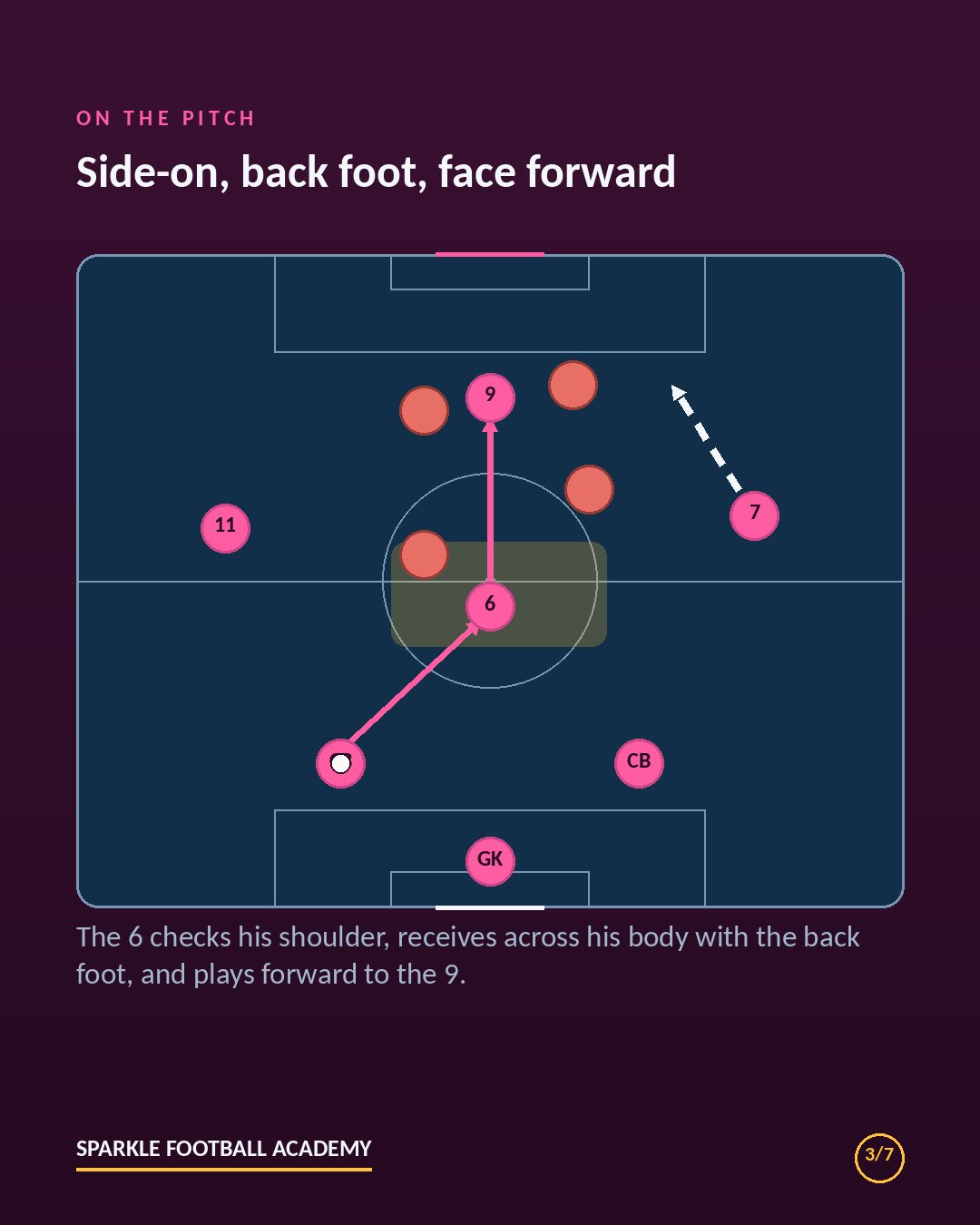
How to Do the Half-Turn: Step by Step
- Scan early. Check your shoulder before the ball is played, not after. You need to know where the pressure is coming from.
- Get side-on. Open your hips at roughly 45 degrees to the passer, so you can see the ball and the field ahead.
- Let the ball run. Do not stop it dead in front of you. Let it travel across your body.
- Receive with the back foot. Use the foot farthest from the passer so your first touch moves you forward.
- Play or drive. Your second action should go forward: a pass through the lines, a switch, or a carry into space.
If you want to build the touch itself first, our guide to the first touch in soccer covers the basics of cushioning and directing the ball.
Half-Turn vs Square-On: What Changes
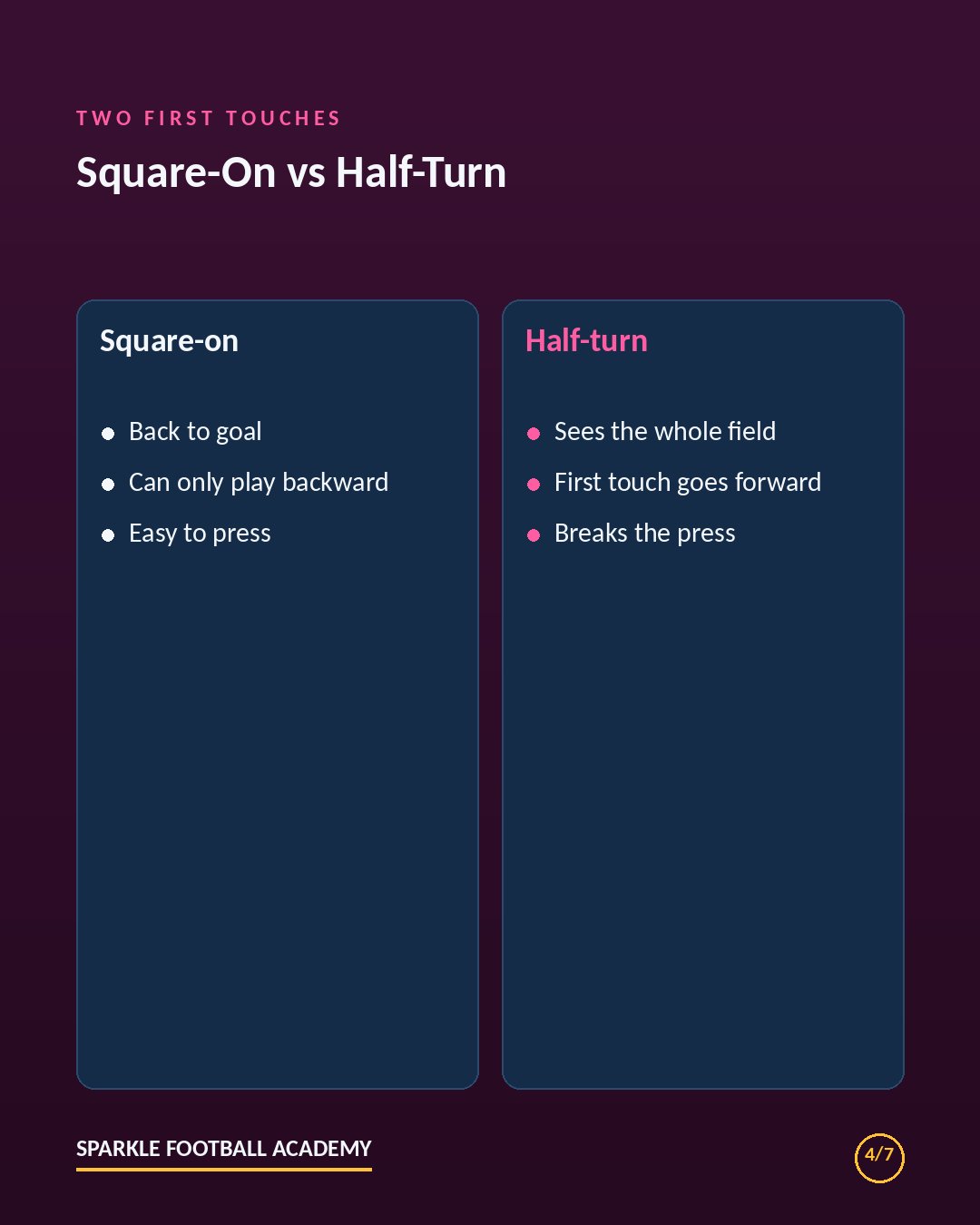
A square-on receiver has one safe option, which is back. A half-turned receiver has three or four. That is why top midfielders, especially the number 6, seem to have more time on the ball. They are not faster. They simply set their body up before the ball arrives.
Common Mistakes Young Players Make
- Checking the shoulder too late, after the ball is already on its way.
- Standing flat-footed and square, then trying to spin with the defender on their back.
- Receiving with the front foot, which stops the ball and turns them back toward the passer.
- Turning into pressure when the scan showed a defender was right there. Sometimes the right answer is still the simple pass back.
That last point matters. The half-turn is a decision, not a trick. Players should learn to read whether there is time to turn, and choose the safe pass when there is not.
How We Coach the Half-Turn at Sparkle
We teach recibir orientado inside games, not in lines. In rondos and 4v4+3 possession games we add one rule: a pass only counts if the receiver’s first touch goes forward. Players quickly learn to scan, open up and receive across their body because that is how they score points. When a team is man-marking tightly, the same habit lets a midfielder spin away from the marker the moment the ball arrives.
For Parents: What to Look For
You do not need to know tactics to spot the half-turn. Watch your child just before they receive a pass. Do they glance over their shoulder? Do they stand at an angle, or flat with their back to the other goal? After the first touch, are they facing forward? Those three small things tell you more about a young midfielder’s development than goals or assists. Praise the scan and the open body, even when the pass that follows does not come off.
Try It at Sparkle Football Academy
Want your player to stop passing backward and start playing forward with confidence? Our sessions build habits like the half-turn into every game we play. Book a free trial session at Sparkle Football Academy and see how much more of the field your child can see.