Attacking corners explained simply: most youth corners end the same way. Everyone sprints at the ball, every defender follows their player, and the cross drops into a crowd. Then the keeper claims it, and the chance is gone. The best set-piece teams in the world do something different. They pick one target, give everyone else a job, and use legal screens and decoy runs so that one player arrives in space. In Spain this idea is often described as bloqueos en el córner. This guide explains how it works, why it works, and how young players can practice it.
Why most youth corners waste the chance
A corner kick is one of the few moments in a game where the attacking team gets to set everything up in advance. The ball is still, the players can take their positions, and the taker can choose exactly where to aim. Yet at youth level corners often turn into a lottery. There are three common problems:
- No clear target. Five players attack the same space, so the ball lands where nobody has the best jump.
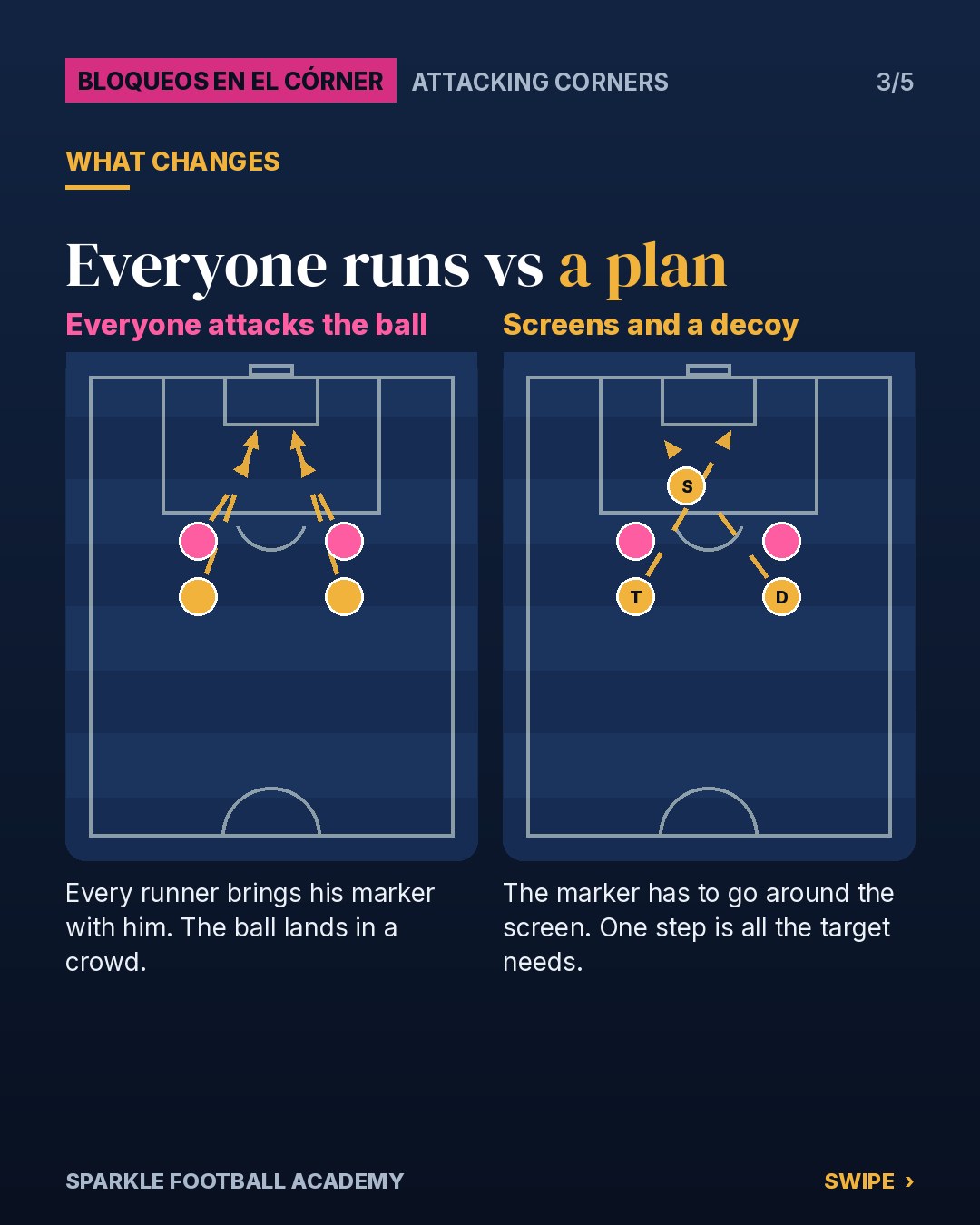
- Every run brings a marker. If you run straight at the ball, your defender simply runs with you.
- Nobody thinks about the second ball. When the first header is cleared, there is nobody waiting at the edge of the box.
Good attacking corners solve all three. They decide in advance who the ball is for, they make it hard for that player’s marker to follow, and they keep someone ready for the clearance.
Attacking corners: the three roles
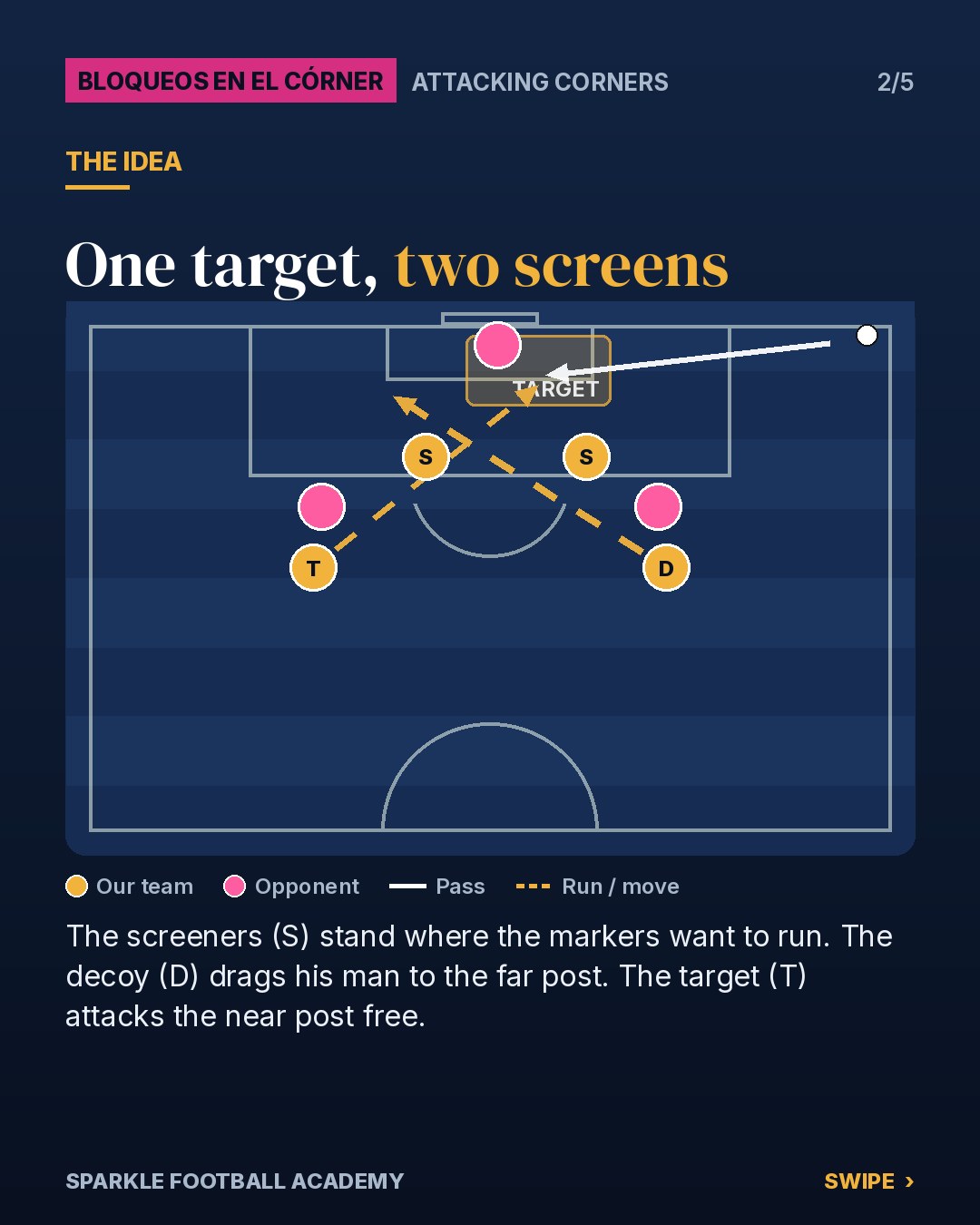
You can build almost any corner routine from three roles. Once players understand them, you can rotate who does what from week to week.
1. The target
The target is the player the ball is for. Usually this is your best header of the ball, but it can also be a player who is good at reaching the near post first. The target starts away from the zone they want to attack, usually a few yards behind the screens, and only moves on the signal.
2. The screeners
A screener stands in the path the marker needs to take. They do not grab, push or hold. They simply occupy the space early so the defender has to go around them. That one extra step is often all the target needs to win the header.
3. The decoy
The decoy makes a strong run to a different zone, usually the far post, to pull a defender with them. A good decoy run looks exactly like a real one. If the defenders ignore it, the decoy may end up free at the back post anyway.
How screens work in attacking corners (and how to keep them legal)
Screening is about position, not contact. The screener takes their spot before the ball is kicked, faces the ball and stands their ground. If the marker runs into them, that is the marker’s problem. The moment a screener grabs a shirt, pushes with the arms or steps across to block a defender who is already past them, it becomes a foul and the referee can award a free kick to the defending team.
For young players, the simple rule is: get there first, stand still, keep your hands down. This keeps the routine fair and keeps players safe. Teams that practice this well rarely need contact at all.
Timing: the signal that makes it all work
The screens and runs only work if everyone moves together. Most teams use a simple signal from the taker: an arm raised, a hand on the head, or a short word. On the signal, the target and the decoy start their runs at the same moment, and the taker strikes the ball into the target zone as the target arrives.
Arsenal’s Gabriel Magalhães is a good example of a target who benefits from this kind of teamwork. His timing is excellent, but the movement of his teammates around him often gives him the half yard of space he needs to attack the ball.
Which zone should the target attack?
For most youth teams the near post is the best first choice. An in-swinging or driven ball to the near post is hard for keepers to claim and a small flick can redirect it into the goal. As players get stronger and the taker’s delivery improves, you can add a far-post option or a penalty-spot option, with the decoy and target simply swapping roles.
A simple corner drill for youth teams
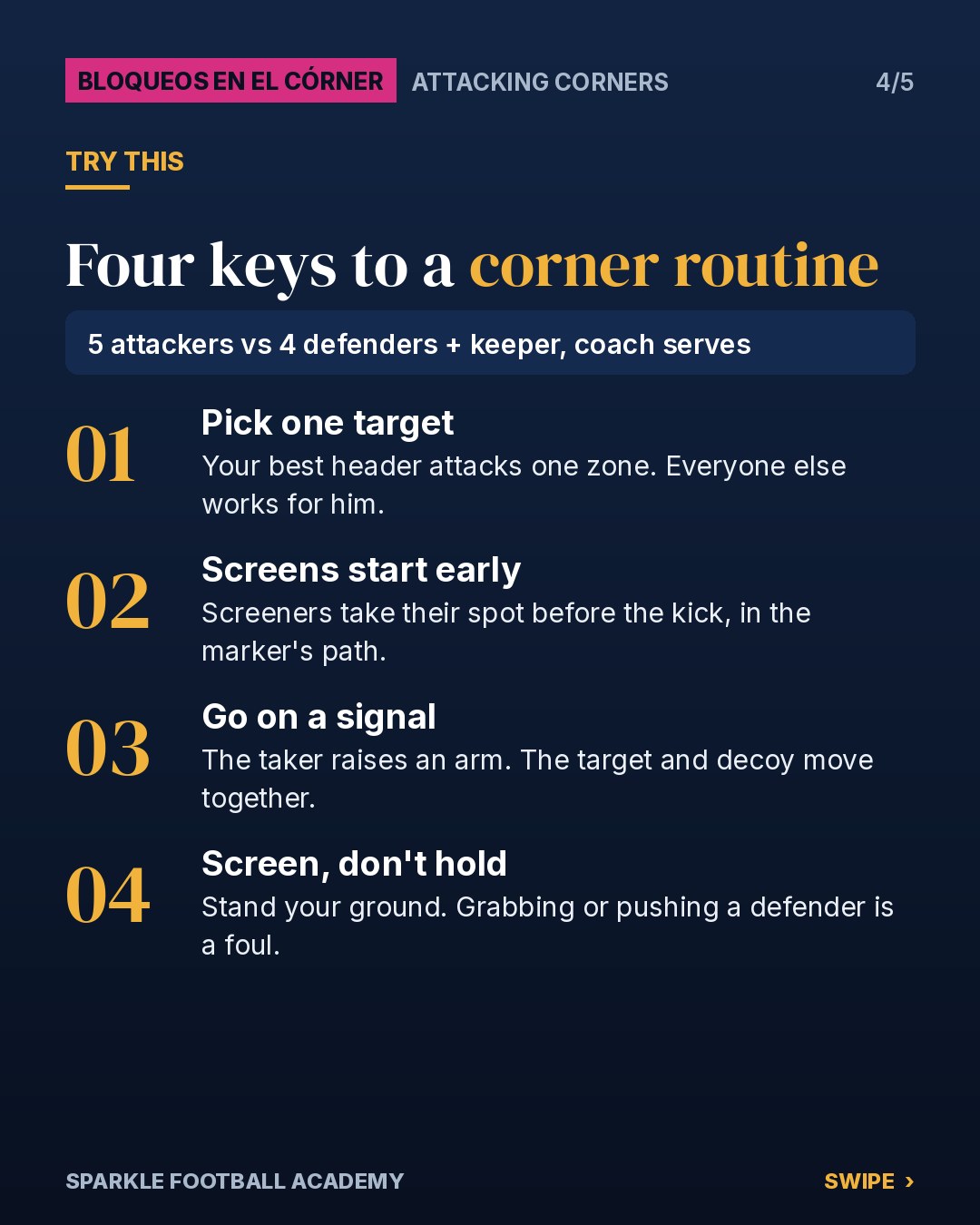
Setup: 5 attackers against 4 defenders and a keeper, with a coach or player serving from the corner. Use a full-size or small goal depending on age.
- Walk it through first. Place the screeners and the target with no defenders. Show the run and where the ball should land.
- Add passive defenders. Defenders follow their player at walking speed so the attackers can feel how the screen works.
- Go live. Ten corners, then switch roles. Count how many times the target gets a clean contact on the ball.
- Add the second ball. Put one attacker on the edge of the box to win or shoot from any clearance.
Small-sided games like this give every player many more repetitions than a full scrimmage. You can read more about that idea in our guide to small-sided games.
How this connects to the rest of the game
Corner routines teach the same habits that help in open play: moving to create space for a teammate, timing runs together, and attacking a zone instead of chasing the ball. Those ideas show up again when you play against a man-marking team or try to break down a low block, where defenders are packed close to their own goal just like on a corner.
For Parents
If your child plays on a youth team, watch the next corner closely. Does everyone run at the ball, or does each player seem to have a job? Corners are a great place to see whether a team is being coached on decisions, not just effort. You can also help at home: ask your player what their job is on corners. If they can explain it, they understand it. And remember, the screener and the decoy are just as important as the player who scores.
Key takeaways
- Pick one target and one zone for each corner.
- Screeners take their spot early, in the marker’s path, and keep their hands down.
- A decoy run to the far post pulls a defender away.
- Use a clear signal so the target and decoy move together.
- Always have someone ready for the second ball.
Train it with Sparkle Football Academy
At Sparkle Football Academy we rehearse set pieces so every player knows their job before the ball is kicked, and we use small-sided games to give players lots of game-speed repetitions. Want to see how your player would fit in? Book a free trial session and come train with us.
Cover and social images: the Instagram cover photo of Gabriel Magalhães is by Chensiyuan, CC BY-SA 4.0, via Wikimedia Commons, and is used for illustration only; no affiliation with Sparkle Football Academy. Diagrams by Sparkle Football Academy.