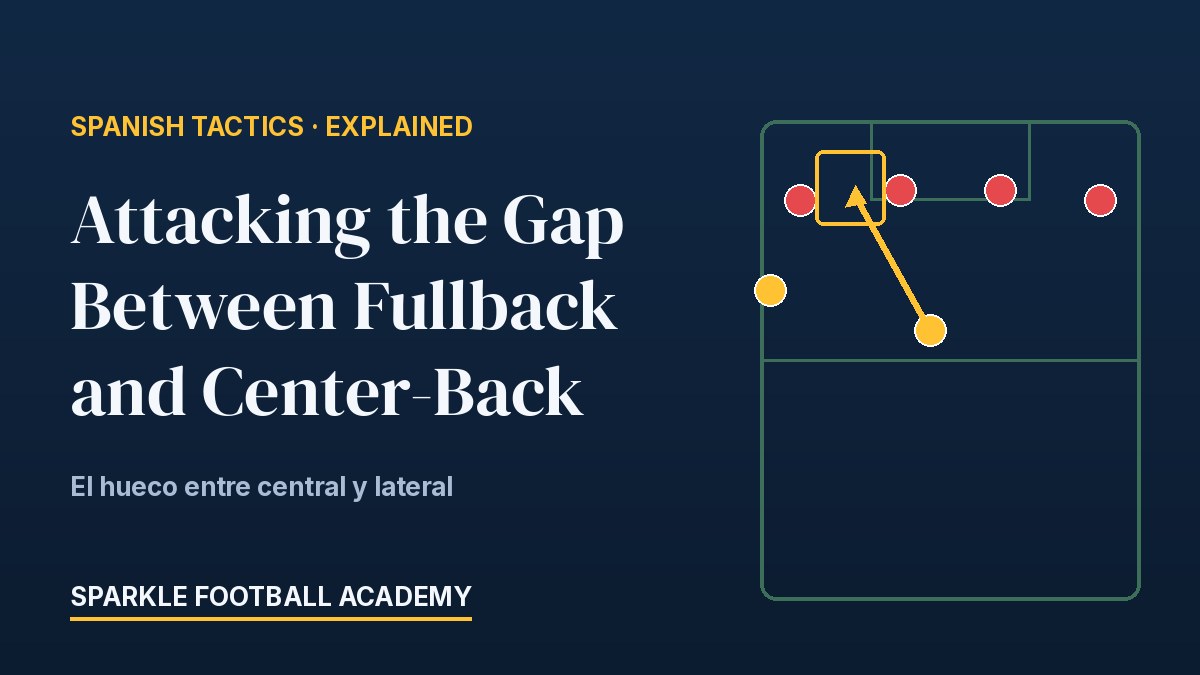
How do you attack the gap between the fullback and the center-back? You make it first, then you run into it. Every back four has a seam between the fullback and the center-back next to them. Most of the time it is closed. Good attacking teams spend the whole game trying to pull it open, and the best young players learn to spot the moment it appears.
Spanish coaches have a simple name for it: el hueco entre central y lateral, the gap between the center-back and the fullback. In English you will also hear it called the channel or the inside channel. This guide explains where the gap comes from, why width is the key that unlocks it, and a drill we use at Sparkle Football Academy to train it.
What is the gap between fullback and center-back?
Picture a back four standing in a line. The two center-backs protect the middle. The two fullbacks protect the wide areas. Between each fullback and the center-back beside them is a strip of grass roughly ten yards wide. When the defenders are close together, that strip is tiny. When one of them moves, it grows.
That strip matters because it sits right in front of goal. A runner who gets into it is inside the width of the penalty box, often facing the goal, and the two nearest defenders are each unsure who should go with them. That moment of hesitation is exactly what attacking the gap between the fullback and the center-back is designed to create.
Why width opens the channel
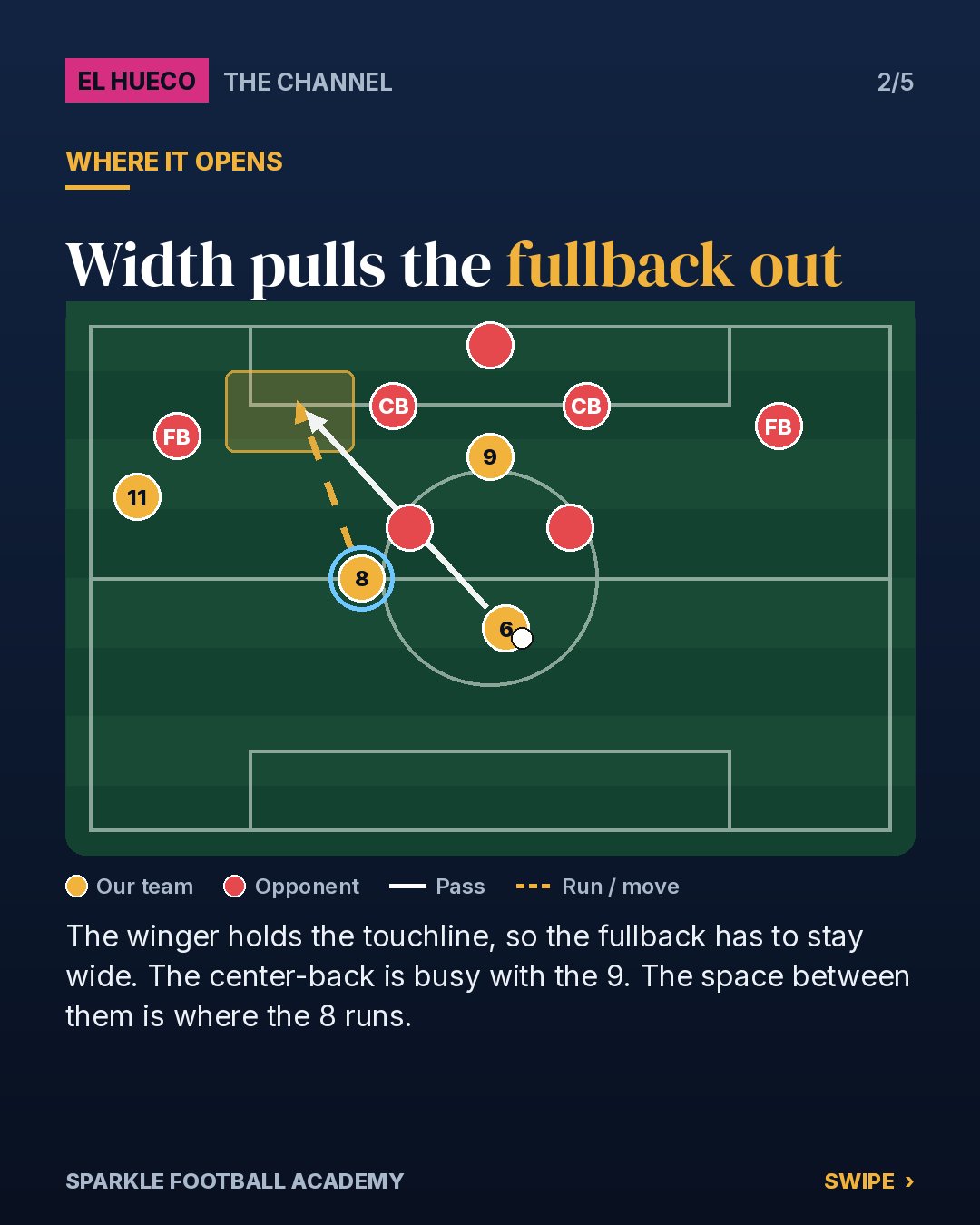
A fullback has two jobs: stop the winger and stay connected to the center-back. They cannot do both if the winger stands on the touchline. If the fullback stays narrow, the winger is free to receive. If the fullback goes wide, the gap opens.
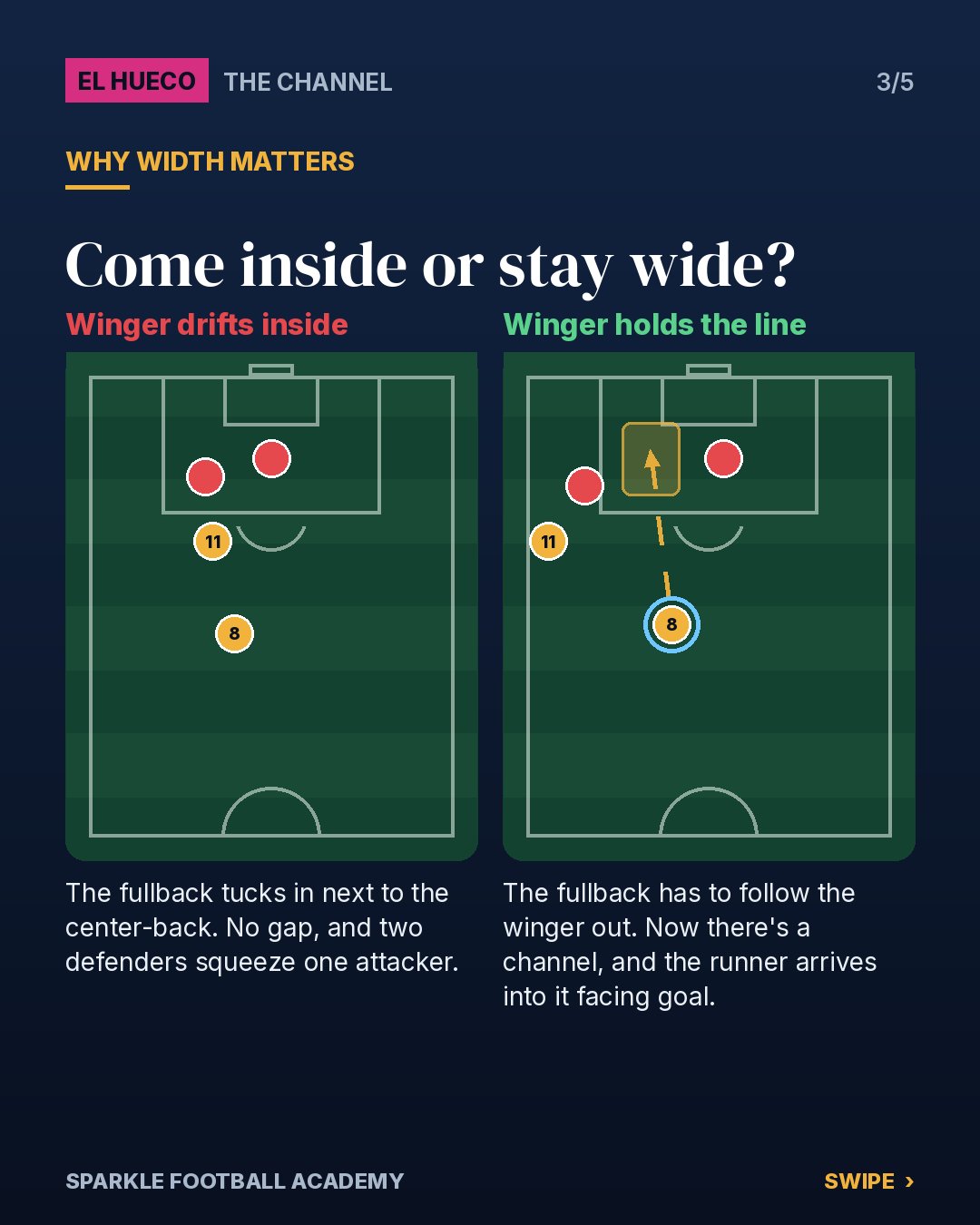
This is why we keep telling young wingers to hold their width. When a winger drifts inside too early, the fullback happily tucks in next to the center-back, and now two defenders are squeezing one attacker in a crowded area. Staying wide feels like doing nothing. It is actually the move that creates the space for somebody else.
Width on its own is not enough. The center-back also needs a problem to solve, which is usually the striker. If the 9 stands on the center-back, that defender cannot slide across to close the gap. Read more about how width and height work together in our guide to breaking a low block.
Who makes the run into the gap?
The runner can come from several places, and changing it keeps defenders guessing:
- The central midfielder (the 8). The most common option. The 8 starts outside the defenders eye line and arrives late, which is hard to track.
- The striker. The 9 can peel off the center-back into the channel, dragging the center-back out of the middle for a second runner.
- The fullback or wing-back. An underlapping run from your own fullback, inside the winger, is a modern favorite.
- The winger. Once the fullback has been pulled wide, a winger can cut back inside on a diagonal run behind them, the move covered in our inverted winger guide.
Timing: run when the fullback steps out
The best runs into the channel start at one clear trigger: the moment the fullback commits to the winger. If you run too early, the fullback simply stays inside and you run into a defender. If you run too late, the fullback has already recovered.
Teach players to watch the fullback, not the ball. When the fullback turns their hips toward the touchline, go. The passer should look for that same signal. A ball played into space for the runner to arrive onto is much harder to defend than a pass to feet.
This is also where third-man combinations help. The winger plays a short pass inside, the midfielder sets it back, and the third player releases the runner into the gap. If that pattern is new to your players, start with our explainer on third-man runs.
What happens after you get into the gap
Getting into the channel is only half the job. From there, the runner has three good options:
- Shoot early if the angle is open and the keeper is not set.
- Cut the ball back along the ground toward the penalty spot, where a late runner arrives facing goal.
- Drive at the near post to win a corner or draw the keeper.
The cut-back is usually the highest-value choice for young players, because defenders running toward their own goal struggle to see the ball and the runner at the same time.
A drill to train it: the channel game
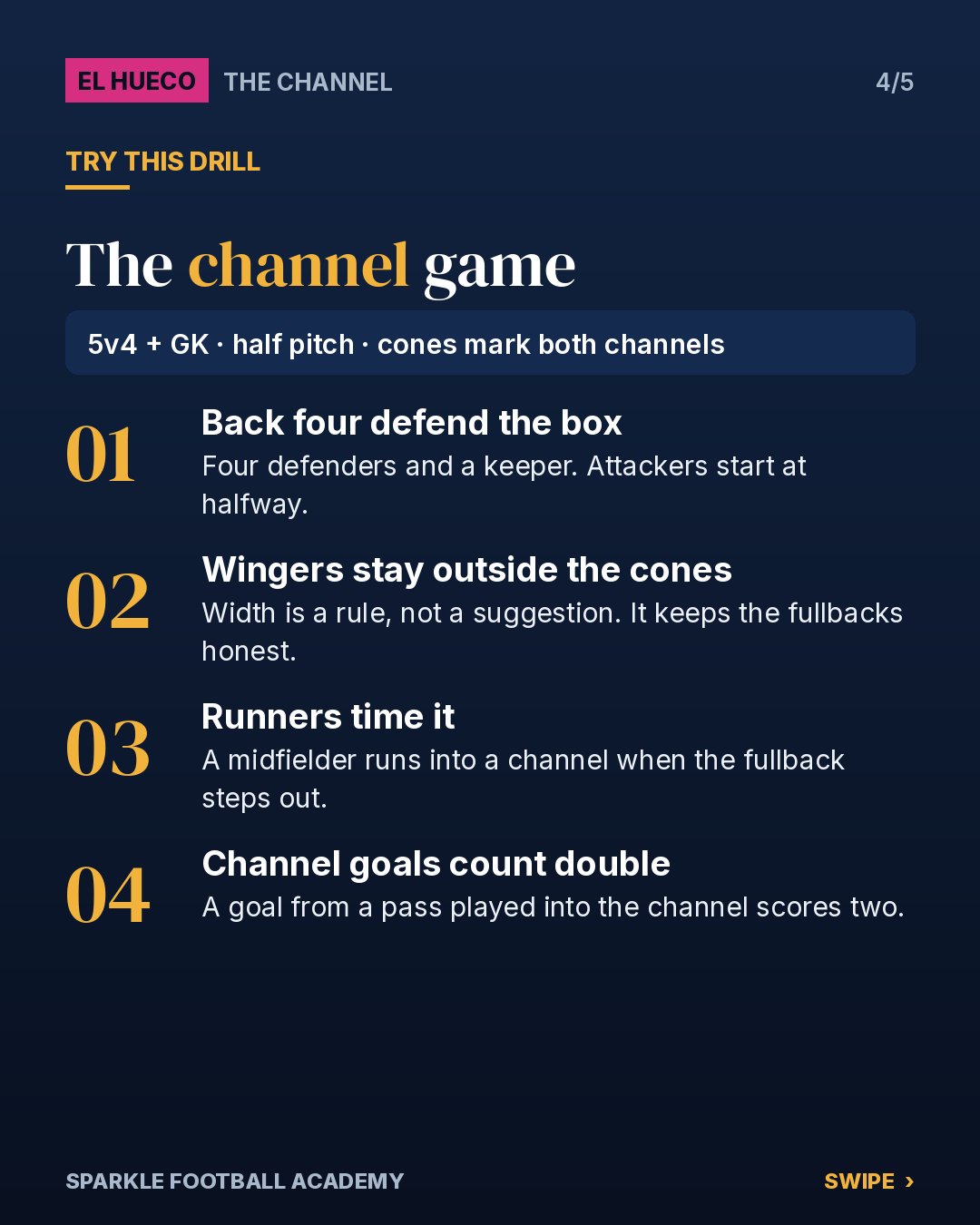
Set up a half pitch with a full-size goal and a keeper. Place cones to mark the two channels between where the fullbacks and center-backs will stand.
- Numbers: five attackers against four defenders and a goalkeeper.
- Rule 1: wingers must stay outside the channel cones until the ball is played forward.
- Rule 2: a midfielder may only enter a channel when the nearest fullback has stepped out.
- Scoring: any goal counts one, but a goal that starts with a pass into the channel counts double.
- Progression: add a recovering defensive midfielder after a few rounds so the runner has less time.
Run it in four-minute rounds and rotate the defenders often. After each round, ask the attackers one question: who opened the gap? Usually the answer is the player who did not touch the ball.
For parents: what to watch on match day
You do not need a tactics board to follow this. During your child’s next game, watch the wide players when the ball is on the other side of the field. Are they staying wide or drifting toward the ball? Then watch the space between the two defenders nearest to them. When a teammate runs into that space and receives the ball facing goal, that is the idea from this article working in real life.
If your child plays in midfield, praise the run even when the pass does not come. Runs into the channel pull defenders around and create space for others, which is exactly the habit good coaches want to see.
Train it with Sparkle Football Academy
At Sparkle Football Academy we coach a Spanish-style game built on understanding space: where it is, who made it, and when to attack it. Players learn ideas like el hueco entre central y lateral through small-sided games, not lectures. Want to see how your player responds to it? Book a free trial session and come train with us.