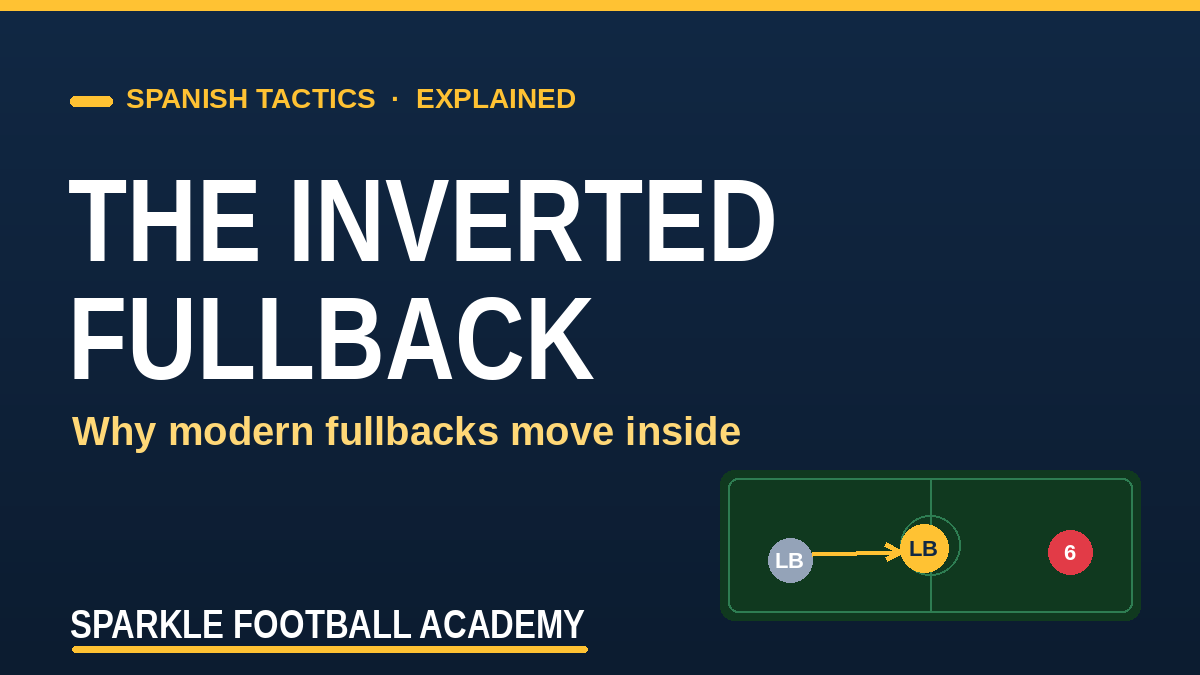
Inverted fullback explained simply: it’s the move where a wide defender steps into central midfield when his team has the ball. If you’ve ever watched a top European side build out of the back and thought, “wait, why is the left back standing in the middle of the pitch?” — that’s the inverted fullback. It’s one of the biggest tactical shifts in modern soccer, and in Spain they call it the lateral invertido. At Sparkle Football Academy we teach it to young players because it trains the thing that matters most: reading space and making a smart decision under pressure. Let’s break it down in plain English.
What is an inverted fullback?
First, the basics. A fullback is the defender who starts on the outside of the back line, near the sideline — the left back (LB) and right back (RB). For years his job was simple: defend his flank, then sprint forward on the overlap to support the winger and whip in crosses.
The inverted fullback flips that script. Instead of bombing up the touchline, he steps inside into central midfield during the build-up. Suddenly your wide defender is standing next to the holding midfielder, helping the team keep the ball and beat the press. Same player, completely different job.
That single movement changes the shape of the whole team — and it’s why so many of the best coaches now ask their fullbacks to think like midfielders.
Where did the inverted fullback come from?
The idea isn’t brand new. Its roots trace back to Johan Cruyff’s Barcelona, who pioneered using fullbacks in central roles. But it was Pep Guardiola who turned the inverted fullback into a staple of the modern game — first with Philipp Lahm and David Alaba at Bayern Munich, then most famously with João Cancelo at Manchester City.
It fits naturally into the Spanish, possession-first style of play. If you want to understand the philosophy behind it, our breakdown of how to play possession soccer is a great companion read. For a deeper tactical history, FourFourTwo’s explainer on the inverted full-back is excellent.
How the inverted fullback actually works
Picture a team building out from the back. The goalkeeper has the ball, the two center-backs split wide, and the defensive midfielder — the pivot, or pivote — drops in to offer a passing option.
Now watch the left back. Instead of staying glued to the touchline, he tucks inside and joins the pivot in central midfield. In one move, the team has an extra body in the middle of the park. The opponent’s press, which planned to mark man-for-man, is now outnumbered in the most important zone on the field.
Meanwhile, the winger on that side stays high and wide. So the team keeps its width up the field and gains numbers in the center. That’s the magic of it — you don’t trade one for the other.
Why coaches love it: four big advantages
When the inverted fullback works, it solves several problems at once:
- An extra man in midfield. You outnumber the opponent’s press in the central zone, making it far easier to play through it.
- You keep your width. Because the winger holds the touchline, the field stays stretched even though your fullback has moved inside.
- Protection against the counter. Your fullback is already central, so if you lose the ball, you’re balanced and ready to defend the middle.
- Safer, shorter passing angles. The tucked-in fullback creates a clean triangle with the keeper and center-back, which makes playing out from the back much calmer.
That central overload usually shows up in the half-spaces — the lanes between the wing and the center, which is exactly where modern attacks are built.
Overlapping vs inverted: same player, opposite job
The easiest way to understand the inverted fullback is to compare it to the old-school overlapping fullback. Here’s the difference at a glance:
- Overlapping fullback: sprints up the outside, provides width and crosses, leaves space behind him, lives on the touchline.
- Inverted fullback: steps inside into midfield, adds a central passer, shields against the counter, lives in the half-space.
Neither one is “better” — they’re tools for different game plans. The best modern fullbacks can do both, reading the moment to decide which run to make. If you want more on how this position has evolved, see our piece on the role of the modern fullback. And because so much of this vocabulary comes from Spain, our guide to Spanish soccer terminology helps explain terms like lateral invertido.
Is there a downside? What to watch for
No tactic is free. The inverted fullback asks a defender to do a midfielder’s job, and that comes with trade-offs worth understanding.
The biggest one is the space left out wide. When the fullback steps inside, the flank behind him is open — so if the ball is lost, a quick switch to the opposite winger can hurt. That’s why timing matters: the fullback only inverts when the team is settled in possession, not when the game is stretched and chaotic. It also demands real composure on the ball. A defender who panics in tight central areas will give it away in a dangerous spot, so technique and scanning aren’t optional here — they’re the whole point.
This is exactly why we introduce it gradually. A player earns the inverted role by first proving they can receive, turn, and pass calmly under pressure. Get those fundamentals right and the rest follows.
For parents: why this is great for player development
If you’re a parent, here’s why this matters beyond the highlight reel. We don’t teach the inverted fullback so your child can copy a pro — we teach it because the skills underneath it are gold for any young player.
To play it well, a young defender has to scan the field before the ball arrives, receive on the half-turn, pass cleanly in tight space, and use both feet. Most of all, they have to make decisions: do I stay wide, or do I step in? That kind of game intelligence transfers to every position on the pitch. A player who learns to read space at fullback becomes a smarter midfielder, winger, or center-back too.
And we keep it age-appropriate. Younger players learn the simple version — “when your winger is wide, you can step inside” — long before we layer in the details. The goal is understanding, not memorizing.
How we coach the inverted fullback at Sparkle
We start with one cue, not a lecture: read your winger. If the winger holds width, the fullback tucks inside. If the winger drifts central, the fullback overlaps outside. Learning to read that exchange is what turns a defender into a modern fullback.
From there, we build it up the way players actually learn:
- Rondos and possession games to train scanning and quick decisions in tight spaces.
- Small-sided games where players get tons of touches and real reps of stepping in and out of midfield.
- Build-up patterns from the back, so the movement becomes automatic under pressure.
It all ties into a clear team play model, so players understand not just what to do, but why. For coaches who want the professional detail, the Coaches’ Voice breakdown of inverted full-backs is a fantastic resource.
See the inverted fullback in action at Sparkle
The inverted fullback looks complicated on TV, but the idea is simple: move where you create an advantage. That’s the kind of smart, modern soccer we coach every week — Spanish-style ideas taught in a way young North American players can actually use.
Want to see how we develop game intelligence like this? Book a free trial session and bring your player out to train with us. Come find out why reading the game beats just running faster — we’d love to show you.