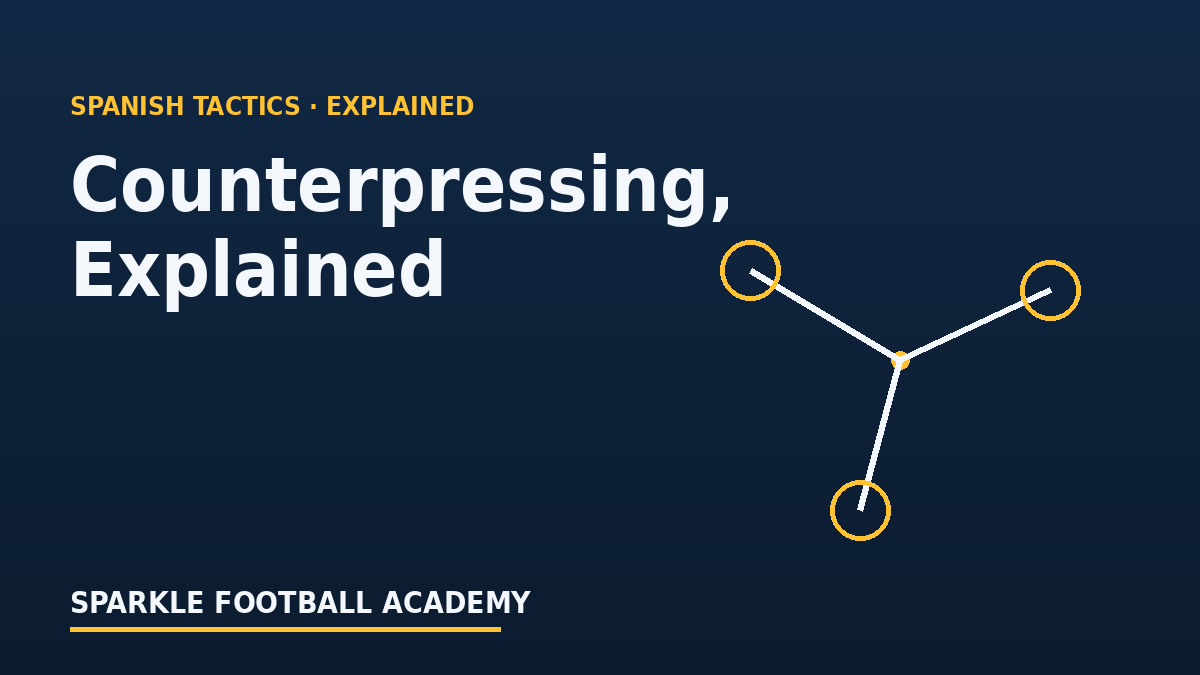
Counterpressing is one of the most exciting ideas in modern soccer, and the good news is that it is simple to understand. Counterpressing means that the moment your team loses the ball, the closest players do not retreat — they press right away to win it back before the other team can settle. If you have ever watched a high-energy team swarm an opponent the instant a pass goes astray, you have seen counterpressing in action.
At Sparkle Football Academy we teach counterpressing to youth players because it rewards effort, teamwork, and quick thinking — three things every young player can control. This guide breaks down what counterpressing is, why it works, the triggers that tell you when to do it, and how we train it so it becomes a habit.
What Is Counterpressing?
The Spanish term is presión tras pérdida, which translates to “pressure after the loss.” It describes the few seconds right after a turnover. Instead of sprinting back toward your own goal, the players nearest the ball immediately hunt the new ball-carrier and cut off the easy forward pass.
The logic is about timing. The instant a team wins the ball, its players are often facing the wrong way, spread out, and still thinking about attacking — not defending. That is the most fragile moment in any possession. Counterpressing attacks that fragility before it disappears.
Why Counterpressing Works
When you win the ball back high up the field, you are already close to the opponent’s goal, so a turnover can turn into a scoring chance in seconds. Even when you do not win it back, a good counterpress forces a rushed clearance, which usually means your team gets the ball again anyway.
It also protects your team. The biggest danger after losing the ball is a fast counterattack into open space. By pressing immediately, you slow the ball down and buy time for the rest of your team to recover their shape. In that sense, counterpressing is both your first attack and your first line of defense.
The Counterpressing Triggers
Counterpressing is not random chasing. Smart teams press on clear signals, called triggers. When a trigger appears, it is a green light to swarm the ball. When there is no trigger, the smart choice is to drop off and rebuild your shape.
- A heavy touch. If the player who just won the ball lets it bounce away from his foot, attack immediately — he cannot pass or run cleanly.
- A receiver with his back to goal. A player facing his own goal cannot see the field or play forward, so pressure from behind is hard to escape.
- A pass into a crowd. When the ball travels toward a group of players, the receiver has little time and few options — jump the moment it arrives.
The rule we give our players is short and clear: if you see a trigger, hunt the ball; if you do not, get back into your block. And if you cannot win it in about five seconds, stop pressing and reset. Endless chasing just opens gaps behind you.
The First Presser’s Job
Counterpressing is a team action, but it starts with one player. The first presser does not need to make a heroic tackle. His job is to delay the ball and steer the carrier toward the sideline or back where he came from, taking away the dangerous forward pass.
While the first presser shows the carrier in one direction, teammates jump the nearest passing lanes. Now the ball-carrier has no easy out, the clock is ticking, and a mistake becomes very likely. That is how a single pressing run turns into a turnover.
Counterpress or Drop Off?
Counterpressing is powerful, but it is not the only option, and part of being a smart player is knowing which choice fits the moment. Here is the simple comparison we use:
- Drop off: everyone recovers toward goal. This is the right call when there is no trigger and the opponent has time and space — you defend in an organized block instead.
- Counterpress: the closest players swarm the ball right now. This is the right call when a trigger appears and you can outnumber the ball near where you lost it.
Great teams are not the ones that press every single time. They are the ones that read the moment and choose well.
How We Train Counterpressing at Sparkle
We do not start with chalkboards. We build counterpressing into small games so players feel it. Our favorite tool is the transition rondo: a keep-away game where the team that loses the ball must win it back within three passes. Lose it, hunt it, win it back, repeat. After enough reps, reacting in that first half-second stops being a decision and becomes a reflex.
From there we scale up to small-sided games with a simple rule — win the ball back within five seconds of losing it or the other team gets a free restart. That single constraint teaches players to read triggers, support each other, and press as a unit rather than as one tired individual. If you want to see how these habits connect to the bigger picture, our breakdowns of the 3v3+3 possession game and playing between the lines show how winning the ball back leads straight into keeping it. The classic rondo drill is where most of this starts.
Common Counterpressing Mistakes
When players first learn counterpressing, the same handful of errors show up again and again. Spotting them early makes the whole team better.
- Pressing alone. One player sprinting at the ball while teammates stand still just opens a passing lane around him. Counterpressing only works when two or three players move together.
- Diving in. Lunging for a tackle is easy to beat with one touch. The first presser should slow the ball and stay on his feet, not gamble.
- Never letting go. If the press is beaten, chasing forever leaves huge gaps behind. After about five seconds with no win, drop off and rebuild your shape.
Fixing these is less about fitness and more about decisions — which is exactly why we coach the read, not just the run.
For Parents
Counterpressing is a wonderful concept for young players because it rewards the things you most want to see your child develop: hustle, alertness, and teamwork. A player does not need to be the fastest or most skillful to counterpress well — they need to care, to react quickly, and to work with teammates.
If your child comes home talking about “winning the ball back,” that is a sign they are learning to read the game, not just chase it. You can support them by praising effort and smart decisions, not just goals. The willingness to sprint back and press for five hard seconds is a habit that pays off in every match, and it builds character off the field too.
Start Your Player’s Journey at Sparkle
Counterpressing is just one of the modern ideas we teach in a way young players can feel and use. At Sparkle Football Academy, we turn big tactical concepts into simple games that build real understanding, confidence, and a love of the sport.
Want to see it in person? Book a free trial session and watch your player learn to read the game like never before.
![Read more about the article [5 Things to Know About] How to Choose the Right Spanish soccer](https://www.sparklesocceracademy.com/wp-content/uploads/2024/12/c3d22633-0366-471b-9e11-9e984696a251-300x226.webp)

Pingback: The 4v4+4 Pressing Game: The Drill That Makes Counterpressing Automatic - Sparkle Football Academy
Pingback: How to Beat a High Press in Soccer: Long, Short, or Around? (Explained Simply) - Sparkle Football Academy