
4-3-3 formation explained for young players: it means four defenders, three midfielders, and three forwards, arranged in three clear lines from the back to the front. Coaches in Spain call it the sistema 4-3-3, and academies from Barcelona to Vancouver teach it before any other shape. Why? Because the 4-3-3 formation hands every young player a clear job, a clear zone, and — this is the magic part — two short passing options the moment the ball arrives at their feet.
If your child just got told they’re “playing the 8” this season and you nodded along without a clue, this guide is for you. Ten minutes from now, the numbers will make sense.
What Does the 4-3-3 Actually Mean?
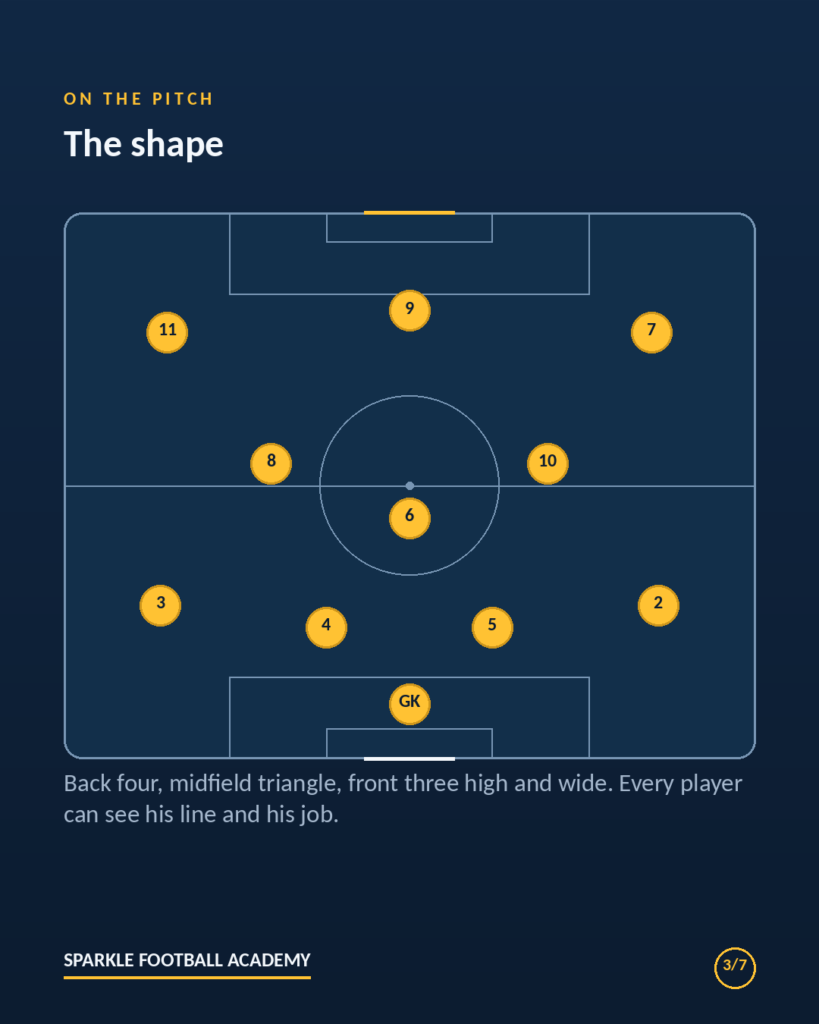
Formation numbers are always read from the back to the front, and the goalkeeper is never counted. So 4-3-3 reads like this: four defenders, then three midfielders, then three forwards.
That’s it. No secret code. When you hear 4-4-2 or 3-5-2, it’s the same trick — defenders first, forwards last.
What makes the sistema 4-3-3 special isn’t the counting, though. It’s the spacing. Three lines, staggered at different heights, cover the field in a way that two flat lines never can.
The Three Lines and Their Jobs
Each line in the 4-3-3 formation has one headline job that even a brand-new player can hold onto:
- The back four defends the width of the penalty box and starts the attack with calm first passes.
- The midfield three forms a triangle — one holding midfielder (the 6) sitting behind two advanced runners (the 8 and the 10) — that connects defense to attack.
- The front three stays high and wide: two wingers stretch the field like elastic, and the striker pins the center-backs so space opens behind the lines.
One line defends the box. One line runs the middle. One line stretches the field. When a young player understands which line they belong to, the game slows down for them.
Where the 4-3-3 Formation Wins: Triangles Everywhere
Here’s the reason Spanish academies are loyal to this shape: wherever the ball travels, the player on it has at least two short options at an angle. The fullback has the winger up the line and the 8 inside. The 6 has both 8s ahead and both center-backs behind. The winger has the fullback underneath and the striker across.
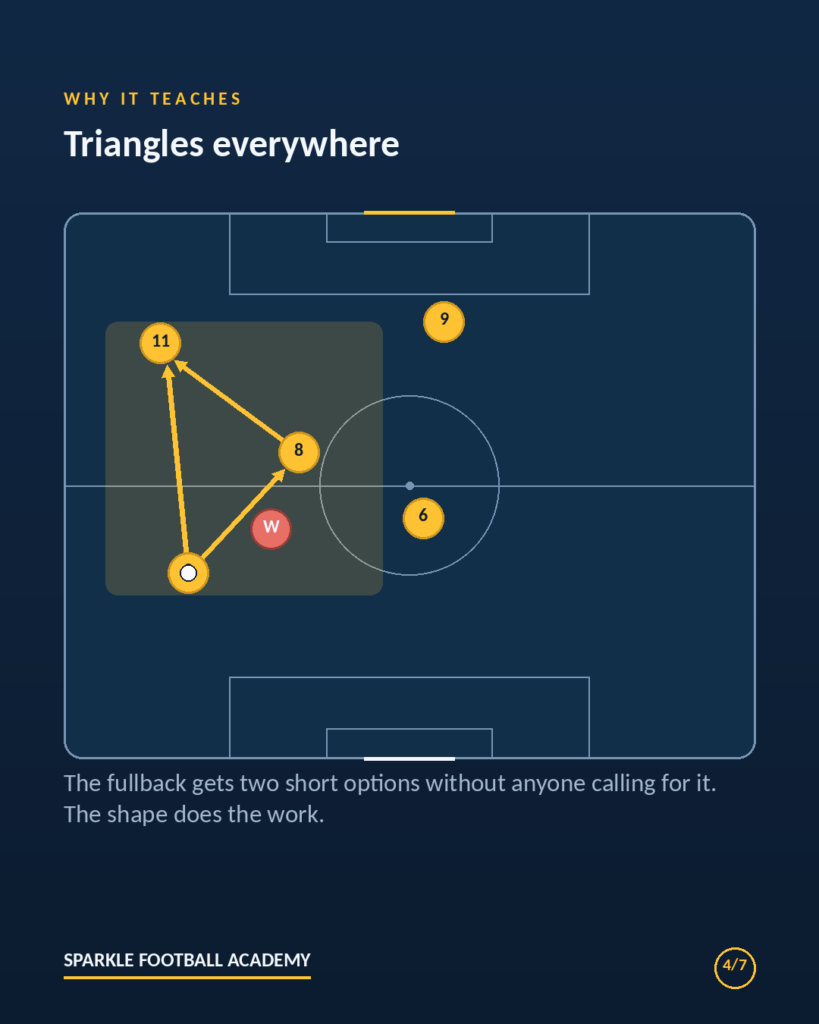
Those little triangles are the engine of possession soccer. Kids stop booting the ball clear because they always have somewhere safe to put it. Passing out of pressure stops being bravery and starts being geometry.
And triangles teach scanning. When you know two options exist before the ball arrives, you start looking for them early — the shoulder checks come naturally because there’s something worth seeing.
Position by Position: Who Does What
A quick tour of the jersey numbers your child will hear at practice:
- Fullbacks (2 and 3): defend the wide lanes, then sprint forward to support the wingers.
- Center-backs (4 and 5): protect the middle, win duels, and play the first calm pass.
- The 6 (holding midfielder): the team’s anchor — screens the defense and keeps the ball moving side to side.
- The 8s (advanced midfielders): the engines — they arrive in the box late, press high, and cover every blade of grass between.
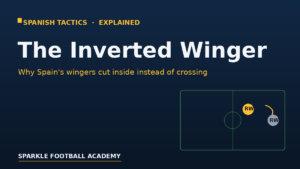
- Wingers (7 and 11): stay wide, attack fullbacks one-on-one, and cut inside when the lane opens.
- The 9 (striker): occupies the center-backs, finishes moves, and leads the press when the other team builds up.
Notice something? No position reads “kick it far” or “chase everything.” Every job is about space, angles, and decisions — which is exactly what makes the shape such a good teacher.
4-3-3 Formation vs 4-4-2: Why Academies Choose Three Lines
The 4-4-2 is a fine shape — plenty of professional teams still defend brilliantly in it. But for development, the comparison isn’t close.
In a 4-4-2, the team forms two flat lines of four. Flat lines mean square passes, and square passes mean fewer angles. The wingers in a 4-4-2 also inherit enormous defensive lanes, so young wide players spend their afternoon running instead of deciding.
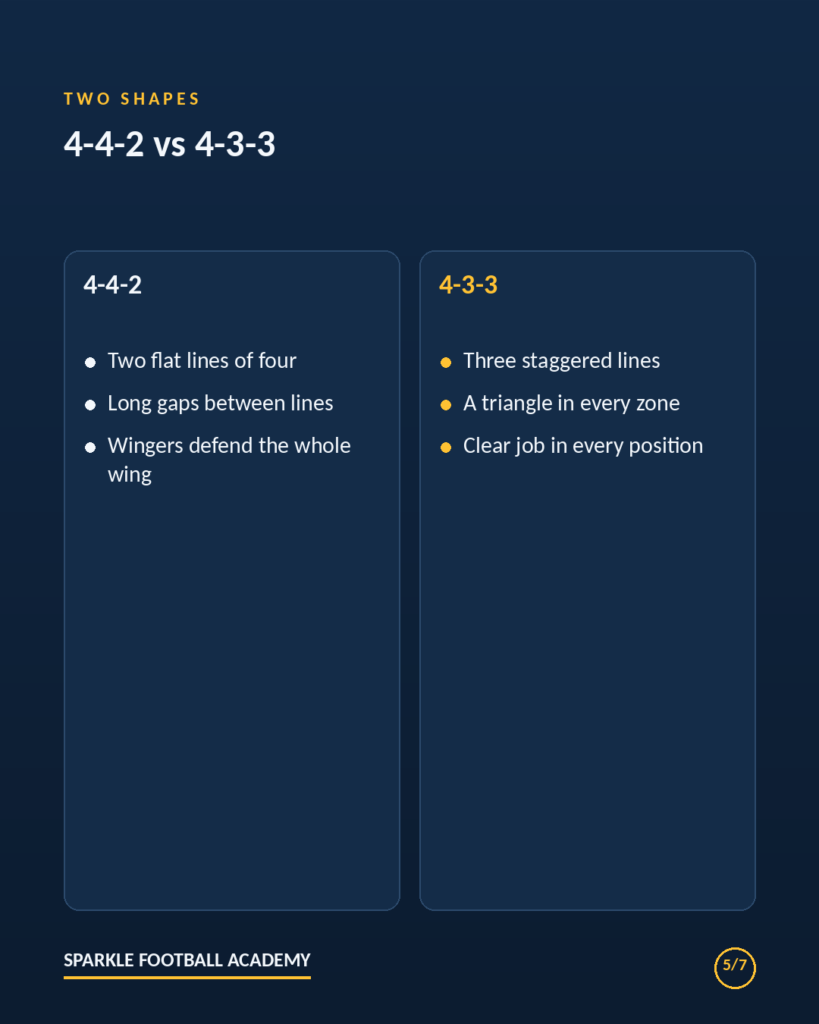
The 4-3-3 staggers the field into three heights, which creates diagonal passing lanes by default. Diagonals break lines; squares don’t. A ten-year-old in a 4-3-3 simply faces more soccer problems per game — receive on the half-turn, pick a triangle, switch the point — and more problems means faster learning.
How Young Players Learn the 4-3-3: From 2-3-1 to the Real Thing
Nobody starts at 11v11. In North America, players in the U9–U10 age groups play 7v7 under U.S. Soccer’s small-sided standards, which exist precisely so kids touch the ball more and make more decisions.
At Sparkle Football Academy, our 7v7 teams play a 2-3-1 — and if you squint, you’ll see it’s the 4-3-3 with the training wheels still on. Two defenders instead of four, a midfield triangle, one striker up top. Same triangles, same jobs, smaller field. When our players step up to 9v9 and then 11v11, the picture is already living in their heads; we just add players to it.
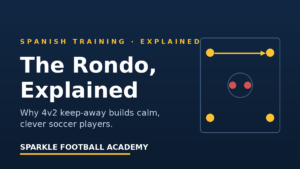
The habits underneath the shape get built in our possession games — the rondo teaches the angles and one-touch escapes, and the 3v3+3 possession game scales those angles up into real positional play. The formation is just where those habits go to live on match day.
For Parents: What to Watch From the Sideline
You don’t need a coaching license to support a kid learning the sistema 4-3-3. Watch for these instead of goals:
- Does your child check their shoulder before the ball arrives?
- After they pass, do they move to make a new triangle — or stand and admire it?
- Are they holding their line’s height and width, or getting sucked toward the ball like a magnet?
Those three habits predict a player’s future far better than Saturday’s score. And on the car ride home, one question beats any lecture: “Which position did you enjoy most today, and why?” Let them teach you the shape — explaining it is the deepest way to learn it.
Quick Answers for Curious Kids (and Parents)
Is the 4-3-3 attacking or defensive? Both, which is the point. With the ball it spreads into attack through the wingers; without it, the front three becomes the first wall of pressure. The shape doesn’t change — the intent does.
What’s the hardest position in it? Most coaches say the 6. The holding midfielder receives surrounded, facing their own goal, with the whole game on their shoulders. It’s also where smart, calm kids quietly become the best player on the team.
Do the pros really play it? Constantly. It has been the backbone of Barcelona’s academy teams, Ajax’s youth system, and plenty of Premier League sides. When your child learns the 4-3-3 formation, they’re learning the sport’s common language.
Ready to Learn It on the Grass?
Reading about the 4-3-3 formation is the appetizer. Feeling it click in a small-sided game — that first moment a kid escapes pressure through a triangle they saw coming — is the whole meal.
That’s what we build at Sparkle Football Academy: Spanish-style positional play, taught in English, in games sized for young players. Your first session costs nothing. Book a free trial and let your player find their spot in the shape.


Pingback: Mid-Block in Soccer Explained: The Pressing Line That Leaves the Center-Backs Free - Sparkle Football Academy