Ask any coach what separates a confident young player from a frustrated one, and “first touch” comes up almost every time. The good news: the first touch in soccer is a skill you can train — and it improves faster than almost anything else once you understand what you are really trying to do.
What a first touch in soccer really is
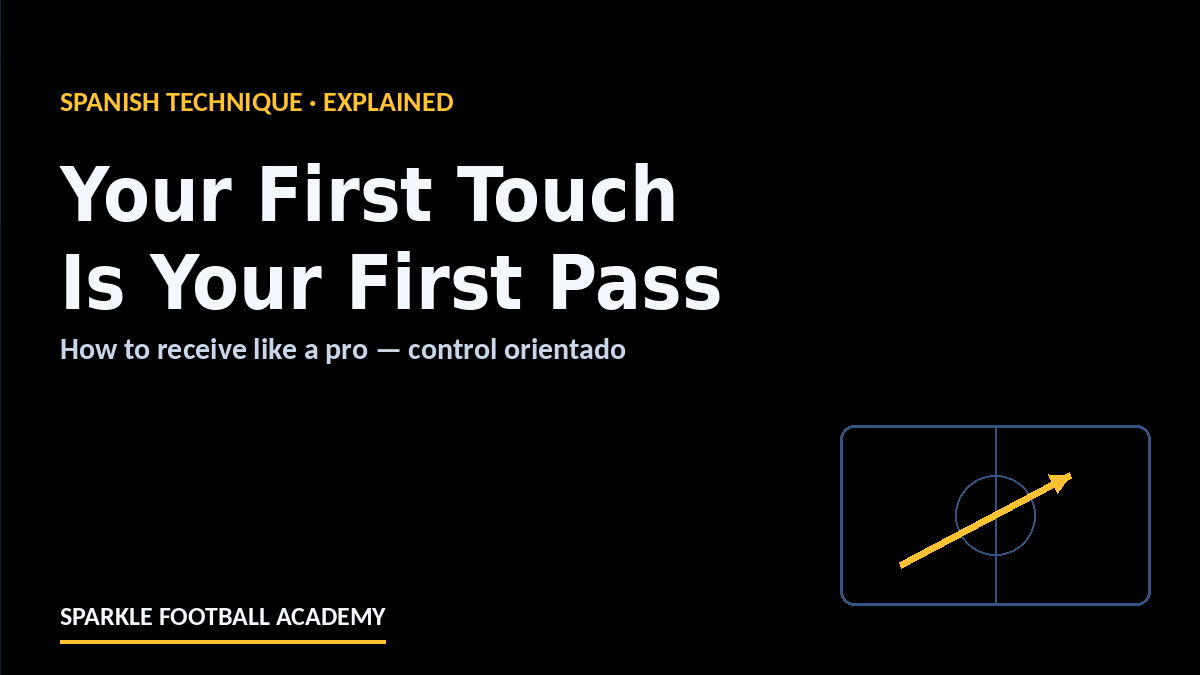
Your first touch is your first pass. The moment the ball arrives, where you push it decides everything that happens next — whether you turn and attack, or get crowded out and play backward. A clean, purposeful first touch is the difference between a player who looks calm on the ball and one who always seems rushed.
At Sparkle Football Academy we teach young players that the first touch is not just about stopping the ball. It is about directing it. Spanish coaches call this control orientado — an oriented, directional first touch that moves the ball into space and points you where you want to go.
Why your first touch is your first pass
Picture a midfielder receiving with his back to goal. If his first touch stops the ball dead at his feet, a defender steps in and the only safe option is to pass backward. Now picture the same player taking a touch that pushes the ball half a yard into space, with his body already turned. Suddenly he is facing forward, the defender is behind him, and the whole field is in front. Same ball, a completely different next second.
That is why we say the first touch is really the first pass: a good one creates time and options before you have even looked up. A heavy or flat one gives them away.
The directional first touch (control orientado)
Control orientado simply means receiving the ball with a plan. Before it arrives, you decide where the space is, and you cushion your touch into that space rather than letting the ball bounce off your foot. Done well, the ball runs across your body into the gap, and your momentum carries you forward.
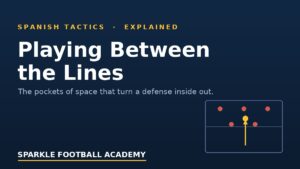
This is the same principle behind receiving between the lines and one of the building blocks of possession soccer. Teams that keep the ball are not magic — they are full of players whose first touch buys them an extra half-second.
Three habits that fix a heavy first touch
- Scan before you receive. Check your shoulder before the ball arrives so you already know who is behind you and where the space is.
- Open your hips. Turn your body side-on toward the field instead of square to the passer, so you can see forward and play forward.
- Cushion into space. Meet the ball with a soft, angled surface and let it run into the gap — do not trap it dead under your foot.
These three habits turn a panicked touch into a calm one. The best part: they are free to practice and they work at every age.
A simple first-touch drill you can do at home
You do not need a team to train this. Find a wall and a ball:
- Pass the ball into the wall, and as it comes back, take a directional first touch to the left, then play it back. Repeat to the right.
- Add a scan: glance over one shoulder before each touch.
- Use both feet, and count clean touches — try to beat yesterday’s number.
Ten focused minutes a few times a week compounds fast. If you want a full routine, our rondo and ball-work drills build the same skill in a game-like setting.
Open vs closed: receiving on the half-turn
Coaches talk about receiving open or closed. Closed means square to the passer with your back to goal — limited, and easy to press. Open (the half-turn) means side-on, hips pointed up the field, ready to play forward in one touch. The directional first touch and the half-turn go hand in hand: open your body, then let your touch carry the ball into the space you have already seen.
For parents: what to watch for
You do not need to be a coach to help. Watch how your child receives the ball. Does it stop dead at their feet, or do they push it into space and keep moving? Encourage the calm version, and praise the decision, not just the goal — “Great touch into space!” goes a long way.
Try not to shout instructions while the ball is travelling; it makes kids rush exactly when they need to slow down. The goal is a player who looks up, takes a confident touch, and plays with their head up.
Train your first touch with Sparkle Football Academy
Every Sparkle session is built around receiving and playing with purpose — small-sided games and rondos where a clean first touch is the only way to keep the ball. If you would like your player to look calmer and more confident on the ball, come and see how we coach it.
Book a free trial at Sparkle Football Academy and give your player a first touch that does the work for them.