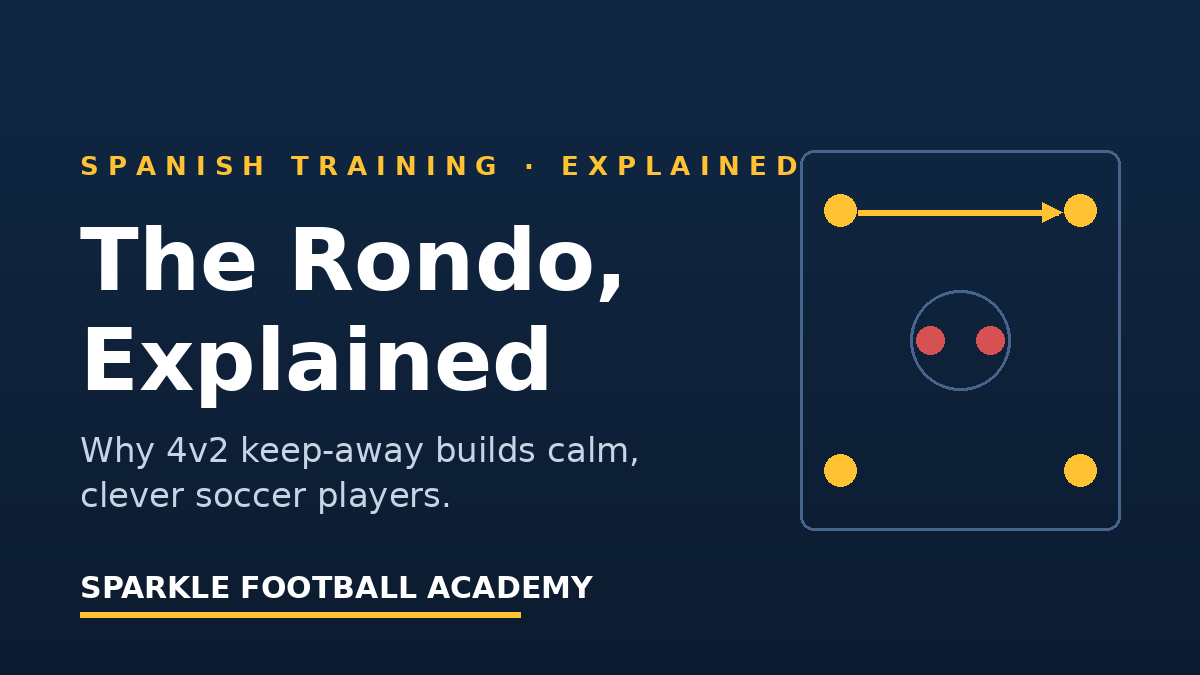
Rondo drill explained simply: it’s 4v2 keep-away in a small square — four players pass, two defenders chase — and it’s the first thing you’ll see at almost every professional academy in Spain. The rondo drill looks like a playground game. Watch it for five minutes, though, and you’ll see why coaches treat it as the single most efficient teaching tool in soccer. Every pass hides a scan, an angle, and a decision made under real pressure.
At Sparkle Football Academy, every session opens with rondos. Here’s what the circle is really teaching — and what to watch for from the sideline.
What Is a Rondo?
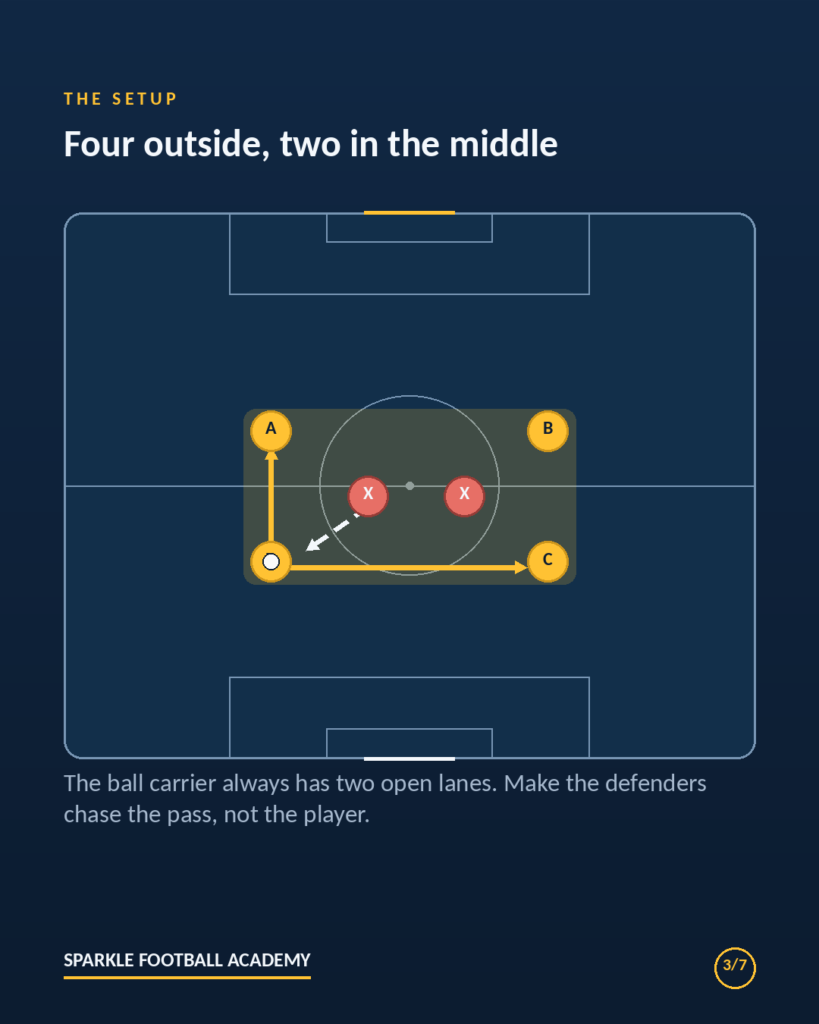
A rondo is a possession game played in a tight grid, usually about six to eight yards across. Four players stand on the outside and try to keep the ball moving; two defenders work in the middle and try to win it. Lose the ball with a bad pass or a heavy touch, and you swap places with a defender. That’s the whole rulebook.
The drill has deep roots. It was popularized at FC Barcelona, where it became the foundation of the academy’s famous possession style, and it spread from there to training grounds everywhere — you can read a short history on Wikipedia’s rondo page. Johan Cruyff summed it up best: “Everything that goes on in a match, except shooting,” he said, you can find inside a rondo.
Why Spanish Academies Open Every Session With It
Spanish academies prize players who can receive under pressure, play one- and two-touch, and choose the right pass while someone is closing them down. A rondo manufactures exactly those moments, dozens of times a minute, with no lines and no standing around. It’s the compressed version of the tiki-taka idea: short passes, constant support, and a numerical advantage used on purpose.
There’s a cultural piece too. El que la pierde, va al medio — whoever loses it goes in the middle. Accountability is built into the game, and kids police it themselves with a grin.
What the Rondo Drill Actually Trains
One small square covers more game skills than any other single exercise we know:
- Scanning. Good players check both shoulders before the ball arrives, so they already know where the defenders are. This habit transfers straight into matches.
- First touch and body shape. Receiving slightly side-on (perfil) turns a trapped player into one with two exits.
- Passing angles. Outside players learn to take two small steps off their cone to open a lane that didn’t exist a second earlier.
- One-touch decisions. With defenders this close, slow thinking gets punished immediately — which is why rondos build the decision-making speed we write about often.
- Composure. The square teaches players that pressure is information, not panic.
The Defenders Are Training Too
A common mistake is treating the middle as punishment. The two defenders are doing real work: they learn to press as a pair, curve their runs so one pass is shown and another is blocked, and pounce the moment a touch gets heavy. The first defender presses the ball; the second reads the next pass. That’s the same coordinated pressing you see from top teams on TV, shrunk to a six-yard square.
Common Rondo Mistakes (and Easy Fixes)
- Standing statues. Players glued to their corners turn the rondo into target practice. Fix: allow two steps along each line and demand constant small adjustments.
- Beauty-contest passing. No-look flicks look great until the streak dies at four. Fix: count consecutive passes out loud; the score keeps everyone honest.
- Defenders who jog. If the middle gives up, nobody improves. Fix: score the defenders’ wins too, and rotate fresh legs in every 60–90 seconds.
- A square that’s too big. Too much space removes the pressure that makes the drill valuable. Fix: shrink the grid until completing ten passes feels like an achievement.
How We Coach the Rondo at Sparkle Football Academy
We treat the rondo as a progression, not a warm-up ritual. Our youngest groups start 4v1 in a generous square so they taste success early. As players improve we shrink the grid, move to 4v2, cap touches at two, and eventually add positional rules so the rondo starts to look like real possession soccer — the kind built on triangles, support angles, and a free man.
We also coach the vocabulary. Our players learn the Spanish words for what they’re doing — rondo, pared (a quick wall pass), perfil (open body shape) — because naming an idea helps a young brain find it again in a match. If you enjoy that side of the game, our guide to Spanish soccer terminology goes deeper.
For Parents: What to Watch From the Sideline
It can look like simple keep-away from the bleachers. Here’s how to see the learning. Watch your child’s head before the ball arrives — are they checking their shoulder? Watch their hips — do they receive side-on so the next pass is already possible? Count their decisions, not their completions: a brave forward pass that gets cut out can be a better rep than ten safe square balls. And listen for talk; rondos quietly teach kids to call names, point, and organize each other.
Progress in soccer is rarely a highlight reel. It’s a thousand small reps like these, stacked week after week.
Try It at Home: A Backyard Rondo
You only need three people, a ball, and four markers. Set a square about six big steps across. Two players pass, one defends — 3v1. Whoever gives the ball away swaps with the defender. Count your record streak of passes and try to beat it before dinner. When that gets easy, shrink the square by one step. Ten focused minutes of this beats an hour of aimless shooting at an empty net.
Come Play the Circle With Us
The rondo drill is the fastest way we know to build calm, clever soccer players — and it’s flat-out fun, which is why kids ask for “one more round” every single time. If your child is in Grades 4–7 and you’d like them to learn the game the Spanish way here in Vancouver, come see a session for yourself. Book a free trial at Sparkle Football Academy — bring cleats, a water bottle, and a competitive streak. We’ll handle the rest.
![Read more about the article [5 Things to Know About] How to Choose the Right Spanish soccer](https://www.sparklesocceracademy.com/wp-content/uploads/2024/12/c3d22633-0366-471b-9e11-9e984696a251-300x226.webp)

Pingback: Rondo Progressions: From 4v1 to 6v3 - Sparkle Football Academy
Pingback: Pre-Match Soccer Warm-Up: The 20-Minute Sequence We Use Before Every Game - Sparkle Football Academy