Looking for small-sided games explained simply? Here it is: shrink the field, cut the numbers, and the game itself starts coaching your kid every few seconds. Small-sided games — anything from 4v4 up to 7v7 — are the backbone of how Spanish academies develop young players, and they’re the easiest upgrade most North American teams can make to their training week. In Spain the approach even has its own name: fútbol reducido, literally “reduced soccer.”
At Sparkle Football Academy, we build every single session around them. This guide covers what small-sided games are, the math that makes them so convincing, what a simple 4v4 actually teaches, and — for the parents on the sideline — how to tell real development is happening.
What Are Small-Sided Games?
A small-sided game is exactly what it sounds like: real soccer, played by fewer players on a smaller field. Picture a 4v4 in a tight grid instead of an 11v11 across a full pitch. The game stays honest — there’s a goal to attack, opponents to beat, teammates to find — but everything is compressed into a space where the action can’t get away from anyone.
That compression is the whole point. With eight players instead of twenty-two, nobody is ever more than one pass from the play. The ball finds every kid, every minute. Defending, attacking, pressing, finishing — each player lives all of it, instead of holding a position and waiting for the game to come visit.
Fútbol Reducido: Spain’s Worst-Kept Training Secret
Walk into a youth session at a top Spanish academy and you won’t find 22 kids spread across a hundred yards of grass. You’ll find tight grids, short games, and a ball that never stops moving. La Masia, FC Barcelona’s famous academy, raised generations of world-class midfielders on exactly this diet: small spaces, big demands.
It fits everything else in the Spanish school of soccer. The rondo warm-up, positional play, the patient build-up — they all assume players who stay calm on the ball with an opponent breathing down their neck. And the only way to train calm in tight spaces is to spend thousands of hours in tight spaces. It’s the same thinking that powers possession soccer: comfort under pressure isn’t a talent, it’s a habit.
New to the vocabulary? Our guide to Spanish soccer terminology walks through rondo, regate, conducción and the rest of the words you’ll hear around our fields.
The Math Behind Small-Sided Games
Why does a 4v4 beat a full-field scrimmage for development? Count what one player actually gets in twenty minutes:
- Touches. You’re one of eight players sharing the ball, not one of twenty-two. Your share of the game multiplies, and every touch is a rep for your first touch, your passing, your dribbling.
- Decisions. The ball comes back every few seconds, so you scan, choose, and act on a loop. Pass or carry? Switch or keep? That loop is the skill.
- Duels. 1v1 moments — beating a defender, stopping an attacker — happen constantly because there’s nowhere to hide and no crowd to pass the job to.
- Goals. More shots, more saves, more celebrations. Kids fall in love with the part of soccer they came for in the first place.
Stack twenty minutes of that against twenty minutes of standing at left back while the ball lives on the other wing, and the gap compounds week after week. The repetitions aren’t just physical, either — they’re mental. We’ve written before about why decision-making is the hidden engine of Spanish football; small-sided games are where those decisions get trained.
What a 4v4 Actually Teaches
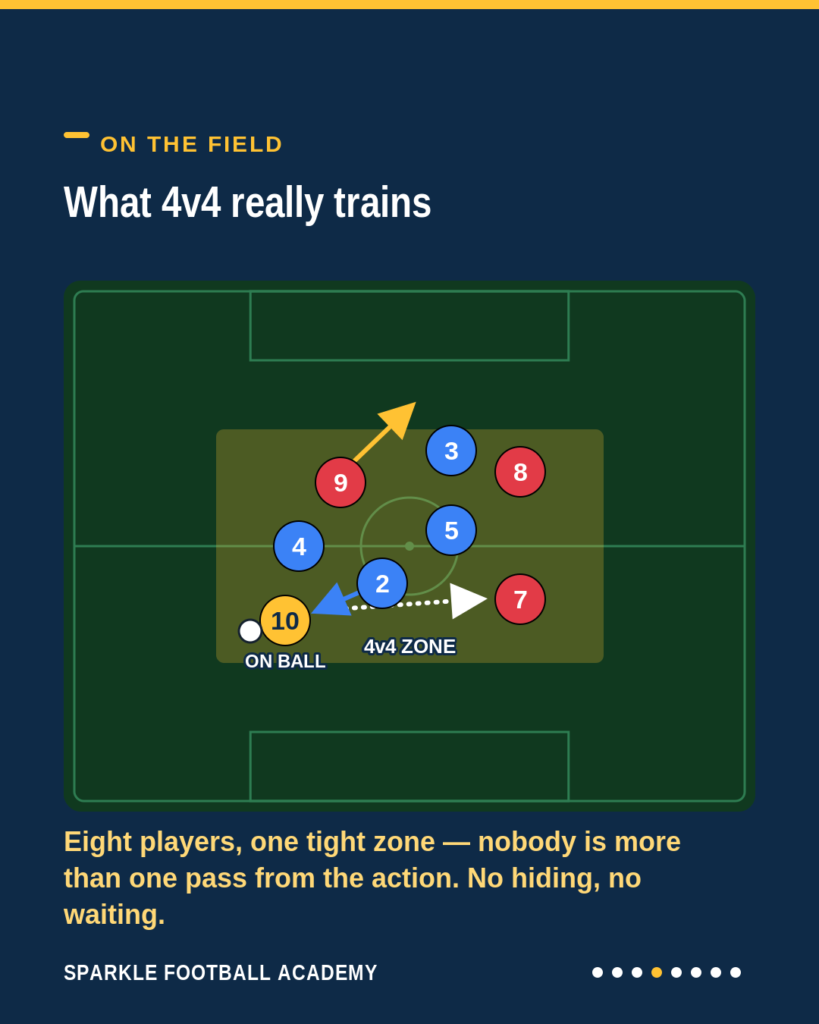
Here’s the picture we use with our players: eight kids, one tight zone, one ball. Nobody is more than a pass away from the action, so four habits get hammered in whether you’re “working on them” or not.
First, scanning. Pressure arrives in a heartbeat, so you learn to check your shoulder before the ball arrives — the same habit we drill when teaching players to receive on the half-turn. Second, support angles. In a small grid, a teammate standing in a bad spot is obvious; kids learn to keep moving to give the ball carrier two options. Third, the first touch. There’s no time for a touch that just stops the ball; it has to take you somewhere. And fourth, reaction to losing the ball. The opponent’s goal is seconds away, so winning it back immediately stops being a coach’s slogan and becomes pure survival instinct.
Small-Sided Games vs 11v11: What Changes for Your Player
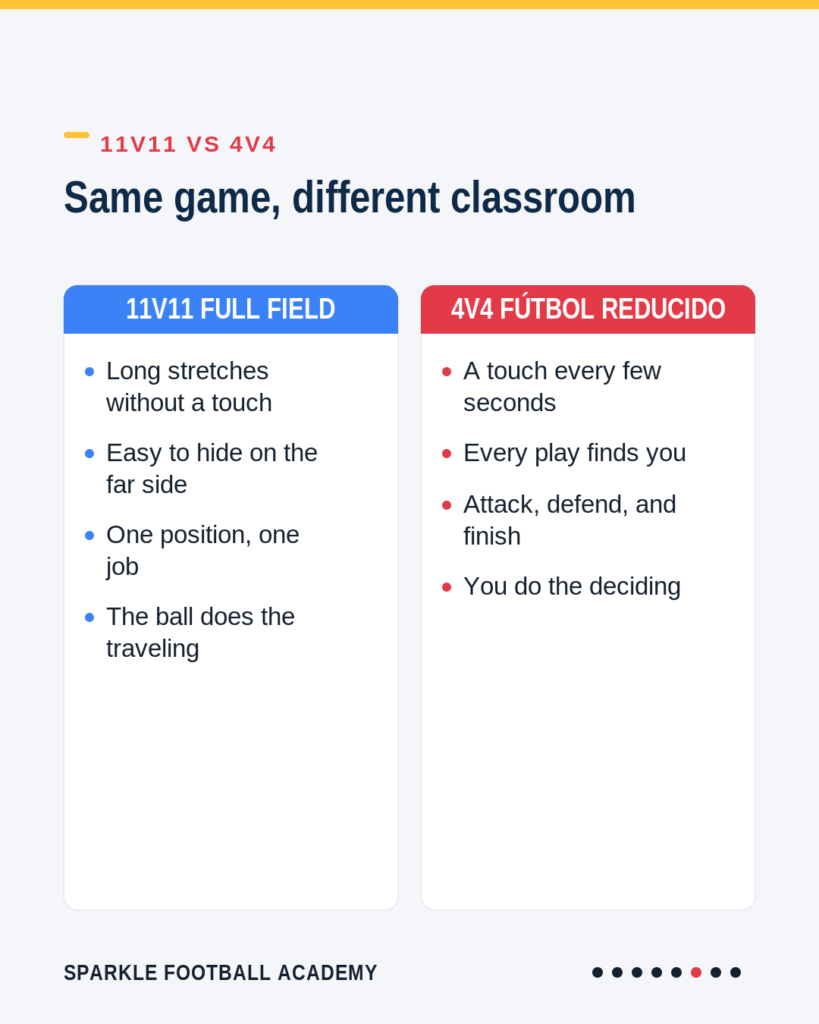
None of this means 11v11 doesn’t matter. The full game is the destination — it teaches team shape, long switches of play, and the discipline of a real match. But the destination is a terrible classroom for a nine-year-old’s feet.
In an 11v11, a young player might go minutes without touching the ball, and an entire half hiding on the weak side. In a 4v4, the game finds them every few seconds and asks a new question each time. That’s why governing bodies across North America now mandate smaller formats for younger ages — 4v4 before 7v7 before 9v9 — growing the field as the player grows. Train small, then express it big.
How We Use Small-Sided Games at Sparkle Football Academy
Every Sparkle session ends in small-sided games, and most begin with their little cousin, the rondo. In between, we change one thing at a time: shrink the zone when the theme is first touch, stretch it wide when we’re teaching switches, add a neutral player when we want the kids to find the free man.
The shape of the grid does the coaching, and that’s deliberate. It’s the approach behind the special coaching style that built Spanish soccer: instead of pausing the game every thirty seconds to lecture, you design a game where the right choice is the one that works — then let the kids discover it under real pressure, against real defenders, while having the most fun of their week.
For Parents: What to Watch From the Sideline
If you want to know whether a training program is actually developing your child, ignore the scoreboard for a night and watch a small-sided game with this checklist:
- Count touches. How many times does your kid touch the ball in ten minutes? In a good small-sided setup the answer should make you smile.
- Watch the head. Glances over the shoulder before the ball arrives are the clearest sign that soccer IQ is growing.
- Watch the first second after a loss. Chasing to win the ball back right away is effort plus understanding — the habit Spanish coaches prize most.
- Listen. Calling for the ball, naming the free teammate, organizing — communication means your child is reading the game, not just running in it.
One more reassurance: if your kid comes home wiped out from “just” a 4v4 night, that’s the good stuff. Small games are dense — more sprints, more thinking, more soccer per minute.
Ready to Train Smaller and Grow Faster?
Small-sided games are where young players fall in love with the ball and quietly build the habits that carry them to the full-sized game. It’s how Spain develops players, and it’s how we train every week at Sparkle Football Academy — alongside programs like our spring soccer and educational program for grades 4–7.
Want to see it live? Book a free trial session with Sparkle Football Academy and watch your player get more touches in one evening than in a month of standing around. Bring cleats, bring water, and get ready for the most soccer-per-minute your kid has ever played.
![Read more about the article [How to Play Possession Soccer] Achieve 70% Possession with These Tips](https://www.sparklesocceracademy.com/wp-content/uploads/2025/03/u2441757251_create_a_realistic_photograph_image_of_a_boy_play_4eb088fb-775e-4e82-90a9-09552d65f6e7_2-300x226.jpg)