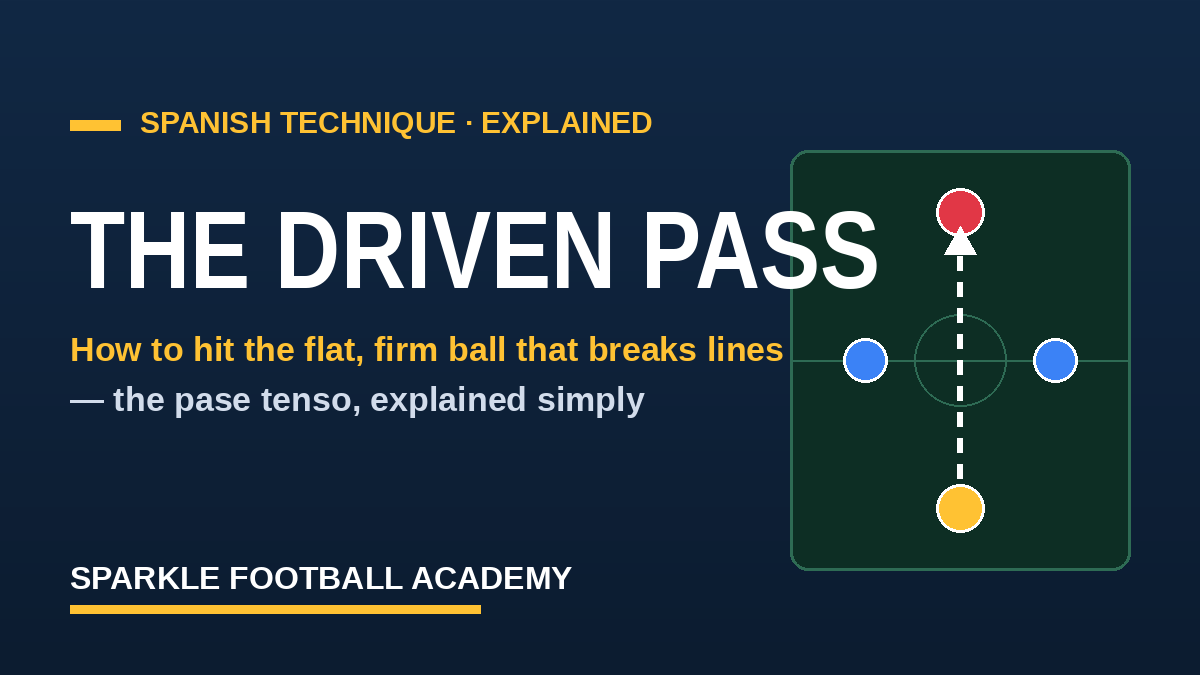
Looking for the driven pass explained simply? It’s the firm, flat pass that travels along the ground — struck hard enough that no defender can step in and pick it off. Spanish coaches call it the pase tenso, the “taut” pass, and at Sparkle Football Academy it’s one of the first technical standards we hold every player to.
Here’s the thing about the driven pass: it doesn’t look spectacular. Nobody puts it in a highlight reel. But ask any academy coach in Spain what separates a tidy youth team from one that actually controls games, and the answer usually comes back to the speed of the ball. Slow passes invite pressure. Fast, flat passes break it.
In this guide we’ll cover what the driven pass is, the exact technique behind it, when to use it in a game, and how we train it with our players — plus what parents should watch for from the sideline.
What Is a Driven Pass?
A driven pass is a ground pass struck with the laces (the instep) rather than the inside of the foot. It stays low — ideally under knee height — travels fast, and arrives at your teammate without a bounce. Where a standard push pass is perfect for short, safe exchanges, the driven pass covers 15 to 30 yards in a blink and still sticks to the receiver’s foot.
The Spanish name, pase tenso, literally means a “tense” or taut pass. The name describes the flight of the ball: stretched flat, like a wire pulled tight between two players. If the ball loops, bounces, or arrives softly, it isn’t tenso — and a Spanish coach will say so immediately.
Why Spanish Academies Are Obsessed With the Pase Tenso
Every famous piece of Spanish training culture — the rondo, positional games, juego de posición — depends on one hidden ingredient: ball speed. Keep-away only teaches anything when the ball moves faster than the defenders can shift. That’s why the pase tenso is demanded constantly at academies like La Masia, from the youngest age groups up.
It’s also the engine of possession soccer. A possession game built on soft passes is a possession game waiting to be robbed. If your team wants to keep the ball the way we describe in our guide to playing possession soccer, the ball has to zip. And if you enjoy the language behind the ideas, our breakdown of Spanish soccer terminology pairs perfectly with this one.
The Technique: How to Hit a Driven Pass
The driven pass is a skill you can feel improving within a single session. Here’s the checklist we coach, in order:
- Plant foot beside the ball, pointed at your target. Too far behind the ball and you’ll lean back and lift it.
- Strike through the middle of the ball with your laces. Not underneath it — through it. Contact below center is what sends passes into the air.
- Lock your ankle. A loose ankle bleeds power and adds spin. Firm ankle, clean contact, no slice.
- Follow through low and straight at your target. Your momentum should travel through the line of the pass, with your chest over the ball.
- Aim for your teammate’s back foot. That small detail lets them take their first touch forward instead of stopping the ball dead.
The two most common mistakes we see? Leaning back (the ball climbs) and opening the hips early (the ball curls wide and arrives with sidespin that’s hard to control). Both get fixed with the same cue: chest over the ball, follow through at the target.
When to Use It: Breaking Lines on the Field
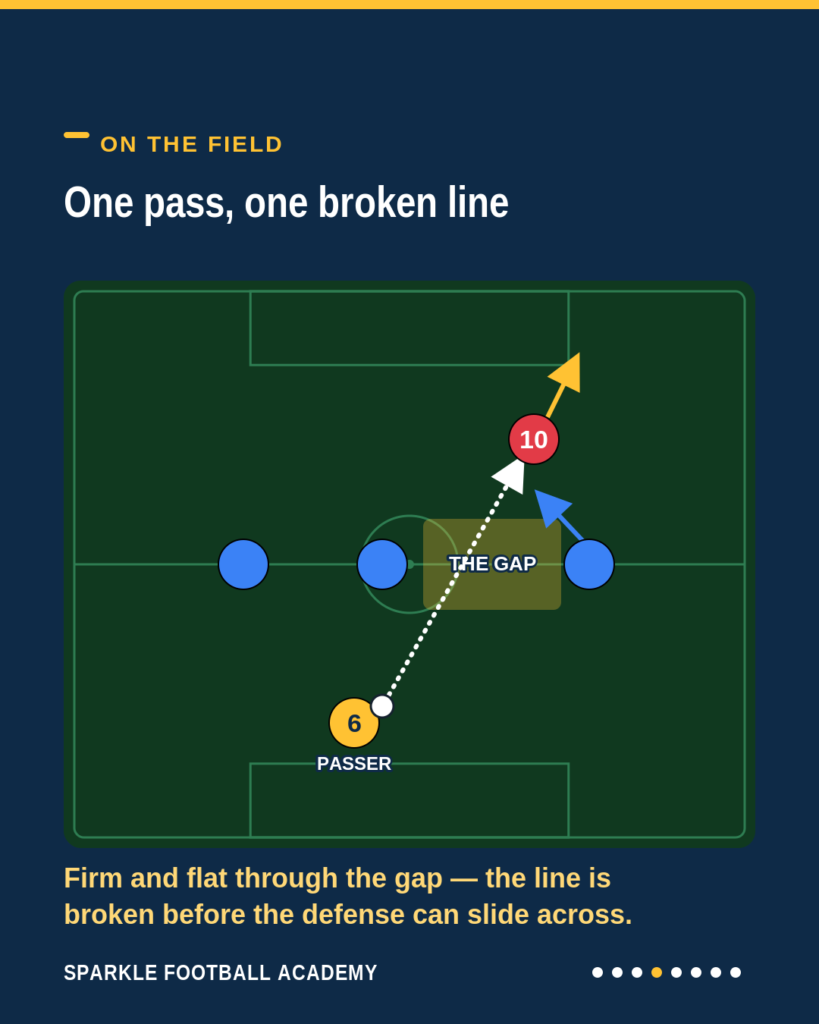
The driven pass is a line-breaking tool. The moment a gap opens between two opposing midfielders, a firm, flat ball through that gap takes the whole midfield line out of the game — four or five defenders beaten with one kick. Played to a teammate between the lines who’s ready on the half-turn, it’s the fastest legal way to turn safe possession into a real attack.
Knowing where those gaps appear isn’t luck. It’s geography. Our article on the 3 zones and 5 lanes maps the spaces where line-breaking passes live, and our guide to learning a play model shows how teams plan these passes on purpose instead of hoping they happen.
One honest caveat for young players: the driven pass is the right ball through traffic on the ground, but it’s not for every moment. Ten yards of open grass to a wide-open teammate? A simple inside-foot pass is fine. Pick the firm ball when there’s a line to break or distance to cover.
Floated vs Driven: Same Distance, Opposite Result
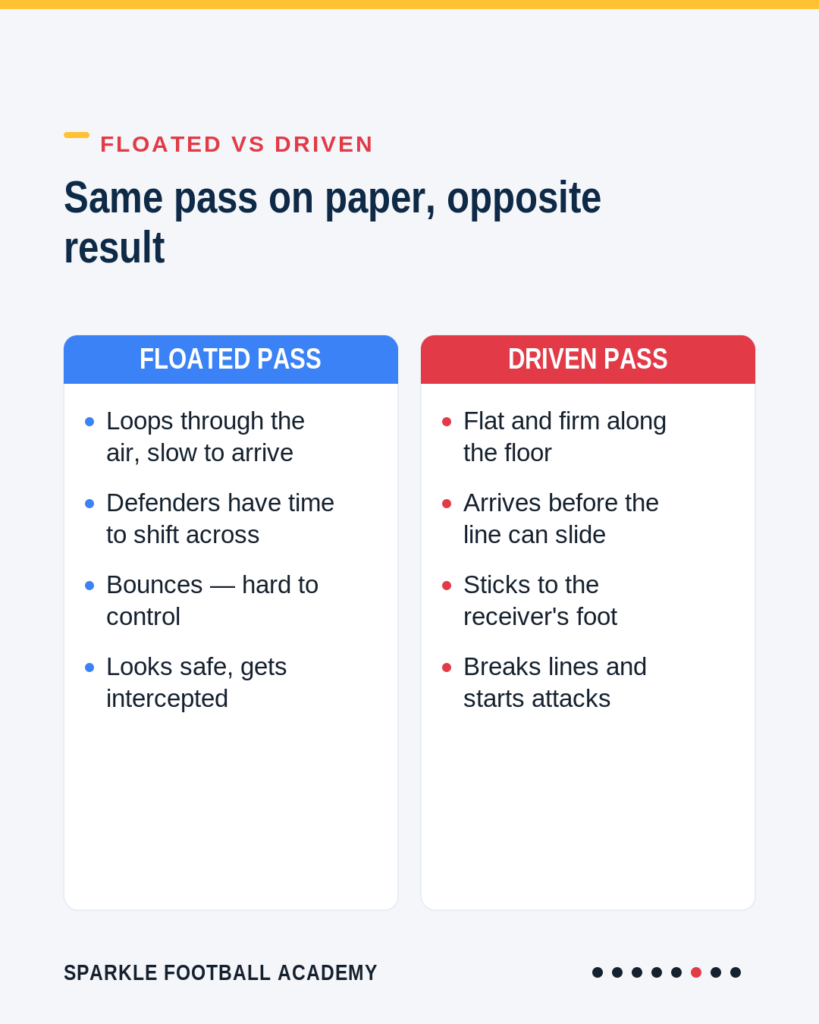
Picture the same 25-yard pass played two ways:
- Floated: the ball loops through the air, hangs long enough for defenders to shift across, then bounces — and your teammate’s first touch is a fight just to bring it down.
- Driven: the ball arrives flat and fast before the defensive line can slide, sticks to the receiver’s foot, and the attack keeps its rhythm.
Same pass on paper. On the field, one resets the defense and the other breaks it. That’s the entire argument for the pase tenso in two sentences.
How We Train the Driven Pass at Sparkle
At Sparkle Football Academy we build the driven pass in a progression, and every step has a clear standard:
- Step 1 — Pairs at 10 yards. Laces contact only. The ball must stay down and arrive firm. We listen for the sound — a clean driven pass has a distinct, crisp strike.
- Step 2 — Stretch the distance. Out to 20, then 25 yards, both feet. The standard doesn’t change: flat, fast, no bounce.
- Step 3 — Add a line to break. Mannequins or passive defenders form a midfield line; passes only count when they travel through a gap to a teammate’s back foot.
- Step 4 — Make it live. In our rondos and positional games, a line-breaking driven pass scores double. Players start hunting the moment instead of avoiding it.
Players earn the right to hit longer passes by keeping the short ones tenso. That rule keeps standards honest and gives every player a next step.
For Parents: Why This Skill Matters
If you’re watching from the sideline, here’s a simple thing to track: where does the ball bounce? Youth games are full of hopeful, bouncing passes, and they produce chaos — rushed touches, 50/50 duels, turnovers nobody planned. A player who moves the ball firmly along the ground changes the games they play in. Their teammates get cleaner touches. Their team keeps the ball longer.
There’s a development payoff too. Passing quality is one of the few skills that matters at every age and every level — it never gets phased out of the game the way raw speed or size advantages do. A 10-year-old with a reliable driven pass on both feet has a tool that high school, college, and pro coaches all recognize instantly. And because hitting it well demands scanning and decision-making (which foot? which gap? when?), training it builds soccer IQ alongside technique.
Come Hit a Few With Us
The driven pass rewards reps with feedback — and that’s exactly what our sessions are built around. If your player is ready to train the way Spanish academies train, in English, here in our community, come see a session at Sparkle Football Academy. Book a free trial, watch how fast the ball moves, and count the bounces. There won’t be many.